






















When browsing the specification page of a landfill compactor, crushing width and minimum ground clearance are easy to skip: one is a millimeter-level dimension, the other looks like just chassis height. Yet when actually organizing landfill operations, these two numbers each connect to two things—how pushing, spreading, and crushing are arranged, and how the machine moves across the waste pile. This article reads these two fields through operational questions, explaining what they can answer and what they cannot.
First, clarify where the two fields sit in the specifications
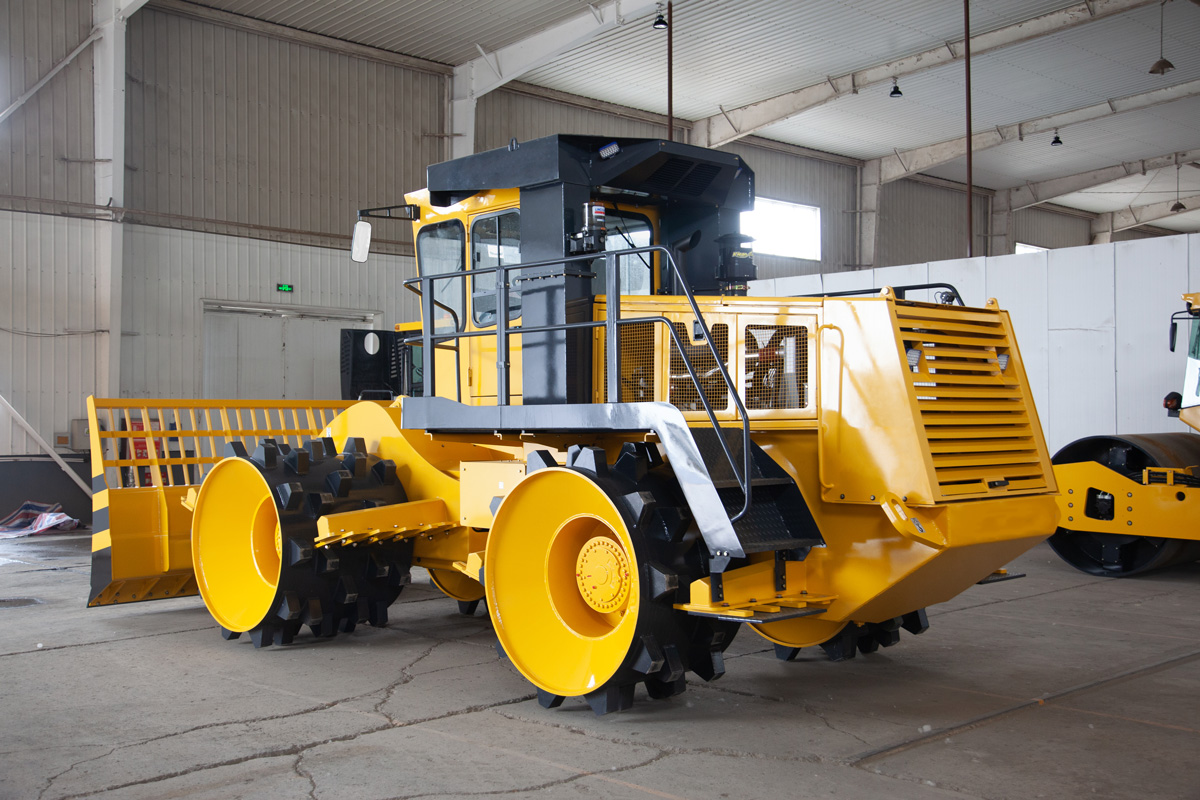
Taking the C230H associated with this site as an example, the relevant fields are: crushing width 3430 mm, minimum ground clearance 490 mm, blade height 1880 mm, operating weight 23000 kg, engine power 192 kW, maximum speed 11 km/h, and compaction capability stated as compression of 0.35 to over 0.9 t/m³. Overall dimensions are 8100 × 3500 × 3670 mm.
Before reading these fields, it is important to distinguish: crushing width describes the working width of the compaction wheels as a dimensional concept, not the layer thickness that every lift of waste must achieve; ground clearance is a static dimension, not equal to passability under any operating condition. Both are structural dimensions and only become meaningful when combined with on-site organization.
Crushing width corresponds to the layout of spreading and compaction
Landfill operations typically involve layered dumping, spreading, and then compaction and crushing. Crushing width determines the width of the working band the machine can cover in one pass, which in turn affects how the working face is laid out.

- When the working face is wide, it is necessary to consider whether to advance in strip zones or have the machine travel back and forth to cover it, depending on daily intake and working face width.
- When the working face is narrow, whether the 3430 mm width facilitates turning and offsetting within the site must be judged together with the overall width of 3500 mm and the on-site road and working band widths.
- Crushing width and compaction capability are two dimensions: the former is working width, the latter is the compression range given in the specifications; compaction effectiveness cannot be inferred from working width.
In other words, crushing width helps answer "how to arrange the working band," but cannot answer "how many passes are needed to meet the standard." The number of passes and layer thickness must be determined separately based on on-site material, moisture conditions, and landfill operation requirements; such construction parameters are not provided in the specifications.
Ground clearance relates to trafficability on the pile surface
The landfill working face is not a formed roadbed; the surface may have loose waste, cover soil, and local unevenness. The minimum ground clearance of 490 mm reflects the static space retained between the chassis and the ground, and relates to the following site conditions:
- Whether the working face has a thick loose layer or local accumulation, requiring the chassis to avoid direct scraping.
- The evenness of temporary roads and transfer passages within the site, and whether the machine needs to move frequently between the dumping area and the working band.
- The maximum speed of 11 km/h given in the specifications is a travel capability parameter, but actual on-site speed is limited by site conditions and operational organization; shift efficiency cannot be calculated from it.
It should be noted that ground clearance is a structural dimension and cannot be used to judge slope trafficability, climbing angle, or soft-ground passability. These items have no corresponding parameters in the available specifications and are matters to confirm with the supplier before purchase.

Read the two fields together with other parameters
Looking at crushing width or ground clearance alone can easily be misleading. During selection checks, they can be compared in the same table with the following verified fields:
| Field | Verified data | Operational question it helps answer |
|---|---|---|
| Crushing width | 3430 mm | Working band width covered per pass, affecting spreading zoning |
| Minimum ground clearance | 490 mm | Static spatial relationship between chassis and working face |
| Blade height | 1880 mm | Blade height condition during pushing and spreading |
| Operating weight | 23000 kg | Overall weight class, related to site bearing capacity and transport |
| Overall dimensions | 8100×3500×3670 mm | Verification of on-site passages, transport, and parking space |
The purpose of this table is to ground dimensional fields in specific work arrangements. Operating weight and overall dimensions also involve two practical constraints: first, site entry transport requires checking road width and height limits and transport vehicle conditions; second, the working face and transfer passages must accommodate the machine's overall dimensions and turning space.
What conclusions cannot be drawn from these two fields
The dimensions on the specification page can support judgments at the spatial and layout level, but several types of questions cannot be answered by them:
- Compaction effectiveness: the compaction capability given in the specifications is compression of 0.35 to over 0.9 t/m³; the specific result depends on material, layer thickness, number of passes, and operational organization, and cannot be inferred from crushing width.
- Slope operation capability: the available specifications do not give climbing angle or slope trafficability parameters; whether slope work is applicable requires separate confirmation.
- Shift productivity and fuel consumption: no corresponding data is available, so these cannot be converted into daily throughput or operating cost.
- Protection configuration: landfill operations have specific requirements for chassis, cooling, and cab protection; the specifications do not list specific protection items, so these must be checked item by item during procurement communication.
Pre-purchase verification sequence
If you are evaluating this type of equipment for landfill operations, align the specification fields with site conditions in the following order:
- First clarify daily intake, layer organization, and working face width, then judge whether crushing width matches the working band layout.
- Check the surface condition of the working face and on-site road conditions, and confirm ground clearance and chassis protection requirements.
- Check transport route width and height limits against overall machine dimensions, and confirm the site entry method.
- Confirm with the supplier the items not listed in the specifications: slope trafficability conditions, protection configuration, specific recommendations for organizing compaction work, and relevant manual requirements.
Crushing width and ground clearance are not the two decisive parameters, but they are the entry point connecting "the specification page" and "how work is arranged on site." Reading these two items back into spreading organization, site trafficability, and entry constraints is more useful than memorizing the numbers alone.