






















Earthwork lines often present this combination: one area needs material piles spread and leveled to form a passable working surface; another needs excavated spoil pushed a short distance and stockpiled. Both tasks are to be assigned to one medium dozer, and the question becomes how it should divide work between grading and pushing so that neither task is compromised.
The answer does not lie in horsepower, but in whether blade type, push distance, and ground contact conditions can all be matched simultaneously. Below, the tasks are broken down, and then a 178-hp class medium crawler dozer's published data is used to explain the relationship between configuration and operation.
First, distinguish the different equipment requirements of "grading" and "pushing"
The core of rough grading is spreading piles thin and eliminating height differences. The machine mostly travels back and forth at low speed, and the blade needs sufficient width and lateral coverage; operation relies more on blade lift and fine adjustment. Pushing means moving soil in a fixed direction over a longer distance and stockpiling it, which tests blade capacity, the blade's ability to hold soil when rolled forward, and the undercarriage's traction and trafficability under load.
- More grading, less pushing: blade width and fine travel adjustment precision are more critical;
- More pushing, longer distance: blade soil-holding capacity and undercarriage traction are more critical;
- Half and half: primary and secondary tasks must be clarified before deciding which blade and which undercarriage version to use.
If one task accounts for only a minor proportion, using the same machine for both is reasonable; if both are near full load, it is necessary to confirm whether the machine's travel speed range, blade specifications, and ground pressure can all be satisfied simultaneously. Otherwise, situations such as "adequate for grading but strained for pushing" or the reverse are likely.

Which tasks the data of a 178-hp class medium machine can match
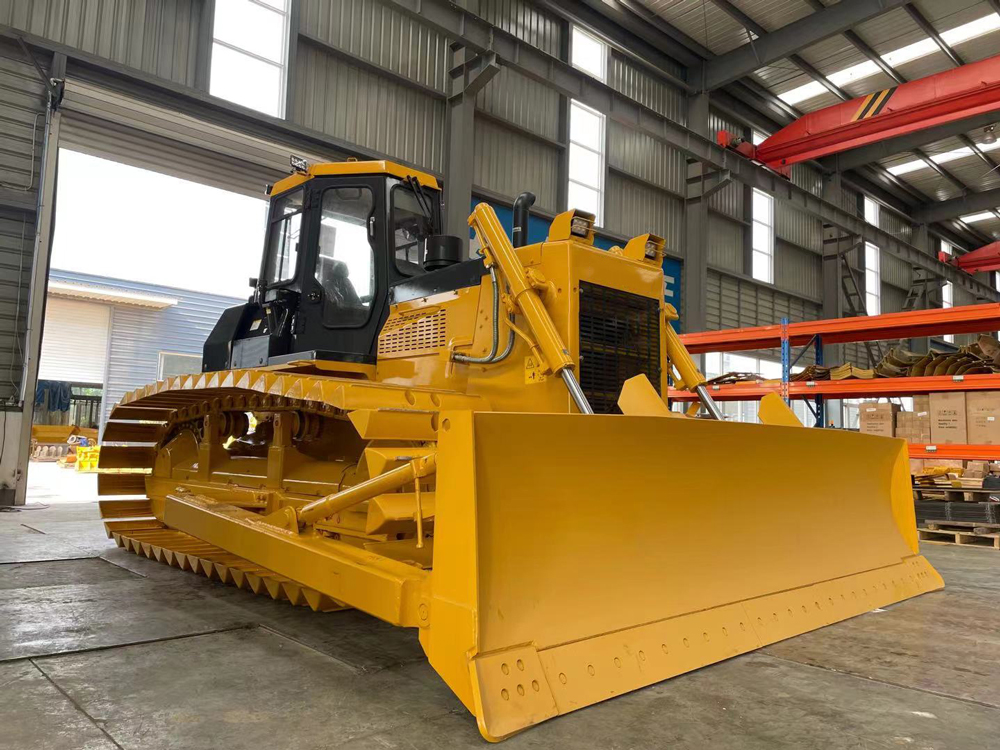
Take the SD16 crawler dozer in this site's data as an example. Its operating weight is 17,000 kg (standard version), rated power is 131 kW, 178 hp, with a WP10 electronically controlled engine. Forward speed has three ranges, with a maximum of 9.63 km/h, and reverse maximum is 12.53 km/h. These figures indicate it is medium earthmoving equipment, and its speed range suits medium- and short-distance back-and-forth work; it is not designed for fast transfer over very long distances.
For blades, the standard version can be equipped with a straight blade, angle blade, or U-blade, with widths of 3,455 mm, 4,011 mm, and 3,556 mm respectively. The three blades suit different tasks:
| Blade type | Width (mm) | Closer-suited operation |
|---|---|---|
| Straight blade | 3455 | Conventional pushing and stockpiling, balancing soil retention and penetration |
| Angle blade | 4011 | Greater lateral coverage, suitable for spreading, leveling, and slope trimming |
| U-blade | 3556 | High-capacity pushing of loose material, suitable for stockpiling bulk materials |
In other words, changing the blade on the same machine shifts the focus of operation. If grading and pushing coexist on one line, determining which blade is primary is more meaningful than asking broadly whether the machine "can do it."
Undercarriage and ground conditions determine whether it dares enter soft ground
The standard version has a ground pressure of 58 kPa, ground contact length of 2,635 mm, track shoe width of 510 mm, and ground clearance of 400 mm. These ground contact parameters suit general earthwork, highways, railways, airports, and similar sites. If the working surface has soft foundations, swamps, or standing water in the rainy season, the data also includes an ultra-wetland version: ground pressure 22 kPa, track shoe width 960 mm, ship-type track shoes, and operating weight 16,900 kg. The difference between the two is not a stack of configurations but a trade-off for different ground bearing capacities.

It should be noted that the data only provides the above values and descriptions of applicable working conditions; it does not give specific soft-ground bearing thresholds, permissible slopes, or upper limits for push distance. Therefore, judging whether "this ground can be entered" still requires on-site measured bearing capacity, moisture status, and transport access conditions, and cannot be inferred solely from ground pressure values.
Push distance and work organization must be confirmed separately
The machine's maximum forward speed is 9.63 km/h and maximum reverse speed is 12.53 km/h, which fall within the common range for back-and-forth work. The longer the push distance, the higher the proportion of ineffective travel in each cycle. In that case, consider whether other transport or transfer methods should be used in coordination, rather than having the dozer alone handle long-distance pushing. The data does not provide an economic push distance; this item must be calculated based on site layout and shift arrangements.
In addition, the overall dimensions of the standard version are 5,140 × 3,455 × 3,024 mm, and those of the ultra-wetland version are 5,262 × 4,150 × 3,074 mm. Before entering the site, transport vehicles, road width and height limits, and unloading areas should be checked, especially for the wide-track version, whose transport organization differs from that of the standard version.
Which configurations are optional and must be confirmed item by item before purchase
- The cab can be configured with FOPS/ROPS as needed; this is a safety configuration option and must be confirmed whether it is included;
- The ripper is a three-tooth type, with a lifting height of 570 mm in the data, suitable for auxiliary work such as breaking clay and frozen soil; whether to equip it depends on the strata;
- The blade type must be specified at ordering; straight, angle, and U-blades are not interchangeable;
- Coal, sanitation, desert, forestry logging, and other versions target specific materials and scenarios; their model names cannot be used to infer that they include all configurations.
For maintenance, the data mentions that side covers can be opened, the fuel filter and air filter are arranged on the same side, and the fan shaft and equalizer beam lubrication points are exposed; these designs facilitate daily inspection. However, specific maintenance intervals and disassembly/inspection procedures should still be based on the accompanying manual; this article does not provide interval values.
Checklist before starting work
Returning to the original question: when an earthwork line requires both grading and pushing, what tasks a medium dozer handles depends on first determining the task proportions and site conditions.
- First determine primary and secondary tasks: whether grading or pushing is primary determines the blade type;
- Then check the ground: general earthwork uses the standard undercarriage; soft wet sites require assessment of whether to choose the ultra-wetland version;
- Then consider transport: the dimensions of the wide-track version impose additional requirements on transport access;
- Finally confirm options and versions: FOPS/ROPS, ripper, and special versions should be settled item by item according to actual working conditions.
When requesting a quotation, it is recommended to provide: material type and moisture status, respective workloads for grading and pushing, approximate push distance, site bearing capacity and slope conditions, shift arrangements, transport width and height limits, and whether a ripper and safety cab configuration are needed. Only after these conditions are clear can it be judged which part of the work this medium dozer will handle on the entire earthwork line and whether coordination with other equipment is needed.