






















Several trucks waiting for one excavator to load may look like "too many trucks, too few machines," but in reality it may be that one link in the loading cycle does not match: bucket capacity is too small relative to material density, digging force is insufficient to penetrate the pile steadily, dump height is insufficient and forces trucks to reposition, or the working face layout requires the machine to travel long distances to reposition each time. If a machine is selected only by tonnage or bucket capacity at this point, it is easy to discover after mobilization that the cycle is constrained elsewhere.
The following uses verified data for a 45-tonne class heavy crawler excavator as an example to explain which conditions should be checked first when a loading bottleneck appears, which fields in the data correspond to these conditions, and which still require on-site confirmation.
First determine where the "queue" is stuck
Number of trucks waiting and effective payload per bucket
When many trucks are queuing, first determine how much material each bucket actually puts into the truck body. The data gives a bucket capacity of 2.0–2.2 m³; this is bucket volume, not effective payload converted by material. Sand and gravel, loose soil, and blasted rock have different bulk densities, so the mass loaded into the truck body with the same bucket capacity varies greatly. If the material is heavy, margin must be left in bucket utilization; if the material is light, more buckets may be needed to fill one truck, increasing the number of cycles.

Pile conditions and penetration capability
Queuing may also stem from difficulty in extracting material. The data lists a bucket digging force of 290 kN and a stick digging force of 236 kN. For working conditions requiring direct cutting from a pile or face, these two values are used to judge whether penetration and bucket curl are smooth; however, stable material extraction also depends on material gradation, pile height, and blast fragmentation. The data does not provide conclusions on working capability by material type, so on-site pile conditions must be considered.
Dumping range and truck repositioning
If trucks repeatedly reposition during loading, the waiting time per truck is extended. The data gives a maximum dump height of 7615 mm and a maximum digging radius of 12016 mm; these determine the truck body height and horizontal range the machine can cover without moving. Whether repositioning can actually be reduced also depends on the dump truck body height and the relative position of the parking spot and the excavator swing center, which must be checked on site against actual truck dimensions.

Why loading cycle time cannot be judged by bucket capacity alone
A loading cycle consists of swing, dumping, return, and re-penetration. Bucket capacity determines the amount per bucket, digging force determines whether material extraction is smooth, dump height and radius determine whether trucks need to reposition, and hydraulic system response affects the continuity of combined motions. The data shows that this machine is equipped with a Linde load-sensing hydraulic system, with a maximum operating flow of 2×360 + 27 L/min and a swing speed of 9.3 rpm. These fields can be used to understand the orientation of the motion configuration, but they cannot be directly converted into trucks loaded per hour—loading efficiency is also affected by operator skill, truck spotting speed, ground levelness, and dispatch organization, and the data does not provide corresponding test data.
Therefore, a more reliable sequence is: first estimate the number of buckets required per truck using truck payload and material density, then check the positioning plan using dump height and radius, and finally check whether travel repositioning capability is sufficient.
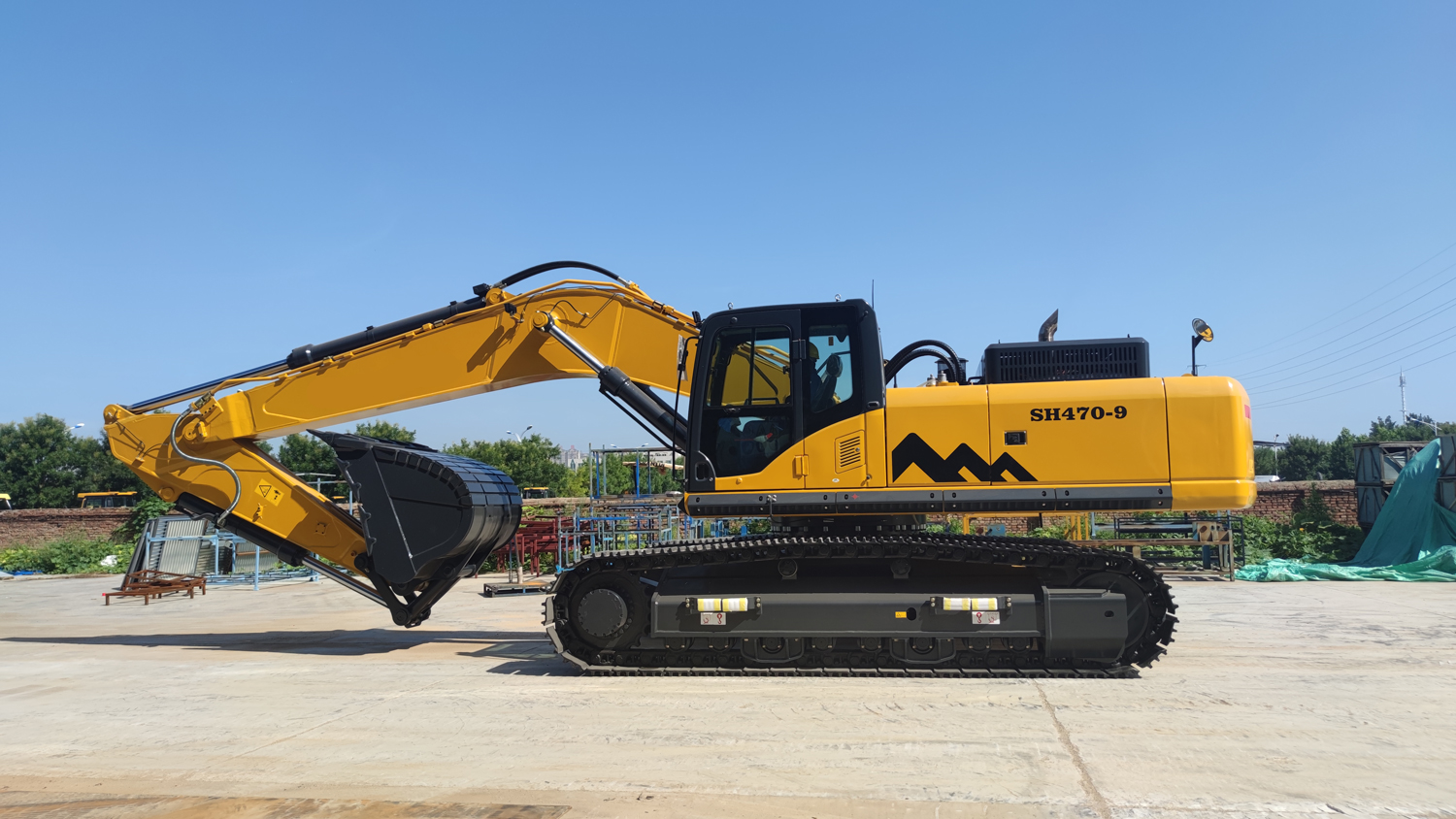
Working face width and repositioning conditions
Multiple trucks queuing is often accompanied by a tight working face. The machine has an overall width of 3490 mm, track shoe width of 600 mm, overall track length of 5335 mm, and minimum ground clearance of 557 mm. These dimensions are used to judge whether the machine can be properly positioned on the face or in the yard passage and whether there is space for passing other vehicles. The data lists travel speeds of 3.2/5.3 km/h, gradeability of 70% (35°), and drawbar pull of 330 kN; if there is a slope between the loading point and the extraction point or frequent repositioning is required, these fields can serve as a basis for verification, but actual suitability still depends on road surface adhesion, slope length, and turning radius.
Map data fields to the verification checklist
| On-site concern | Data field to verify | Conditions still to confirm |
|---|---|---|
| How many buckets per truck | Bucket capacity 2.0–2.2 m³ | Material bulk density, truck body rated payload |
| Whether material extraction is smooth | Bucket digging force 290 kN, stick digging force 236 kN | Pile height, fragmentation, whether loosening is needed |
| Whether trucks need to reposition | Maximum dump height 7615 mm, maximum digging radius 12016 mm | Dump truck body height, parking spot layout |
| Whether the site can accommodate the machine | Overall width 3490 mm, track shoe width 600 mm | Passage width, passing space, tail swing space |
| Whether repositioning is convenient | Travel speed 3.2/5.3 km/h, gradeability 70% | Slope road surface condition, slope length, turning conditions |
Boundaries to confirm before mobilization
- Transport conditions: overall length 12090 mm, ground contact length during transport 6735 mm, total track width 3360 mm; flatbed trailer selection and road width/height limits must be checked separately against these dimensions.
- Bearing conditions: operating weight 44900 kg, ground pressure 80.2 kPa; the bearing capacity of the working face and transport road must be confirmed on site, and the data cannot replace a foundation assessment.
- Continuous operation arrangements: fuel tank capacity 650 L, hydraulic tank 350 L/system 406 L; these can be used to estimate the organization of refueling intervals, but actual fuel consumption depends on working conditions and operation, and the data does not provide fuel consumption figures.
- Working attachment configuration: the data lists a 2.0–2.2 m³ bucket; if other working attachments are required on site, they must be confirmed separately during inquiry and cannot be inferred from the existing data.
Conditions to provide when requesting a quote
If the loading step is indeed the bottleneck, it is recommended to prepare the following before inquiry: material type and bulk density, average daily loading volume and truck payload, dump truck body height and parking method, working face width and slope conditions, transport road width/height limits and bearing conditions, shift arrangements, and power configuration requirements. Equipment such as bulldozers or loaders should be considered only as supporting operations and do not change the basis for judging the loading step in this article. Once the above conditions are complete, confirm each item against the specific configuration; this is more effective than looking only at tonnage or bucket capacity in reducing rework-style adjustments after mobilization.