






















When pushing earth and rock in confined areas such as building foundation pits, road widenings and the corners of material yards, machines often must turn, reverse direction and doze along edges within limited space. The drivetrain directly affects whether these maneuvers can be completed smoothly. This article compares full hydraulic drive and mechanical transmission for confined-site dozing and uses data from a 178 hp hydrostatic bulldozer to explain when a hydraulic solution is worth considering.
Core constraints of confined-site dozing
The difficulty in confined areas is not whether a bulldozer can push material, but whether it can complete the necessary maneuvers in restricted space. The main constraints include:
- Turning radius: site corners or passage widths determine whether the machine can turn around in place or steer in a small radius.
- Direction-change frequency: when push distances are short and repeated forward-reverse cycles are needed, how smoothly the machine changes direction affects the operating rhythm.
- Speed control precision: edge-adjacent dozing or work near structures requires stable low-speed travel without sudden speed changes.
- Operator workload: frequent steering and direction changes amplify differences between control arrangements.
How the two drivetrains differ under these constraints
Steering and turning radius
Mechanical-transmission bulldozers typically steer through a combination of steering clutches and brakes: the outer track stays driven while the inner track is disengaged or braked, and the turning radius is limited by the structure. Full hydraulic drive uses a dual-circuit hydrostatic drive system in which the left and right tracks are controlled by independent hydraulic circuits, enabling load steering and stepless speed control. According to the available data, the 178 hp hydrostatic bulldozer supports both load steering and fixed steering modes, allowing more flexible steering maneuvers in confined work areas.

Direction changes and speed control
Changing direction with a mechanical transmission requires operating the clutch and gear mechanism, and gear shifts involve a power interruption. Full hydraulic drive achieves stepless speed control through hydraulic displacement, making forward-reverse changes smoother. Taking the DH17-G as an example, both forward and reverse speeds are 0–10 km/h, and travel and work equipment are controlled by a single joystick, so the operator can coordinate travel and blade movements without leaving the joystick. The data also lists slip-ratio control, economy mode, driving response control, reverse start mode and auto idle; these functions adjust hydraulic output through an electronic control system and fall under electronic control—they are unrelated to pure electric power.
Boundaries of productivity
Full hydraulic drive offers structural convenience for frequent direction changes, edge-adjacent dozing and precise low-speed control, but dozing productivity also depends on material properties, push distance, blade configuration and operator skill. The data does not provide actual efficiency figures for this model across different materials and distances, so productivity cannot be judged on drivetrain type alone. In confined sites, turning radius and smoothness of direction changes more directly affect the number of work cycles per unit time.
Comparison table: main differences in confined-site dozing
| Item | Full hydraulic drive | Mechanical transmission |
|---|---|---|
| Steering method | Dual-circuit hydrostatic drive, independent left/right track control, load steering supported | Steering clutch and brake combination |
| Speed adjustment | Stepless speed control | Gear shifting with power interruption |
| Smoothness of direction changes | Hydraulic displacement control, relatively smooth | Depends on clutch and transmission operation |
| Control arrangement | Single joystick for travel and work equipment | Typically multiple levers |
| Application boundary | Frequent direction changes, edge-adjacent work, space-restricted sites | Long-distance dozing, stable-load sites |
This table reflects only the typical structural differences between the two drivetrains; it does not mean a specific machine is superior to the other type under all conditions. Actual selection also requires considering site dimensions, material type and work organization.

The DH17-G example: what the data supports
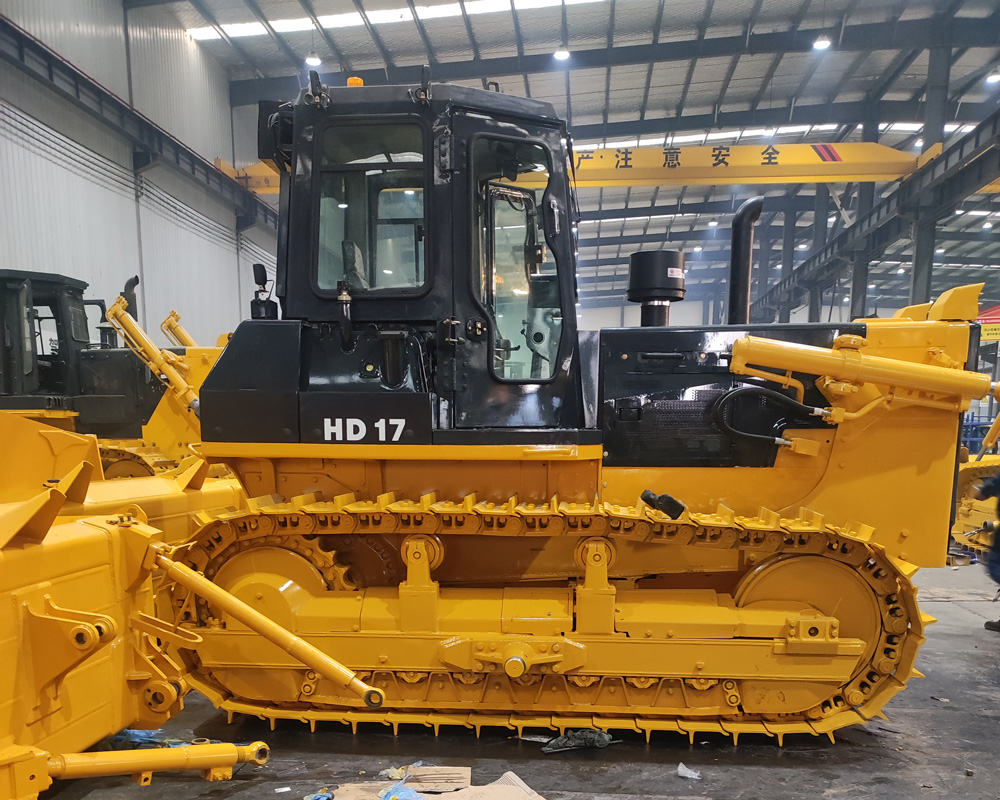
The DH17-G is a 178 hp hydrostatic bulldozer equipped with a Weichai WP7 China IV electronically controlled engine, rated at 152 kW (178 HP). The machine uses a dual-circuit electro-hydrostatic drive system with load-adaptive capability. The standard version has an operating weight of 17,730 kg (with ripper) or 19,290 kg (with drawbar), a minimum turning radius of 3,745 mm, ground pressure of 65 kPa (with ripper) or 77 kPa (with drawbar), and a standard track shoe width of 510 mm, with 560 mm or 610 mm optional.
These data relate to confined-site dozing requirements as follows:
- Dual-circuit hydrostatic drive and load steering address frequent steering and edge-adjacent work; the 3,745 mm turning radius can serve as a reference when checking passage widths.
- The stepless 0–10 km/h speed range and single-joystick control address precise low-speed dozing and direction changes.
- The 410 mm minimum ground clearance and 2,675 mm ground contact length affect mobility and travel stability; steps, trenches or soft ground on site should also be checked.
- The model is offered in standard, super-wetland, coal, sanitation, forestry and desert versions, each for different conditions. For confined-site dozing, the standard version's undercarriage and blade configuration are usually considered first, but version selection must still be based on actual ground conditions and materials.
Note that the above parameters are whole-machine values listed in the product data and do not mean the model will achieve the same steering performance on any confined site. Actual turning behavior is also affected by ground traction, blade load and operating method.
Conditions to confirm before choosing
If the site is confined and the dozing task involves frequent direction changes, full hydraulic drive deserves priority in the comparison. Before requesting quotes and confirming configuration, prepare the following information:
- The narrowest passage width and available turning area on site, to compare with the minimum turning radius.
- The material type, single push distance and per-shift workload.
- Ground bearing conditions and whether a wetland version or other undercarriage configuration is needed.
- Blade type selection: straight-tilt or semi-U blades suit different material-pushing methods.
- Transport dimensions for machine entry and on-site road conditions.
- Continuous shift arrangements, to check fuel capacity and refueling conditions.
Mechanical transmission still has its place in long-distance, stable-load dozing tasks; the two types are not simple substitutes for each other. For confined-site dozing, first list the turning space, direction-change frequency and speed-control requirements clearly, then check the specific model's turning radius, drivetrain and control configuration—avoid drawing conclusions from the drivetrain name alone.