






















For sites primarily handling bulk material pushing, the most easily overlooked step before project start is clarifying upfront: what material will be pushed, whether the ground can support the machine, and whether the blade needs to be changed. Many projects treat bulldozers as general earthmoving machinery and submit plans directly, only to find upon equipment arrival that standard blades spill material when pushing coal, or that track shoe width does not match site bearing capacity. Using two configurations of a 235 hp medium bulldozer as a guide, this article explains what items to verify before project start, which equipment feature each condition corresponds to, and what information needs to be confirmed item by item with the supplier.
First, distinguish that "pushing soil" and "pushing bulk material" are not the same thing
Ordinary earthmoving focuses on penetration, full load, and haul distance; bulk material pushing focuses on material flowability, bulk density, and blade capacity. Materials such as coal, mineral powder, and bulk grain have low density and high flowability. Under the same pushing force, a blade that is too narrow carries less, while one that is too wide tends to spill from both sides during pushing. Therefore, equipment verification for bulk material projects starts not with horsepower but with whether material characteristics and blade type match.
Another common situation is that materials change: the same yard may contain both coal and crushed stone or hard soil. In this case, the judgment should be based on which material dominates and its proportion, rather than configuring a general-purpose machine for the heaviest material. The following uses the standard and coal versions to illustrate how this judgment maps to specific parameters.

Which differences between the two configurations to examine first
On the same 235 hp platform, the standard and coal versions have clear differences in operating weight, ground pressure, and blade dimensions. The table below lists only the items directly related to bulk material pushing for easy comparison with site conditions.
| Item | Standard Version | Coal Version |
|---|---|---|
| Operating Weight | 23450 kg | 24000 kg |
| Ground Pressure | 66 kPa | 57.5 kPa |
| Blade Type | Straight/Angle/U/Semi-U | Coal Blade |
| Blade Width | 3725 / 4635 / 3800 / 3725 mm | 4200 mm |
| Blade Height | 1315 / 1055 / 1343 / 1374 mm | 1350 mm |
| Standard Track Shoe Width | 560 / 610 / 660 mm | 660 mm |
The first insight from the table is that the coal version is heavier overall but has lower ground pressure. This mainly comes from the larger ground contact area provided by 660 mm track shoes. For bulk material yards, this difference affects whether the machine can remain stable on soft coal piles or backfilled ground; however, it does not mean the machine can go on any soft ground. Actual bearing capacity also depends on surface strength, moisture content, and stockpile thickness.
Blade width should be considered against material flowability and pile height
The coal version's 4200 mm wide coal blade is suitable for continuous pushing of large-capacity, low-density materials; the standard version offers straight, angle, U, and semi-U blades, with blade widths ranging from 3725 mm to 4635 mm. U-blades are suitable for aggregate pushing, while angle blades are suitable for edge cleaning and slope work. If a bulk material project only pushes coal, the coal blade's capacity and shape are more suitable; if coal, crushed stone, and hard soil alternate, the standard version can be fitted with multiple blade types for broader applications, but blade changeover time and supporting tools should be included in preparation items.

Ground pressure cannot replace site bearing capacity assessment
The coal version's 57.5 kPa and the standard version's 66 kPa are whole-machine parameters under specific configurations. Whether the site is accessible also depends on whether the existing ground is compacted and hardened, backfilled soil, or a long-term stockpile area. Before project start, request bearing capacity data from the site manager, or at least clarify the surface conditions along the equipment travel route; if data is missing, list "travel route surface treatment" as a pre-start item to be confirmed rather than judging passability solely by ground pressure values.
Items to verify in order before project start
The checklist below is arranged in the chronological order of project preparation: first determine materials and site, then configuration and entry conditions, to avoid repeatedly revising procurement plans.
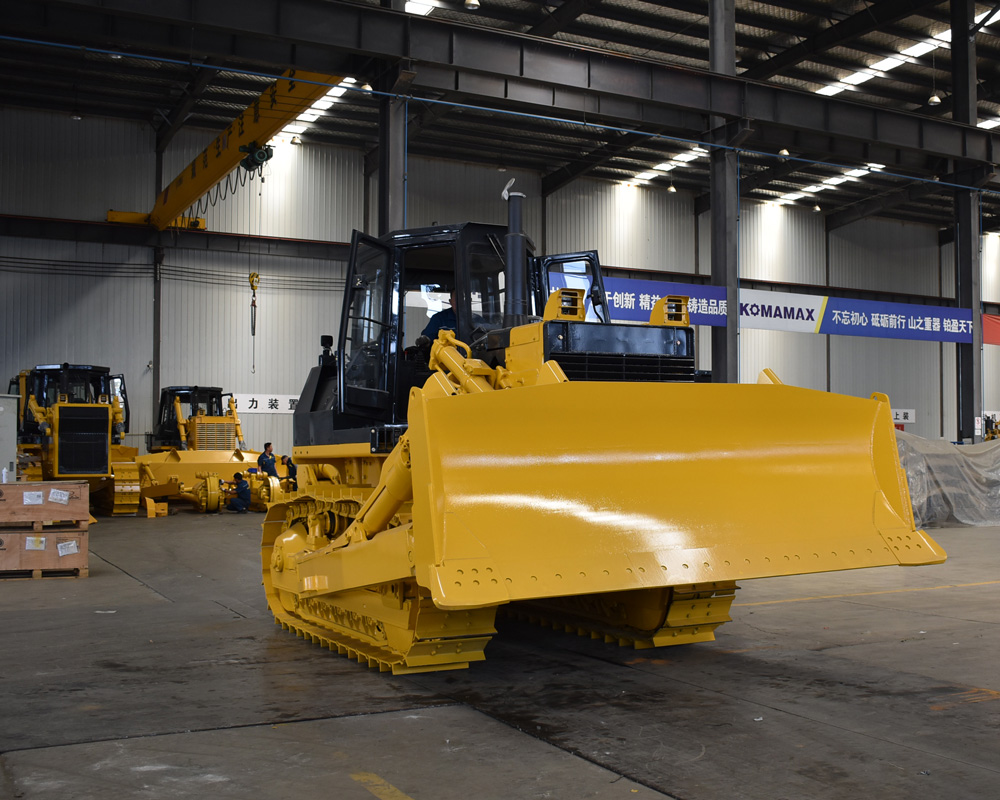
Group 1: Materials and Work Area
- Main material types, bulk density, moisture state, and whether there is caking or mixing with large debris.
- Average daily pushing volume, single push distance, and pushing direction; whether there are fixed slopes or stockpile height restrictions.
- Whether the work area is flat pushing or slope pushing; slope gradient and length need on-site measurement.
- Whether rough leveling, edge cleaning, or ripping is also required; this determines whether blades and rippers should be selected together.
Group 2: Machine Configuration
- Whether blade type and width match the primary material; the coal version's coal blade and the standard version's multi-blade options correspond to different material combinations.
- Whether track shoe width is initially selected based on site bearing capacity; the standard version offers 560, 610, and 660 mm, while the coal version comes standard with 660 mm. Final width still needs confirmation based on the travel route.
- Whether a ripper is needed; this series offers single-shank and three-shank options, with ripping depths of 695 mm for single-shank and 666 mm for three-shank. Applicability should be judged by material hardness.
- Whether emissions match the usage region; the engine is marked as meeting China Stage III off-road emission standards, and export projects need separate confirmation of the target market's emission requirements.
- Whether the cab is equipped with FOPS/ROPS protective structures, and whether LED work lights are needed for night operations.
Group 3: Entry and Support
- Overall dimensions: standard version 5495×3725×3402 mm, coal version 5820×4200×3402 mm. The transport plan must be recalculated based on the selected blade and track shoe width.
- Fuel tank capacity 450 L, working hydraulic tank 110 L; continuous work shifts and refueling arrangements need to be planned in advance.
- Travel speed ranges are three forward gears 0–3.6/0–6.5/0–11.2 km/h and three reverse gears 0–4.3/0–7.7/0–13.2 km/h; transfer distances and on-site shunting methods should be arranged accordingly.
- Minimum turning radius 3300 mm; yard passage widths need to allow margin.
Which conditions must be confirmed item by item with the supplier
The parameters listed above come from public information for this model, but the following should not be inferred solely from the model name: First, the operating weight and ground pressure vary with different combinations of blades, track shoes, and rippers; before quoting, request parameters based on the final configuration. Second, actual efficiency of bulk material pushing is affected by material moisture, pile height, and operating method; the materials do not contain corresponding test data, so efficiency commitments cannot be given. Third, whether China Stage III off-road emission standards meet the project location's registration or entry requirements must be verified by the user against local regulations. Fourth, adaptability to special sites such as wetlands and slopes has not been verified under corresponding working conditions in the materials, so it should be listed as an item to be confirmed.
State conditions clearly at the time of inquiry
For equipment inquiries in bulk material pushing projects, it is recommended to provide the following together with the inquiry form: material type and bulk state, average daily pushing volume and haul distance, site surface conditions and travel route, whether rough leveling or ripping is needed, transport method and entry road restrictions, daily work shifts, target market emission requirements, and preliminary preferences for blade and track shoe configuration. Writing these conditions clearly enables the supplier to provide parameters and quotes under the same configuration basis, avoiding later discrepancies due to different blade types or track widths.