






















The same bulldozer performs very differently when pushing backfill soil versus weathered rock. If "can push soil" is treated as a vague condition during equipment procurement, two situations easily arise: configuring the machine for the lightest earthwork, only to find it cannot push through rock sections; or uniformly configuring for the heaviest rock conditions, creating excess capability in ordinary earthwork sections. To judge whether equipment capability is sufficient, first layer materials by pushing difficulty, then see which level the overall machine corresponds to in terms of power, undercarriage, and blade.
First, layer push tasks by material
The resistance in dozing operations mainly comes from the material itself. Backfill soil, loose earth, sand-gravel mixtures, weathered rock, and stony soil roughly form a progression from loose to hard. The further along, the harder it is for the blade to penetrate, the more obvious track slippage and undercarriage impact become, and the faster the wear on blade edges and push rod assemblies.
This progression is not simply "one machine for earthwork, one for rock." Actual projects often have multiple materials alternating within the same site. The key is to determine: what proportion the hardest material accounts for, whether it appears continuously, and whether crushing and ripping processes can reduce difficulty in advance. These conditions determine which capability level the equipment should be configured for.

Capability progression corresponds to three areas on the machine
Power and torque reserve
Rock stripping and heavy-load pushing require sustained output. When power is insufficient, the machine can only maintain operation by reducing speed, disrupting the work rhythm. Data for a 320-horsepower-class crawler bulldozer shows its engine rated power is 257kW/2000rpm (some configurations 258kW/2000rpm), with large torque reserve noted to ensure stable operation under heavy loads. This power level is positioned for heavy earthwork and stony conditions, not light grading.
Undercarriage structure and ground contact conditions
Track ground contact length, track shoe width, and ground pressure together affect machine performance on hard and soft ground. For this class of machine, track ground contact length is 3150mm, track shoe width options are 560/610/660/710mm, standard version ground pressure is 97.7kPa, and rock version is 99.4kPa. The data also states that its undercarriage structure has been verified by long-term market use, with ground clearance of 500mm, for handling harsh construction environments. It should be noted that these parameters only describe undercarriage specifications and cannot be used to infer passability on arbitrary terrain; slopes and wet soft ground still require separate verification.
Blade and ripper configuration
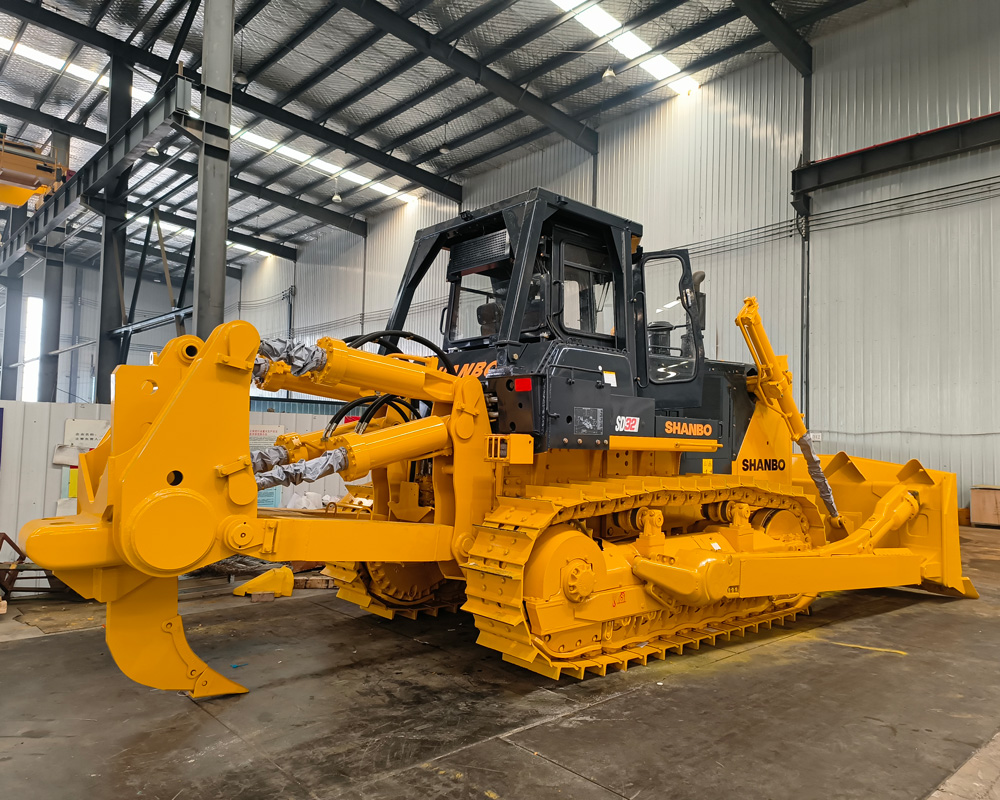
Blade type directly corresponds to material. The standard version offers straight, angle, and semi-U blades; the rock version provides rock straight, rock angle, and rock semi-U blades, equipped with thickened high-wear-resistant cutting edges and reinforced push rod assemblies; the coal version has semi-U and U-shaped coal blades. Rippers are available in single-shank or three-shank, with single-shank maximum ripping depth of 1250mm and three-shank 842mm. For hard materials that need loosening before pushing, the ripper configuration is one link in the capability chain, but it cannot replace crushing operations; whether direct ripping is possible still needs confirmation based on rock properties and site conditions.

Decision path from earthwork to rock
Following the sequence below can turn "whether to go to rock-level configuration" into a verifiable judgment rather than choosing the largest based on feeling.
- Step 1: List materials and proportions. Mark backfill soil, sand-gravel, weathered rock, and stony soil separately, and note whether each appears continuously or as sporadic interlayers.
- Step 2: Confirm whether hard materials require pretreatment. If rock sections need blasting or crushing before pushing, equipment capability can be determined based on the crushed stockpile; if direct penetration into weathered rock or stony soil is required, verify against rock condition configuration.
- Step 3: Verify continuous operation intensity. Data shows this class of machine has a fuel tank capacity of 640L, hydraulic tank of 97L, and standard high-brightness LED work lights supporting continuous day-night construction. Continuous operation duration, shift arrangements, and refueling conditions affect actual usability; these are site support conditions that machine parameters alone cannot answer.
- Step 4: Match blade and ripper. Whether the main task is pushing or loosening determines selection of straight blade, semi-U blade, or ripper; when rock sections account for a high proportion, prioritize verifying rock version blade and push rod configuration.
- Step 5: Verify transport and site access. This class of machine has overall dimensions of 8650×4130×3760mm, requiring corresponding heavy-haul transport conditions; access roads, turning radii, and unloading areas should be confirmed before purchase.
Version differences must be verified item by item according to working conditions
Within the same power class, standard, rock, coal, desert, and sanitation versions differ mainly in blade, tracks, protection, and intake/cooling components; not all versions have all configurations. Based on verified data: standard version operating weight is 40200kg (with single-shank ripper and ROPS), rock version 40900kg, coal version 40500kg; the coal version uses 610mm wide wear-resistant tracks and coal blade, while the desert version is equipped with high-position dust-proof intake, enhanced radiator, and 710mm wide shock-absorbing tracks. These differences indicate that versions are divided by material and site environment. During procurement, the project's dominant working conditions should be compared item by item with the corresponding version, rather than combining configurations from multiple versions as the capability of a single machine.
| Version direction | Main corresponding working conditions | Configuration differences in data |
|---|---|---|
| Standard version | General earthwork, water conservancy, road construction | Straight/angle/semi-U blade, optional single-shank or three-shank ripper |
| Rock version | Stony soil excavation, weathered rock stripping | Rock blade, thickened wear-resistant cutting edges, reinforced push rod assembly |
| Coal version | Power plants, ports, bulk material yards | Coal blade, 610mm wear-resistant tracks, box-type body structure |
| Desert version | High temperature, strong wind, heavy dust environments | High-position dust-proof intake, enhanced radiator, 710mm shock-absorbing tracks |
The table only reflects configuration directions explicitly stated in the data; it does not mean a version cannot be used under other working conditions, nor can it be used to infer unlisted performance differences.
Conditions still to confirm before purchase
Equipment capability progression judgment can narrow the range but cannot replace on-site verification. Before inquiry and configuration finalization, it is recommended to clarify the following information: material types and proportions of each section, treatment method for the hardest material (direct pushing or crushing first), average daily pushing volume and shift duration, site slope and ground bearing conditions, access road and transport dimension limits, specific combination requirements for blade and ripper, and local emission and fuel supply conditions. Statements such as "domestic leading level" and "outstanding reliability" in the data are product descriptions and do not constitute commitments to specific project efficiency or returns; actual operational performance still depends on material, operation, and site organization.