






















Earthmoving work on narrow sites is often difficult not because of the volume of soil, but because of whether the equipment can get in, turn around and stand stably. This can occur on narrowed road sections, factory corners, both sides of municipal pipe trenches and farmland improvement plots: the working face is limited in width, stockpiling and transport vehicles cannot easily get close, and the bulldozer can only perform short-distance hauling and on-site leveling. The question this article answers is: in such confined spaces, what earthmoving tasks can a small bulldozer handle, and which tasks require conditions to be checked first.
Constraints first: what narrow sites demand of a bulldozer
Selection for confined sites cannot rely on engine power alone. Three things must be addressed in turn: whether the overall machine envelope can pass through the access road and the working-face opening; whether the blade width matches the passage to avoid repeated scraping on both sides; and whether the track ground pressure is compatible with the ground bearing capacity. If any one of these three does not hold, even high horsepower is of no use.
In addition, narrow sites often involve short-distance back-and-forth pushing and frequent turning, so the machine's low-speed gears, steering operation and blade raise/lower coordination affect the actual work rhythm more than the traction capacity for long-distance pushing. Before purchase, the task should be broken down into three questions: "what can be pushed, how far, and where to stockpile."
Applicable conditions for the SD10 in this scenario
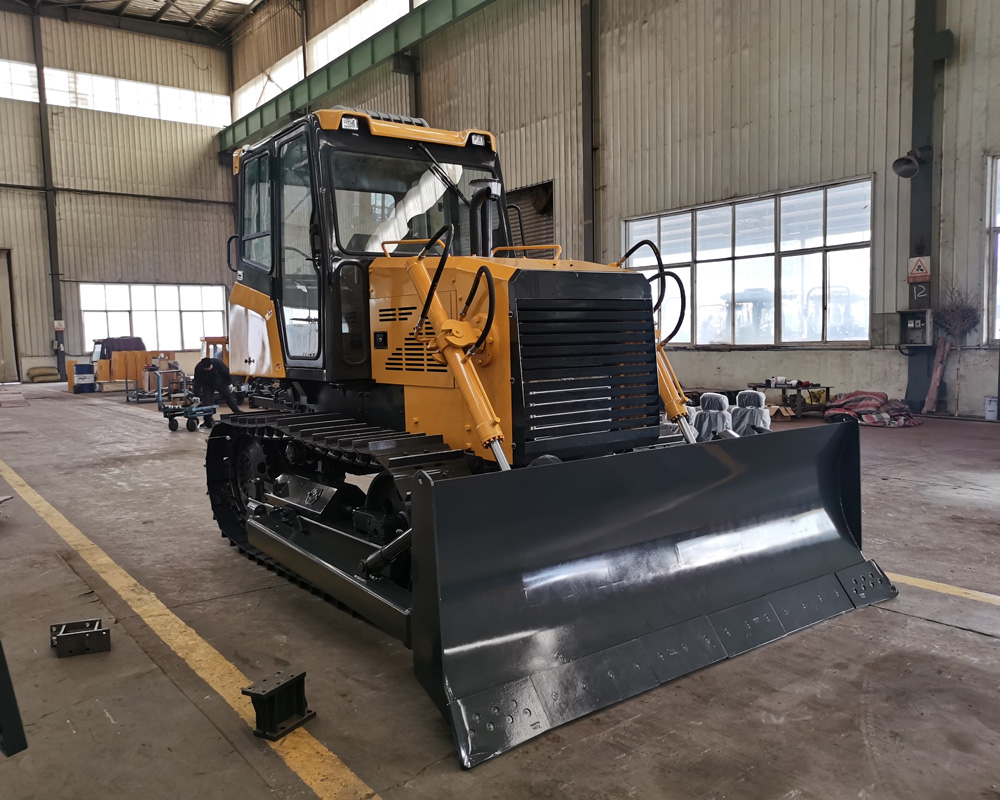
The SD10 is a small model in this site's bulldozer catalog. Verified data shows that the machine has a total weight of 10000kg, a Cummins 4BT3.9-C125 engine, a rated power of 81kW (125HP)/2300r/min, a maximum traction force of 95kN, a 4F+2R mechanical transmission, a forward speed of 2.6 to 10.4 km/h, and a reverse speed of 3.7 to 6.7 km/h.

These data mean that the machine is a compact crawler bulldozer whose low-speed gears can cover back-and-forth pushing within a site, and whose mechanical transmission is simple in structure and relatively straightforward to operate and maintain. However, the speed range only reflects equipment capability and cannot be used to infer the actual shift efficiency on a specific site.
Dimensions and envelope
The data gives the SD10's overall dimensions as 4400×2960×3030mm, with a track shoe width of 450mm. The machine width is close to 3 meters, meaning the access road and working-face opening must leave clearance on both sides; if the site has doorways, culverts or temporary fencing, this width must be checked section by section. The 4400mm body length relates to the turning radius and the distance to the stockpile point.
Blade and pushing tasks
The SD10 bulldozer blade dimensions are 2960×960mm, with a maximum lift height of 830mm and a maximum digging depth of 350mm. The blade width is essentially the same as the machine width, making it suitable for straight-line pushing along passages and on-site leveling, but not for wide lateral casting of soil. The 350mm digging depth can be used for topsoil, loose stockpiles and stripping of relatively thin overburden; hard compacted soil or material requiring breaking is a different operation and should not be inferred directly from this parameter.

Ground bearing and trafficability
The machine's ground pressure is 54.4kPa. This value must be used in comparison with site ground conditions: the bearing capacity of hardened surfaces, compacted backfill and soft cultivated soil differs greatly. The data indicates that the machine has a certain stability on soft ground, but this cannot be taken as a commitment that any soft foundation is passable; before entry, the site's surface conditions and existing rut depth should still be inspected.
Tasks it can handle and tasks requiring separate discussion
Based on the above data, the following judgments are condition analyses, not customer cases or construction results.
| Task type | Correspondence with SD10 data | Conditions to confirm |
|---|---|---|
| Short-distance earthmoving | 95kN maximum traction force, low-speed gear from 2.6 km/h | Pushing distance, looseness of soil material, location of stockpile point |
| Rough site grading and spreading | Blade width 2960mm, lift height 830mm | Grading accuracy requirements, whether subsequent roller cooperation is needed |
| Stripping of topsoil or loose material | Blade maximum digging depth 350mm | Soil hardness, whether stones or construction waste are present |
| Light scarifying and towing | Optional fixed towing equipment or three-shank ripper | Rear attachment configuration, material rippability |
"Optional" in the table only indicates attachment options listed in the data and does not mean every machine is equipped by default. Whether to add a ripper depends on whether the site needs surface loosening; fixed towing equipment is used for towing-related support tasks, and its capability limits likewise depend on the weight of the towed object and ground conditions.
Conversely, concentrated pushing of large earthmoving volumes, rock stripping and long-distance continuous pushing are not the strong suit of small machines. Such tasks place higher demands on blade capacity, machine weight and undercarriage durability, and should be evaluated separately according to the data for the corresponding models.
Questions to resolve on site before purchase
- Compare the narrowest points, turns and height limits of the access route section by section with the 4400×2960×3030mm envelope.
- Whether the working face allows the machine to turn around, or only one-way pushing and reversing back.
- The surface type and bearing condition of the ground, and whether it matches the 54.4kPa ground pressure.
- Whether the soil material is loose stockpile, topsoil, or hard compacted soil that must first be loosened.
- Whether a rear ripper or towing equipment is needed, and how these attachments affect overall machine length and working radius.
- Shift arrangements and fuel supply method; the machine is diesel-powered, so refueling conditions must be confirmed on site.
The power form must be based on the data: the SD10 uses a diesel engine and is not a pure electric solution. If the project has special requirements for electrification or emissions, the corresponding model should be checked separately and cannot be inferred from this machine's data.
Operating information to provide when requesting a quote
When consulting an equipment supplier about a small bulldozer, it is recommended to explain at once the material type, working-face dimensions, pushing distance, ground conditions, shift arrangements and whether rear attachments are needed. For a bulldozer, blade form and track configuration are two items that must be checked; for narrow-site tasks like those in this article, access route and turning conditions should also be added. The above information determines the configuration direction, while the specific suitability still needs to be confirmed through site survey and product data.