






















Compaction tasks in municipal road maintenance and small-scale foundation reinforcement are often summed up with a single phrase: "how many passes with the roller." On site, the real problem is usually a mismatch of conditions: the work area may be residential roads, garden paths and the areas around inspection manholes, with shallow paving lifts but frequent relocations; some projects also require local strengthening of existing road base courses. These tasks place different demands on equipment than large-scale subgrade filling, and a high-tonnage, high-amplitude approach cannot simply be copied. This article sets out the boundaries of applicability: under what conditions a 10-ton single-drum vibratory roller is worth considering, which conditions must be confirmed first, and which conclusions cannot be drawn from the available data and must be verified separately.
First define the work objective and site constraints
The compaction objective in municipal maintenance and general foundation reinforcement is usually to compact the lift to design requirements within a limited area, while ensuring the machine can enter, turn and reach edges and corners. This creates several constraints:
- Narrow work areas and frequent turns mean the machine's turning radius and body width directly affect accessibility;
- Lifts are often thin or placed in layers, and excessive vibration energy may loosen the surface or disturb adjacent structures;
- Residential and garden sites often have slopes or level changes, so gradeability must match the actual longitudinal gradient;
- Maintenance work points are scattered, so travel speed and transport method affect process continuity;
- Urban areas have emissions management requirements, so engine emission standards must be checked against local access conditions.
These constraints do not rule out any particular type of equipment; they are inputs that must be quantified before selection. Without lift thickness, material gradation and site dimensions, any tonnage judgment is only a starting point.
Conditions corresponding to a 10-ton single-drum vibratory roller
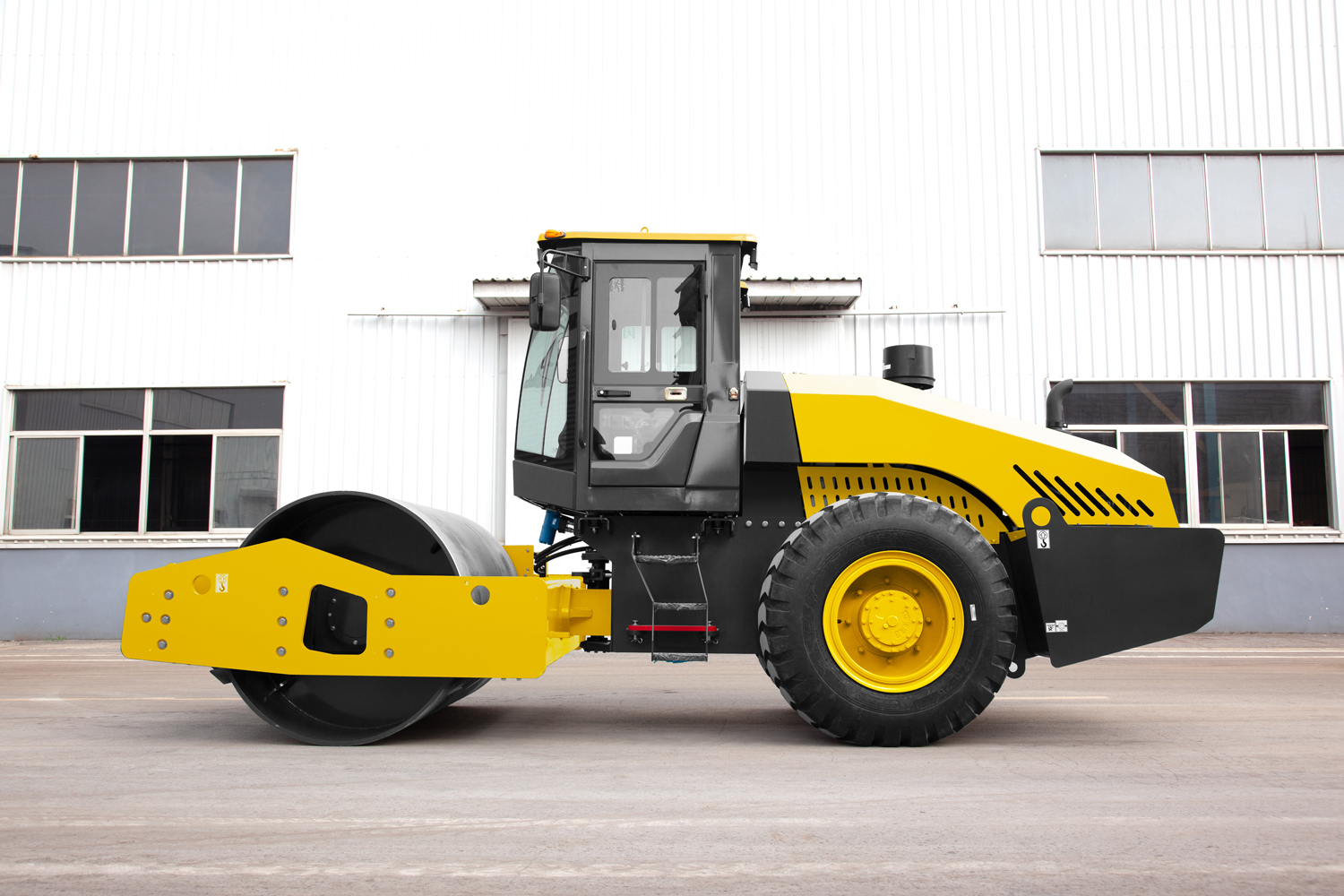
Using the S101S data on this site as reference, this is a 10-ton single-drum vibratory roller with an operating mass of 10,000 kg, a vibratory drum 2,100 mm wide and 1,490 mm in diameter, and a drum shell thickness of 20 mm; amplitude 1.6 mm, vibration frequency 30 Hz, centrifugal force 140 kN, static linear load 238 N/cm; speed range 0–9 km/h, gradeability 30%, turning radius 6,250 mm; overall length 5,940 mm, overall width 2,275 mm, overall height 2,800 mm, wheelbase 2,980 mm, minimum ground clearance 400 mm; power from a 97.5 kW engine, emission standard China II. Each of these figures corresponds to a type of site issue and must be considered separately.

Relationship between vibration parameters and lift conditions
The 30 Hz vibration frequency, 1.6 mm amplitude and 140 kN centrifugal force form this model's vibration output combination. For thin asphalt surface courses or small-area base courses, how vibration energy is applied must be determined together with lift thickness, material type and number of passes; the data only give machine-side parameters and cannot be used to directly derive the number of passes or degree of compaction for a given material. What can be established is that this vibration parameter set is a conventional single-drum configuration suitable for general work requiring vibratory compaction; if the on-site material is sensitive to vibration or the lift is extremely thin, the vibration activation method and pass schedule should be confirmed separately. The static linear load of 238 N/cm reflects the load per unit drum width in the static condition and can be used for comparison, but it is not equivalent to the actual effect under vibratory operation.
Dimensions and access conditions
A drum width of 2,100 mm and overall width of 2,275 mm mean the work area must be at least wide enough for the whole machine to pass; the 6,250 mm turning radius determines whether it can turn around and work close to edges on residential roads, garden paths and around inspection manholes. The 400 mm minimum ground clearance and 30% gradeability are reference values for judging site entry and short-slope passage; actual accessibility also depends on slope surface adhesion, pavement structure and turning space. The overall length of 5,940 mm and height of 2,800 mm must be checked together with transport vehicles and height-restricted routes.
Power and emissions access
This model has a 97.5 kW engine with China II emission standard. In municipal projects, emissions access requirements vary by region and project type; the data cannot determine whether a specific city or project accepts this emission standard, so each item must be confirmed against local management requirements before purchase. The 0–9 km/h speed range can be used to estimate short-distance travel time between work points, but long-distance transfers should still use transport vehicles.

Applicability boundaries and unsuitable cases
Putting the above conditions together allows a conditional judgment rather than a conclusive recommendation:
- Where the work area is wide enough for the whole machine to pass, turning space meets the 6,250 mm turning radius, and the lift is general municipal maintenance or foundation backfill compacted in layers, a 10-ton single-drum vibratory roller can be considered a candidate;
- Where the work area consists of narrow paths, manhole surroundings and green-belt edges, or compaction close to walls is required, the single-drum structure may not cover the work, and small equipment or supplementary tamping tools should be considered;
- For large-area deep subgrade filling requiring continuous operation with high vibration energy, the suitability of a 10-ton model must be assessed separately according to lift thickness and compaction requirements; the data are insufficient to support direct application;
- In areas with stricter emissions access, the China II standard may be a limitation, and local requirements must prevail.
The above is a conditions analysis, not a situation that has occurred on a specific project. Any "applicability" must be based on measured inputs for the project's lift, material and site.
Items to verify before purchase
If, after comparing conditions, the decision is to proceed with a 10-ton single-drum direction, the following matters should be clearly stated during inquiry and contracting:
| Verification item | Information to be provided or confirmed |
|---|---|
| Lift and material | Compaction target (asphalt surface course, base course, backfill, etc.), layer thickness, material type and gradation |
| Work volume and site | Compaction area, minimum work area width, turning and turnaround space, longitudinal gradient |
| Travel and transport | Distance between work points, transport vehicle matching, height and width restrictions along the route |
| Drum and vibration configuration | Whether drum width and diameter, amplitude, frequency and centrifugal force match the target lift |
| Power and emissions | Whether engine power and emission standard are consistent with local access requirements |
| Shifts and support | Daily operating hours, refueling or maintenance arrangements, spare parts supply method |
It should be noted that the data do not give this model's degree of compaction, productivity or fuel consumption for specific materials, nor can they be used to judge its advantages or disadvantages relative to other tonnages or structural forms. Compaction performance depends on the lift, material moisture content, pass combination and operating method, and process parameters should be determined through a trial section before construction. Vibratory compaction involves equipment and personnel safety, and operation and maintenance must follow the accompanying manual; this article does not provide operating steps.
Conclusion: define conditions first, then equipment
For compaction selection in municipal maintenance and foundation reinforcement, the order should be to first clarify lift thickness, material type, work area dimensions and travel conditions, then check whether the machine's vibration parameters, dimensions and access capability correspond. A 10-ton single-drum vibratory roller can be a candidate when the above conditions hold; when they do not, smaller equipment can be used for reduced work areas, while deep large-area compaction requires separate assessment. When requesting quotations, providing material or lift information, work volume, site and transport conditions, shift arrangements and drum and vibration configuration requirements will yield a more verifiable proposal than quoting only a tonnage.