






















Landfills must complete two interrelated tasks every day: first, spreading and compacting the day's waste before covering; second, continuously compacting the waste mass to gain airspace. Many buyers merge these into one question—"just buy a compactor"—but in terms of equipment conditions, daily cover focuses more on crushing width and uniform thin-layer spreading, while waste mass compaction focuses more on overall weight and continuous operation capability under repeated rolling. Both are constrained by site bearing capacity and slope access. This article follows a requirements breakdown sequence, turning operational goals into verifiable conditions, then compares public data for a 23-ton landfill compactor to explain which features correspond to which needs and which still require on-site confirmation.
First, break down operational goals: what daily cover and waste mass compaction each require
Daily cover typically requires completing spreading, crushing, and compaction of the day's working face within a limited time. The working layer is relatively thin, and when waste contains bagged items or bulky debris, crushing effectiveness directly affects the smoothness of the subsequent cover layer. Waste mass compaction involves repeated rolling over a longer period, pursuing density per unit volume, and the equipment needs sufficient weight and stable continuous operation capability. Breaking these two goals apart yields the following checklist:
- Layer conditions: single-layer spreading thickness, waste composition, whether bulky or bagged items are mixed in.
- Crushing needs: whether the equipment must crush and reduce volume while compacting.
- Site bearing capacity: whether the landfill working face can support repeated equipment traffic.
- Slope access: slope gradient of the waste mass side slopes, slope stability, and route planning for equipment going up and down slopes.
- Work shifts: daily operating hours and whether continuous multi-shift operation is required.
- Protection and maintenance: equipment protection requirements for landfill gas and leachate environments, and daily inspection conditions.
These conditions have no universal answer; waste composition, moisture content, and work organization vary greatly among landfills. The equipment data below is only used to illustrate which conditions a particular machine can cover and cannot replace on-site judgment.

Applying conditions to equipment: what data for a 23-ton compactor shows
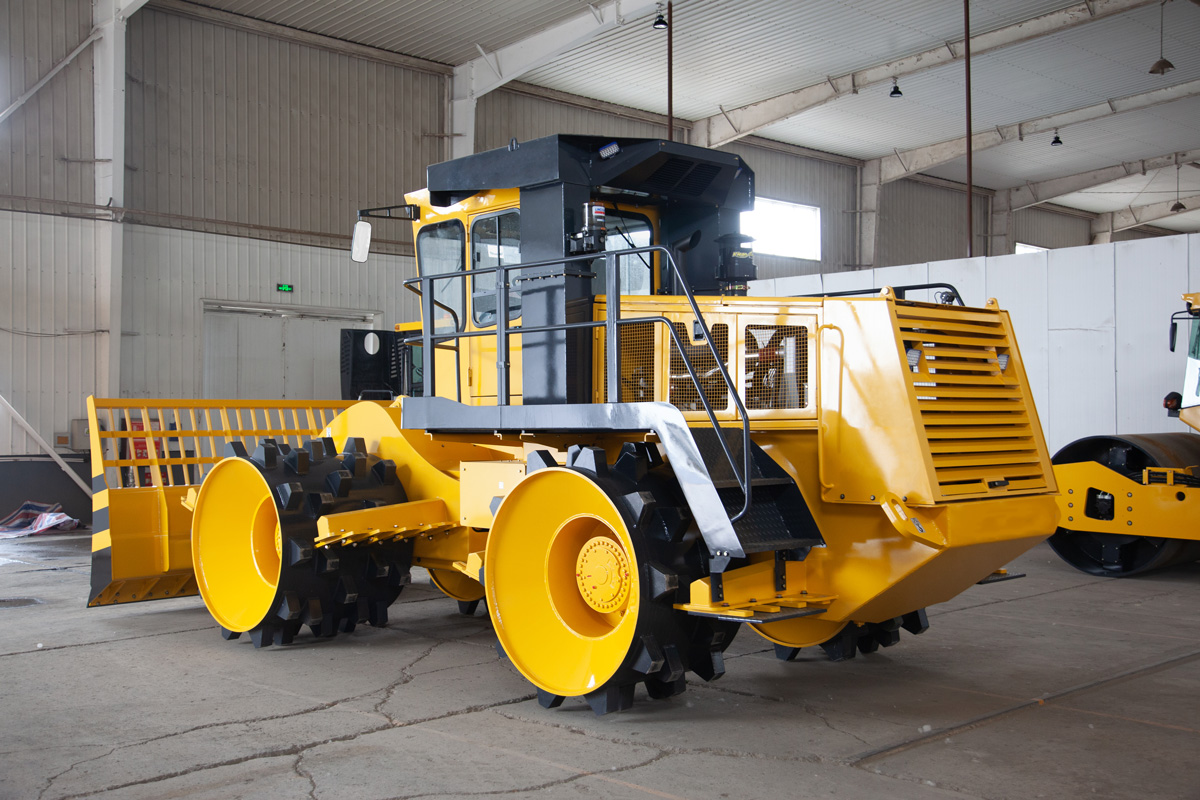
The C230H in this site's landfill compactor catalog has an operating weight of 23,000 kg, a 192 kW (262 hp) Shangchai Tier 3 engine, a maximum speed of 11 km/h, a minimum ground clearance of 490 mm, a crushing width of 3,430 mm, a blade height of 1,880 mm, overall dimensions of 8,100 × 3,500 × 3,670 mm, and a compaction capability rated at 0.35 to over 0.9 tons per cubic meter. These figures should be viewed against the conditions above rather than listed in isolation.
Crushing width and blade height correspond to daily cover spreading needs
The 3,430 mm crushing width and 1,880 mm blade height indicate that this machine can cover a relatively wide working face in one pass, making it suitable for spreading and crushing the day's waste during daily cover. A wider crushing width means fewer passes are needed for the same working face, but actual efficiency still depends on waste composition, spreading thickness, and operating method. The data does not provide efficiency figures for different materials, so layer thickness should be verified on site before purchase.
Overall weight and compaction capability correspond to waste mass compaction goals
The 23,000 kg operating weight is one of the basic conditions for waste mass compaction, and the rated compaction capability is 0.35 to over 0.9 tons per cubic meter. This range indicates that the equipment design covers compression from lower to higher density, but the density actually achieved is directly related to layer thickness, number of passes, and waste moisture content. The data does not provide compaction pass counts or density guarantees for specific materials, so it cannot be inferred that any waste composition will achieve the same compaction result.

Ground clearance and overall dimensions correspond to site access conditions
The 490 mm minimum ground clearance is one reference for judging whether equipment can pass smoothly in landfill environments with uneven ground, debris, and soft areas. The overall length of 8,100 mm, width of 3,500 mm, and height of 3,670 mm relate to working face width, transfer passages, and transport size limits for site entry. It should be noted that ground clearance is only one aspect of access conditions; site bearing capacity and slope traction still require on-site confirmation. The data does not provide gradeability or ground pressure figures, so it cannot be used to judge whether the equipment is suitable for waste mass side slopes of any gradient.
Engine power and maximum speed correspond to shift arrangements
The 192 kW engine power and 11 km/h maximum speed mainly affect equipment transfer between working faces and continuous operation capability. Maximum speed is a road travel parameter and does not represent travel speed during compaction work or actual operating efficiency. Daily shift length and whether multi-shift continuous operation is needed must be judged based on site organization and equipment maintenance conditions; the data does not include fuel consumption or continuous operation duration figures.
Conditions requiring on-site confirmation before purchase
The above data helps judge the equipment category and basic capability direction, but several conditions must be verified by the user on site and cannot be concluded from product parameters alone:
- Waste composition and moisture content: whether bulky items, construction waste, or high-moisture materials are mixed in directly affects crushing and compaction performance.
- Layer thickness and number of passes: the data does not provide operating parameters for different layer thicknesses, which must be determined according to on-site processes.
- Site bearing capacity and slope conditions: the data does not provide ground pressure or gradeability figures, so soft ground and slope access require separate assessment.
- Protection configuration: protection requirements for the chassis, cooling, and electrical parts in landfill environments must be confirmed against the specific configuration list.
- Maintenance conditions: daily inspection items, wear part replacement conditions, and spare parts supply should be determined by reference to the accompanying manual and on-site maintenance capability, and generic maintenance intervals should not be applied.
- Transport and site entry: overall dimensions correspond to limits on transport vehicles and access roads, which must be checked in advance.
Operational information to provide when requesting a quote
To move the selection discussion toward specific configurations, it is recommended to provide the following with the inquiry: daily throughput and cover working area, main waste composition and layer thickness, slope gradient and site bearing conditions of the waste mass side slopes, daily work shifts, site entry transport conditions, and whether specific protection configurations are required. Specific options for compaction wheels and protection configurations should be based on the supplier's configuration list, checking item by item against the site's operating conditions.