






















When browsing bulldozer product catalogs, it is common to see multiple names such as standard, coal, rock, forest, and wetland versions arranged under the same power platform. A large number of versions can easily be interpreted as "there is always one that fits," but version classification itself is not intended for buyers to pick a name from; rather, it pre-packages material characteristics, site conditions, and attachment requirements into configuration combinations. Understanding this is essential to judge whether a particular version truly matches one's operational goals.
Where version differences lie in configurations
The bulldozer's operation can be broken down into three stages: the blade contacts and pushes material, the undercarriage carries the entire machine and travels on the site, and the power and transmission deliver power to the work equipment. Version classification typically adjusts configurations around these three stages. Taking the medium bulldozer product information on this site as an example, different versions under the same power platform mainly differ in blade type and capacity, track shoe width, ground pressure, cab protection, and whether a winch or ripper is equipped.
This means version names are more like labels for a set of configurations rather than independent performance levels. To judge whether a version is worth considering, one should return to specific operational conditions: what material is being pushed, what the ground bearing capacity is, whether protective structures are needed, and whether additional work equipment is required.
Using a medium machine as an example to see how configurations correspond to needs
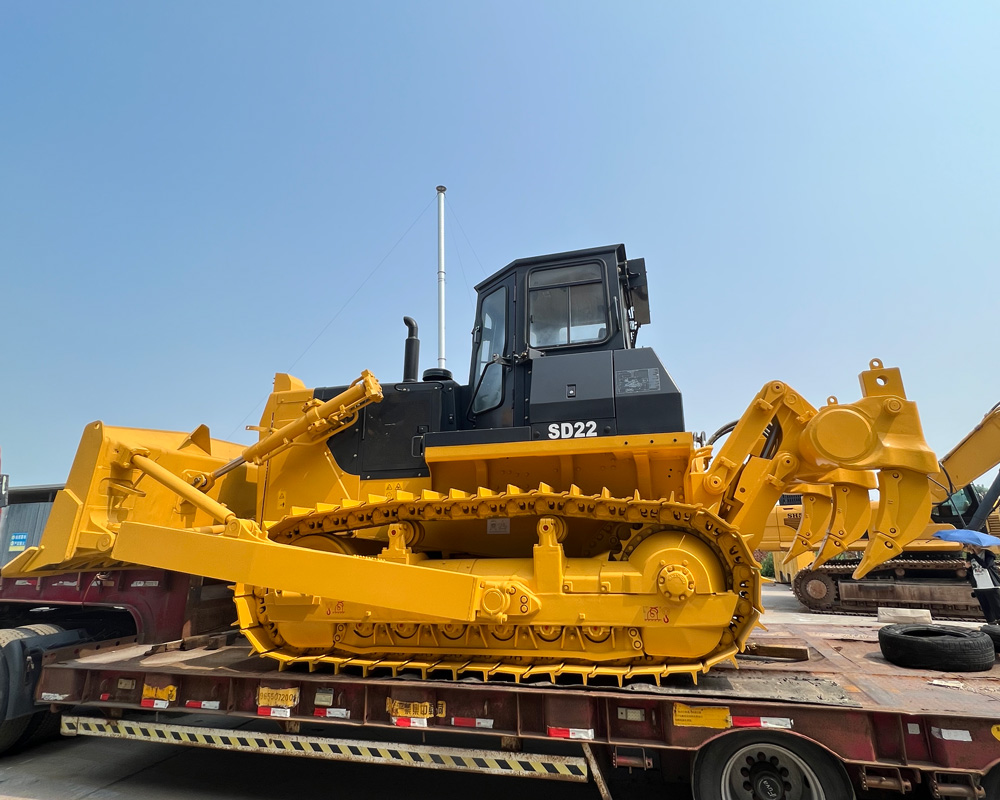
The medium bulldozer featured on this site has a rated power of 175 kW (235 HP) and an operating weight between 23,450 kg and 24,000 kg, with slight variations across versions due to attachment differences. Its version classification illustrates the above logic.

Standard version: general earthwork and loose material pushing
The standard version has an operating weight of 23,450 kg, ground pressure of 66 kPa, ground contact length of 2,730 mm, and track shoe width options of 560 mm, 610 mm, or 660 mm. Blade options include straight, angle, U, or semi-U blades; the straight blade has a width of 3,725 mm, lift height of 1,210 mm, and digging depth of 540 mm. These parameters correspond to general road construction, earthwork excavation, and ordinary bulk material handling. If the work primarily involves conventional earthmoving and rough grading, the standard version's attachment combination serves as the baseline reference.
Coal version: low ground pressure and large-capacity blade
The coal version has an operating weight of 24,000 kg and ground pressure of 57.5 kPa, lower than the standard version; track shoe width is 660 mm, and the blade is a coal blade with a width of 4,200 mm and height of 1,350 mm. The reduced ground pressure and increased blade capacity correspond to scenarios such as coal yards and port bulk stockyards involving lightweight bulk materials that require a larger single-pass push volume. The application scenarios listed in the information are coal yard stockpiling, thermal power plants, port bulk stockyards, and bulk material transfer operations. Note that this version's low ground pressure is configured for bulk material conditions; whether it suits other soft-ground sites still requires confirmation based on specific bearing conditions.
Rock version: wear-resistant attachments and reinforced structure
The rock version has an operating weight of 23,600 kg and ground pressure of 66 kPa. Blade options include rock straight, rock angle, rock U, or rock semi-U blades. The information describes it as equipped with high-strength wear-resistant rock blades and reinforced push arms, targeting quarries, mountain road reconstruction, rock terrain excavation, and hard soil ripping. The difference from the standard version lies mainly in the wear resistance and impact resistance of the work equipment, not the power platform itself. If the work object is crushed stone, weathered rock, or mixed stone sites, attachment strength is an item that needs separate verification.

Forest version: protection and self-recovery configuration
The forest version is described in the information as equipped with an impact-resistant cab, with optional wide tracks and a mechanical winch, targeting forest logging, timber harvesting, and mountain road opening scenarios. The version logic reflected here is protective structures and auxiliary devices: cab protection addresses falling object and collision risks, while the winch addresses self-recovery needs in complex terrain. The information does not provide specific dimensions and weight parameters for this version, which need to be confirmed separately before purchase.
Wetland and sanitation versions
The product information mentions wetland and sanitation types in the series overview but does not elaborate on their specific parameters and applicable conditions. If the work site is soft wet ground or involves sanitation operations, track shoe width, ground pressure, and dedicated attachments should be treated as separate verification items and cannot be inferred directly from standard version values.
Questions to answer first when choosing a version
Version names provide clues, not conclusions. Before selection, conditions can be sorted in the following order:
- Material type: Conventional earthwork, lightweight bulk materials such as coal, and crushed stone or weathered rock have different blade type and wear resistance requirements.
- Ground bearing capacity: Soft or wet soft sites require attention to ground pressure and track shoe width, but whether a low ground pressure configuration suits a specific site still needs support from on-site bearing data.
- Workspace and terrain: Scenarios such as forests and slopes involve protective structures and auxiliary devices; slope capabilities not covered in the information should not be inferred independently.
- Additional operations: Whether a ripper is needed for hard or frozen soil and whether a winch is needed will change the overall machine configuration combination.
- Transport and site access: Overall dimensions are 5,495×3,725×3,402 mm (standard version); transport routes and site access passages need to be verified in advance.
Same power does not equal same operational capability
Multiple versions of this product share the 175 kW (235 HP) power platform and a similar undercarriage base, but blade capacity, ground pressure, and attachment strength differ significantly. When purchasing, comparing only power figures can easily overlook configuration items that truly affect operational matching. Conversely, one should not infer that a version can cover all working conditions just because it has corresponding configurations for a certain scenario. Suitability for push distance, slope capability, wetland adaptability, and other aspects not provided in the information all require separate confirmation based on site conditions.
Information to prepare before requesting a quote
If preparing to request a quote for such a medium bulldozer, it is recommended to provide the supplier with: main pushed materials and loose density, average daily workload and haul distance, site ground bearing conditions, whether ripping or winching is needed, work shifts and fuel supply conditions, transport route restrictions, and the desired blade type and track shoe width. Version selection should ultimately be based on a configuration list verified item by item with the supplier against these conditions, rather than ordering solely by version name.