






















If a fleet simultaneously handles general earthwork, soft wet sites, and bulk material yards, procurement often faces the situation where one medium bulldozer model is divided into multiple versions. More versions may look like flexible choice, but what really affects daily management is another matter: whether the chassis and undercarriage components are common across these versions, whether spare parts can be shared, and whether operators have consistent habits after switching machines.
This article focuses on public information for a 178-horsepower medium crawler bulldozer and outlines the relationship between chassis and overall machine configuration in a multi-version strategy. All parameters in this article come from verified product information and do not involve other models.
Version division starts with whether power and drivetrain are consistent
All versions in this series share the WP10 electronically controlled engine, rated at 131 kW and 1850 rpm, meeting China's National Stage IV emission standards for non-road machinery. The standard, coal, extended, and super-wetland versions all list this power configuration, and the drivetrain is also manufactured within the same system. For a fleet, this means maintenance experience, filter specifications, and daily inspection items on the power chain can be managed together across versions, without establishing a separate power maintenance process for each version.

However, consistent power does not mean a consistent machine. Version differences mainly lie in the chassis, undercarriage components, and work equipment, and these are exactly what scheduling and spare parts stocking must focus on.
Chassis differences center on tracks and ground pressure
According to the information, the standard, coal, and extended versions all have a track shoe width of 510 mm, track center distance of 1880 mm, and ground contact length of 2635 mm; the super-wetland version increases track shoe width to 960 mm, keeps the same ground contact length, has an operating weight of 16900 kg, and ground pressure of 22 kPa. For reference, the standard version has an operating weight of 17000 kg and ground pressure of 58 kPa; the coal version is 17500 kg with ground pressure of 55 kPa.
| Version | Operating weight (kg) | Track shoe width (mm) | Ground pressure (kPa) |
|---|---|---|---|
| Standard | 17000 | 510 | 58 |
| Coal | 17500 | 510 | 55 |
| Super-wetland | 16900 | 960 | 22 |
The trade-off here is direct: soft wet sites require lower ground pressure, spreading the load by widening the track shoes; while for general earthwork and bulk material pushing, if a super-wetland chassis is used long-term, the changes in steering and mobility brought by wide tracks need separate evaluation. The information does not provide conclusions on the mobility of each version under specific soil conditions; it only shows that ground pressure values differ. Whether a machine can actually enter a given site still depends on on-site bearing capacity and moisture conditions.

Work equipment varies by version, and attachment compatibility must be confirmed separately
The standard version can be equipped with a straight blade, U-blade, angle blade, coal pushing blade, rock blade, sanitation blade, ripper, and drawbar; the coal version is equipped with a coal blade, with blade width of 4150 mm and height of 960 mm; the super-wetland version is equipped with a straight blade, with width of 4150 mm and height of 1245 mm. For rippers, the standard version information lists a three-shank ripper with a lift height of 570 mm.
This means the chassis may share some structural components, but blades and rippers are not common across all versions. If different versions are mixed in one fleet during procurement, attachment interchangeability must be checked version by version; it cannot be assumed that all blades can be directly swapped.
Practical significance of the shared chassis approach for procurement and scheduling
Multiple versions in the same series sharing the engine, drivetrain, and part of the chassis structure has the benefit of narrowing spare parts categories and overlapping operator training content. But three boundaries should be noted:
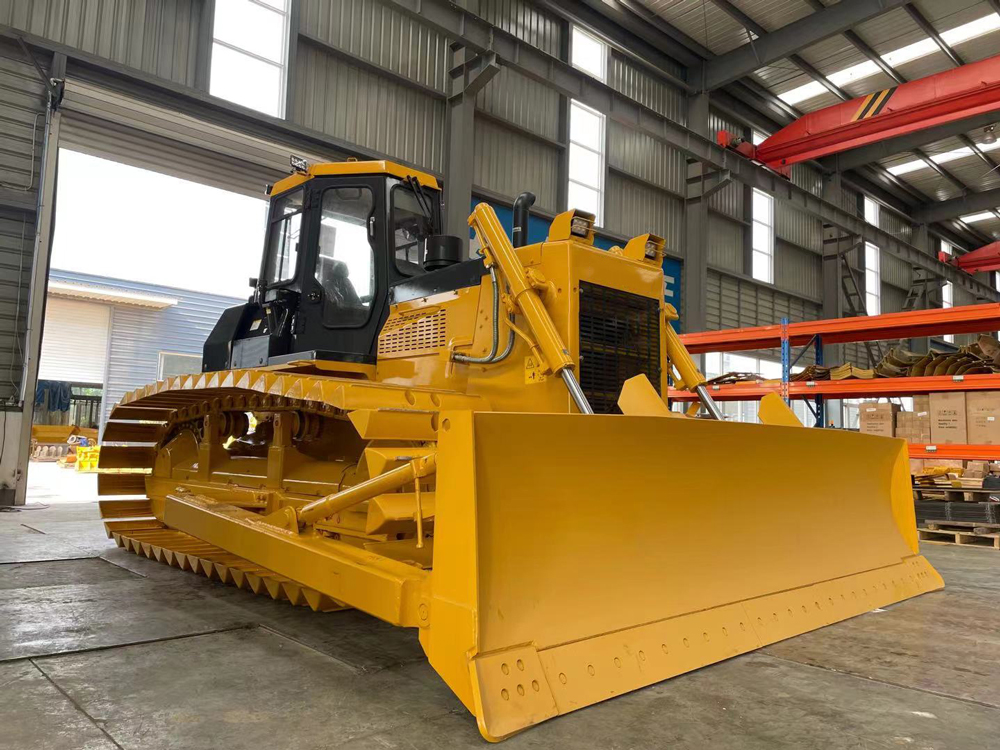
- Differences in ground pressure determine that different versions suit different sites; they cannot substitute for one another in wet soft or heavy-load sites merely because they are in the same series.
- Attachments such as blades and rippers vary by version; before cross-version use, the mounting interface and hydraulic matching must be checked.
- The information does not provide efficiency conclusions for each version under specific materials, slopes, and continuous operating durations; procurement judgments should be separately confirmed based on site conditions.
Chassis and working condition information to prepare before inquiry
If considering a version in this series, explaining the following conditions to the supplier is more helpful for judging whether the configuration matches than merely giving a model number:
- Main material type: general earthwork, clay or frozen soil, bulk coal, or wet soft silt.
- Site bearing capacity and moisture conditions, especially whether access to swamps, wetlands, or river training areas is required.
- Workload, pushing distance, and whether ripping is required.
- Transport conditions: whether overall machine dimensions and weight meet access road and trailer limits; the super-wetland version has overall dimensions of 5262×4150×3074 mm and must be checked separately.
- Whether cab configurations such as FOPS/ROPS and heating and air conditioning are required.
- Attachment list: specific specifications for straight blade, U-blade, coal blade, ripper, etc.
Multiple versions themselves are not the problem; the problem is managing version differences as if they were the same machine. Confirming the real differences in chassis and attachments first, then deciding how many versions to include in the fleet, is closer to actual use than simply comparing horsepower.