






















On earthmoving loading sites, a common discussion arises: is the truck waiting for the bucket, or the bucket waiting for the truck? Some attribute the cause to insufficient excavator tonnage, others to uneven truck scheduling. Loading pace is the result of equipment, material, transport, and site working together; tonnage is only one variable. To judge the relationship between tonnage and pace, one must first look at what time components make up the loading cycle, then examine which conditions can be explained by equipment parameters and which must be solved through on-site organization.
What time segments make up loading pace
A loading cycle can be roughly divided into four segments: excavator digging, swing and positioning, dumping, and empty bucket return. A transport cycle also includes loaded travel away, dumping, empty return, and reversing into position. Whether loading pace is smooth depends on whether the two cycles connect: if the excavator waits for trucks, the transport cycle is slow; if trucks wait for the excavator, the loading cycle is slow or truck supply is too dense.
Two concepts are easily confused here. Bucket capacity determines how much can be loaded at once, and cycle time determines how many buckets can be loaded per unit time; their product is the theoretical loading capacity. Tonnage affects overall power, hydraulic flow, and structural dimensions, which indirectly influence cycle time, but tonnage cannot be directly equated with loading pace. For equipment of the same tonnage class, cycle time may differ noticeably under different materials, swing angles, and operating habits.
Relationship between tonnage and bucket capacity, cycle time
Tonnage is a rough classification of overall machine specification, not a direct indicator of loading capacity. Under the same tonnage, different products may be equipped with different bucket capacities or hydraulic systems tuned for different materials. Therefore, a more accurate statement about tonnage and pace is: tonnage determines a rough range of bucket capacity and power, while specific pace still depends on verified data such as bucket capacity, digging force, hydraulic flow, and swing speed for that model.

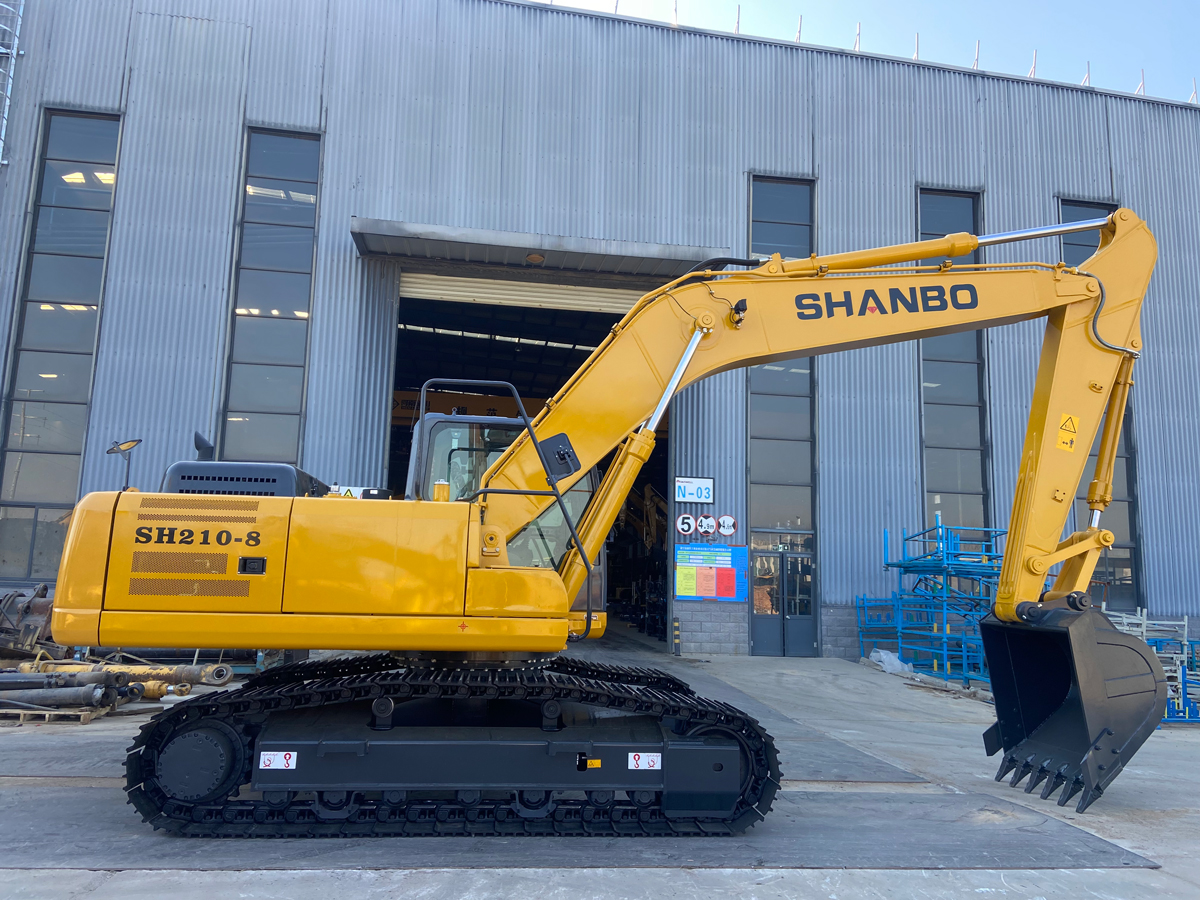
Taking a 21-ton crawler excavator as an example, the configuration given on this site is a 1.0 m³ bucket, optional 129/153 kW dual engines, a 34.3 MPa high-pressure dual-pump hydraulic system, hydraulic flow of 2×231.7 L/min, digging force of 126/134 kN, maximum digging depth of 6.35 m, and maximum digging radius of 9.7 m. These data help judge under what conditions it can form a smoother connection with transport vehicles, but they cannot be directly converted into how many trucks are loaded per hour.
Using 21-ton equipment to examine loading connection
In earthmoving loading scenarios with medium haul distance and continuous truck supply, there is a bucket-matching relationship between the 1.0 m³ bucket capacity and the bed volume of common medium dump trucks. Assuming the effective bed volume and loose material condition are known, one can estimate the number of buckets needed to fill a truck; assuming the average cycle time is known, one can estimate the loading time per bucket. Both assumptions require on-site measurement or verification against data from similar working conditions and cannot be inferred from tonnage alone.
The hydraulic system parameters of this model deserve attention: 34.3 MPa system pressure and 2×231.7 L/min flow indicate high working capability of the hydraulic system; 126/134 kN digging force corresponds to different engine configurations. For loading operations, digging force affects whether the material pile can be cut smoothly and whether bucket fill is high, rather than directly determining loading pace. If the pile is compacted and material lump size is large, bucket fill decreases and cycle time lengthens; only then do the advantages of tonnage and bucket capacity become more apparent.
On the other hand, the travel speed of 28-35 km/h and gradeability of ≥70% correspond to on-site repositioning and slope passage conditions. If there are slopes between the loading point and dumping point or frequent repositioning is needed, these parameters affect auxiliary time; if the loading point is fixed and transport is handled by trucks, these two parameters have limited direct impact on loading pace.

Which conditions affect pace before tonnage
The following conditions should be checked first before selection; they often explain on-site pace problems better than tonnage:
- Material condition: loose soil, cohesive soil, frozen soil, or stone-containing material differ in digging difficulty and bucket fill;
- Bed volume and sideboard height: when bucket capacity and bed volume do not match, either the truck is not full or secondary leveling is needed;
- Swing angle: the larger the angle between the excavator digging point and the truck parking position, the longer the swing time;
- Truck supply organization: whether truck arrival intervals are even and whether the dumping point is congested;
- Site bearing capacity and slopes: soft ground or slopes limit equipment positioning and travel speed;
- Operation and handover: whether non-working time such as shift changes, refueling, and maintenance is counted in the shift.
When these conditions lack verified data, they can only be treated as items to be confirmed, and one cannot directly conclude that “switching to a larger tonnage will solve it.”
Applicable boundaries of this class of equipment
The 21-ton crawler excavator is medium-sized equipment suitable for loading, excavation, and site preparation in earthwork and infrastructure construction. Several applicable boundaries can be read from the data: maximum digging depth of 6.35 m and maximum digging radius of 9.7 m indicate a limited working range, so deep foundation pits or long-distance digging require separate evaluation; the 1.0 m³ bucket capacity corresponds to medium-scale loading, and if transport truck beds are noticeably larger or the material looseness factor is special, the number of buckets and leveling time need to be recalculated.
The data also notes a 1-year warranty on core components, stock availability, delivery time of 1-7 days, and a minimum order quantity of 1 unit. These are procurement and delivery information and do not constitute a basis for judging loading pace, but they can be confirmed together during the inquiry stage.
It should be noted that loading pace is also affected by the actual technical condition of the equipment, operator skill, and on-site management. This site does not provide measured loading efficiency, fuel consumption, or shift output for this model, so no specific truck count or volume commitment can be given.
Loading conditions to prepare before inquiry
If preparing an inquiry around loading operations, it is recommended to provide the following information to help judge whether tonnage and configuration match:
- Material type and condition, and whether crushing or scarifying is needed;
- Effective bed volume, sideboard height, and full-load requirements of transport vehicles;
- Distance between loading and dumping points, swing angle, and site slope conditions;
- Planned loading volume or truck trips per shift, and truck supply organization;
- Site bearing conditions, transport method, and access road restrictions;
- Confirmation items for power form, working attachment, and bucket capacity configuration.
The relationship between tonnage and loading pace is not simply proportional. List material, truck bed, haul interval, and site conditions clearly first, then compare against the bucket capacity, digging force, hydraulic flow, and working range of a specific model to judge whether a certain tonnage class is suitable for the current loading organization. The parameters of this 21-ton model on this site can serve as a starting point for comparison, but actual pace still needs to be verified against on-site conditions.