






















In municipal roadbed construction, the difficult part of compaction is often not the roller itself but matching operating conditions with equipment capability. Working areas are frequently cut narrow by utilities, fencing and intersections; lift thickness varies with fill material and roadbed structure; and within a single project the machine must repeatedly relocate among the main line, ramps and ancillary areas. If the equipment is oversized, it cannot maneuver in narrow zones; if undersized, more passes are needed to reach the compaction target. The following outlines the deployment conditions for a single-drum vibratory roller based on the actual constraints of such working conditions, and explains the basis for judgment using public data on a 12-ton single-drum machine.
First, clarify what municipal roadbed compaction must solve
Municipal roadbed construction is generally organized by layered filling and layer-by-layer compaction. Compaction quality depends on fill properties, moisture content, lift thickness, number of passes and equipment vibration parameters. On the equipment side, the main controllable factors are exciting force, amplitude, frequency, travel speed and drum dimensions. Therefore, discussing whether a roller can be used is essentially discussing whether its vibration parameters and geometric dimensions can cover the on-site lift and working-area conditions, rather than looking only at tonnage.
Compared with highway roadbeds, municipal roadbeds have two additional constraints: first, working width is limited, leaving little room for turning and offset tracking; second, relocation distances are short but frequent, so maneuverability and gradeability affect process continuity. These two points are easily overlooked during selection.
What requirements do working areas and relocation conditions impose on equipment
- Drum width matching working-area width: If the drum is too wide, edge compaction in narrow zones is difficult; if too narrow, overlapping passes increase and efficiency suffers.
- Turning and offset tracking space: Municipal roadbeds often contain inspection wells, utility trenches and curbs; turning radius and minimum ground clearance affect whether the machine can work close to the edge.
- Relocation and gradeability: Temporary access roads and slope changes are common between the main line and ancillary areas; gradeability determines whether the machine can relocate on its own.
- Adjustable vibration parameters: Different fill materials and lift thicknesses require different amplitude and frequency, and dual-amplitude dual-frequency configuration provides adjustment room.
These conditions are not exclusive to any one machine but are items commonly requiring verification in municipal roadbed compaction. The following examines how far a 12-ton single-drum machine can cover them based on specific data.

Correspondence between the data for a 12-ton single-drum machine
The S126D is a 12-ton single-drum vibratory roller with an operating weight of 12000 kg, a vibratory drum width of 2130 mm and diameter of 1533 mm, drum thickness of 25 mm, and static linear load of 322 N/cm. Vibration is dual-amplitude dual-frequency: amplitude 1.85/0.83 mm, vibration frequency 30/34 Hz, and centrifugal force 280/162 kN. Travel speed is 0-9 km/h, gradeability 45%, turning radius 6500 mm, and minimum ground clearance 410 mm. Power comes from a 105 kW (143 hp) engine, with emissions meeting China II/Tier 2.
Putting these parameters back into the municipal roadbed scenario allows item-by-item correspondence:
| On-site condition | Corresponding data | Judgment direction |
|---|---|---|
| Limited working-area width | Drum width 2130 mm, turning radius 6500 mm | Check edge and turning space against the narrowest working-section width |
| Variation in lift and fill | Dual-amplitude dual-frequency, amplitude 1.85/0.83 mm, frequency 30/34 Hz | Can switch between two vibration states; the specific combination must be confirmed by trial section |
| Energy demand for layered compaction | Centrifugal force 280/162 kN, static linear load 322 N/cm | Typical magnitude for a 12-ton single-drum roller; whether it is sufficient depends on lift thickness and passes |
| Short-distance relocation and access-road slope | Gradeability 45%, speed 0-9 km/h | 45% is the nominal data value; actual performance is affected by road adhesion and load |
| Edge work and obstacle clearance | Minimum ground clearance 410 mm | Check on-site trench and curb heights |
It should be noted that the table above only maps data fields to working conditions and does not constitute the conclusion that the equipment is suitable for all municipal roadbeds. Whether centrifugal force and linear load can achieve the design compaction degree depends on fill type, moisture content, lift thickness and number of passes, which must be determined through trial sections or on-site testing.

Significance of dual-amplitude dual-frequency configuration in layered compaction
Municipal roadbed fill may be plain soil, lime soil, graded crushed stone or recycled material, and lift thickness also changes with design. Dual-amplitude dual-frequency means the machine can combine larger and smaller amplitudes with two frequency levels, providing adjustment room for different lifts. For example, thicker lifts requiring higher excitation energy may favor the large-amplitude setting; near the top of the roadbed, where disturbing the lower layer is a concern, the small-amplitude setting may be preferred. However, the data does not give recommended setting combinations, rolling speed or number of passes; these should be determined by the contractor based on fill and trial-section results.
In addition, the static linear load of 322 N/cm is directly related to drum width and operating weight. When the working area is narrow, whether the 2130 mm drum width is appropriate depends on whether the narrowest section can ensure full drum coverage with allowance for offset overlap. If there are many narrow zones below 1.5 m on site, this width may be too large, and it is necessary to assess whether to organize work in sections or use another compaction method. This is a conditional judgment, not a rejection of the model.
Boundaries to note in relocation and maneuverability
The speed range of 0-9 km/h and gradeability of 45% are whole-machine performance ratings in the data. For short-distance relocation, these indicators are useful references, but actual climbing is affected by road surface material, whether traveling with vibration, tire pressure and load distribution. Temporary access roads on municipal sites are often temporary fill, and adhesion is poor after rain; nominal gradeability alone cannot determine whether passage is possible.
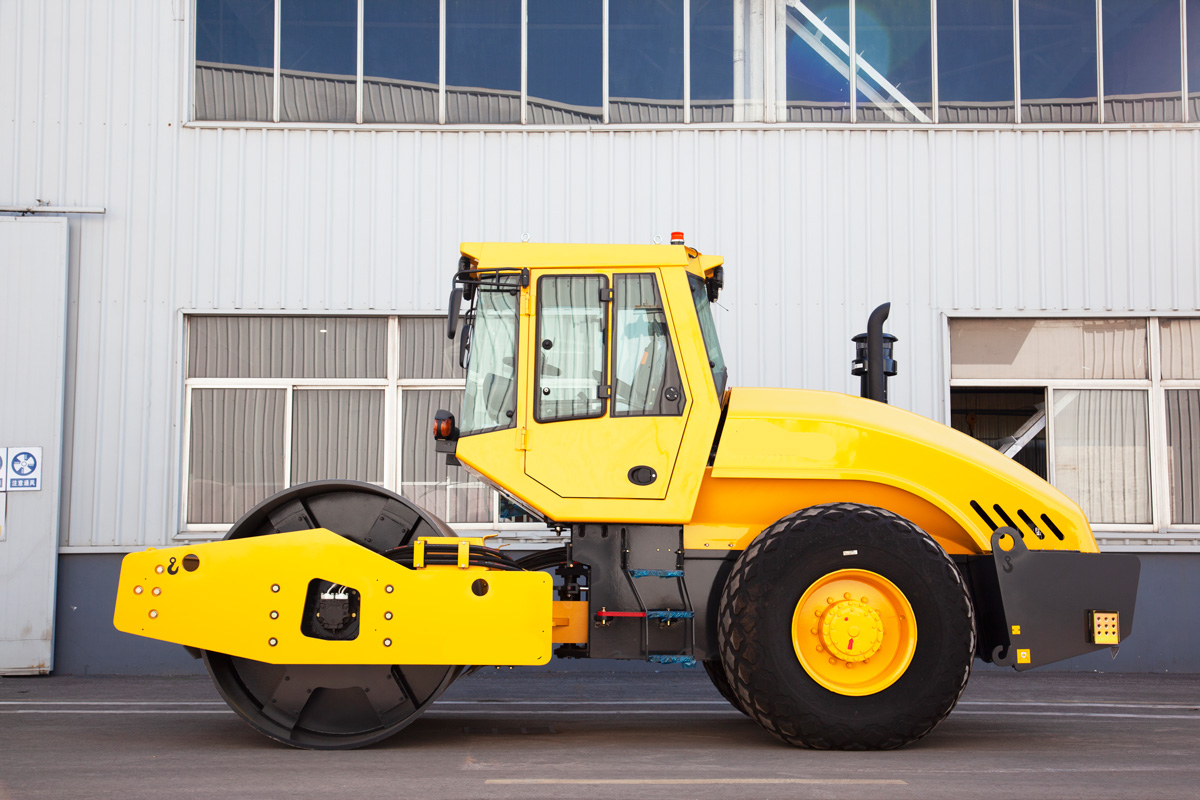
The turning radius of 6500 mm also needs to be checked against the site. Space is tight at municipal roadbed intersections, around inspection wells and at fencing corners; if the turning radius is insufficient, reversing adjustments or sectional compaction may be required. Minimum ground clearance of 410 mm relates to passability over trench covers and curb steps.
Items still requiring confirmation before purchase
Public data alone cannot determine whether a roller is suitable for a specific municipal project. The following items are recommended for item-by-item confirmation during inquiry and planning:
- Fill and lift: Main fill type, design lift thickness, moisture content control range.
- Compaction target: Design compaction degree or settlement difference requirements, and whether a trial section has been conducted.
- Working-area dimensions: Narrowest working-section width, turning and offset tracking space, obstacle distribution.
- Drum and tire configuration: The data lists a tire diameter of 1350 mm, but tire-type and single-drum machines differ in compaction mechanism; whether they need to be used together across different processes should be determined by the construction method.
- Relocation and transport: Overall length 5900 mm, overall width 2290 mm, overall height 3150 mm; transport route width and height limits must be checked.
- Power and emissions: Engine emissions are China II/Tier 2; the project location's emission access requirements must be confirmed.
- Shift organization: Daily compaction area and number of relocations affect equipment quantity and process continuity arrangements.
When inquiring, provide the above material, lift, workload and site conditions so the supplier can give configuration explanations corresponding to the working conditions. Whether the equipment is suitable is ultimately subject to on-site trial sections and test results; public parameters can only serve as a basis for preliminary screening.