






















The compaction task at a municipal solid waste landfill is often simply understood as "pressing the waste tightly." However, if equipment and methods for ordinary roadbed compaction are directly moved into a landfill, problems such as loose materials, uneven layers, poor site bearing capacity, and limited slope access are often encountered. The goals of the two types of operations appear similar, but the material properties, working surface conditions, and equipment requirements they actually face are not the same.
This article focuses on the operational goal of landfill layer compaction, explaining the main differences from ordinary roadbed compaction and which conditions need to be checked during equipment selection. When specific whole machines are mentioned, only verified data is used, without extending to site or efficiency conclusions that lack a basis.
First, distinguish the objects faced by the two types of compaction
Ordinary roadbed compaction deals with soil, crushed stone, or stabilized materials, and layer thickness and moisture content can usually be controlled relatively clearly in construction organization. Compaction equipment applies vibration or static pressure to the layer via steel wheels or tires, with the goal of compacting the material to the design density.
The compaction object at a municipal solid waste landfill is municipal solid waste with uneven composition and varying degrees of looseness. Operations often involve spreading, crushing, and compaction simultaneously. The material displaces and breaks under the compaction wheels, and layer thickness is not as easy to keep uniform as in roadbed work. The two impose different requirements on the equipment's working devices, travel conditions, and operational organization.

Several conditions to watch in landfill compaction operations
Loose material and crushing needs
After entering the landfill area, municipal solid waste usually needs to be spread and rolled. Loose material requires the equipment to have a certain crushing and compaction capability during compaction. If viewed only through the lens of roadbed compaction, the impact of material crushing on compaction effectiveness and stack stability is easily overlooked.
Site bearing capacity and travelability
The landfill working surface consists of waste stacks, and bearing conditions are related to compaction degree, layer thickness, and moisture content. Equipment travel requires attention to ground clearance and underbody protection. Roadbed compaction equipment typically does not need to consider such site conditions.
Slope and working surface organization
Landfills have operational needs for slope work and layered stacking. The equipment's blade height, crushing width, and overall dimensions affect how spreading and pushing are coordinated. These conditions need to be checked in the operational organization plan for the specific site.

In verified data, which operating conditions does the C260H correspond to?
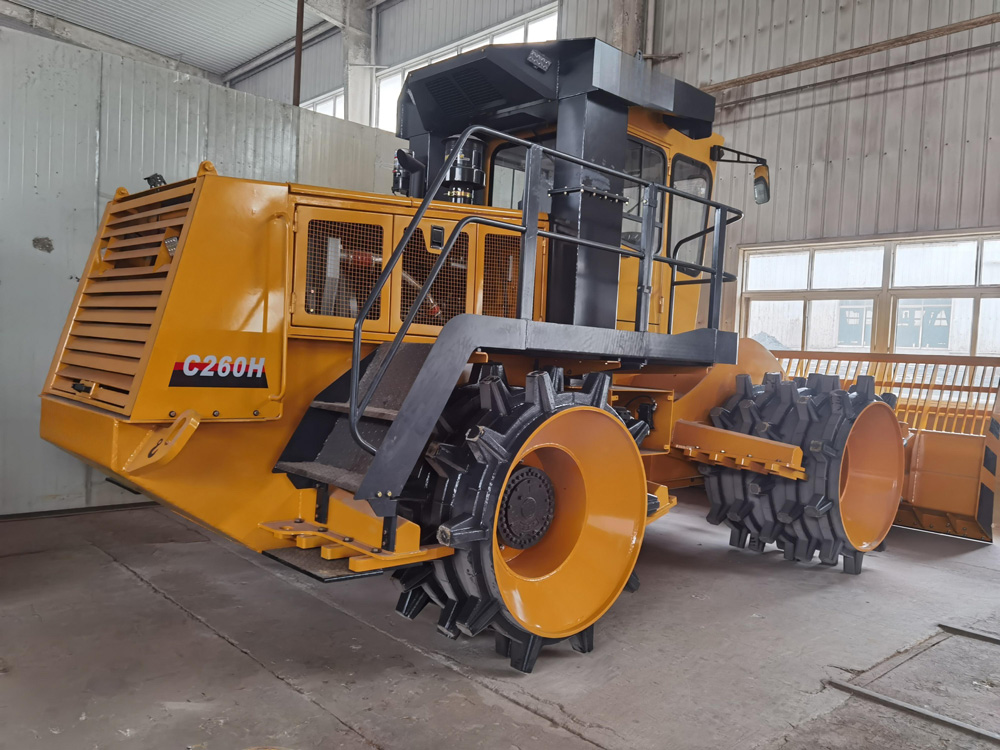
The C260H in this site's landfill compactor catalog is positioned in the data as a 26-ton heavy-duty landfill compactor for municipal solid waste landfilling, waste crushing, waste reduction, and large-scale solid waste treatment projects. The following parameters are only used to explain its correspondence with the aforementioned operating conditions and do not represent a commitment of applicability to any site.
| Data item | Verified value | Corresponding operating condition |
|---|---|---|
| Operating weight | 26,000 kg | Stability requirements of heavy-duty compaction operations on the whole machine |
| Engine power | 192 kW (262 HP), Shangchai Tier 3 | Power source for continuous operation |
| Crushing width | 3,430 mm | Coverage of the spreading and crushing working surface |
| Compaction capability | 0.35–1.0+ t/m³ | Compaction capability range given in the data |
| Ground clearance | 490 mm | Travel conditions on the landfill working surface |
| Blade height | 1,880 mm | Working height for spreading and pushing |
| Overall dimensions | 8,100×3,800×3,670 mm | Site entry transport and working surface layout |
According to the data, the configuration direction of this machine is closer to the integrated operational needs of landfill spreading, crushing, and compaction, rather than being a substitute for ordinary roadbed compaction equipment. Crushing width and blade height correspond to the coordination of spreading and pushing, ground clearance corresponds to travel conditions on the waste working surface, and compaction capability is the indicator used in the data to describe compaction effectiveness.
Differences in trade-offs compared with ordinary roadbed compaction equipment
Roadbed compaction equipment is usually configured around density targets for soil or pavement materials, focusing on steel wheel or tire type, vibration parameters, and layer thickness control. Landfill compaction equipment, however, needs to handle spreading, crushing, and compaction of loose waste simultaneously, and the working devices and overall machine protection direction are different.
This does not mean that roadbed compaction equipment cannot be used at landfills at all, but rather that in scenarios with higher requirements for layer organization, material crushing, and site travelability, equipment capability needs to be rechecked according to landfill operating conditions. Conversely, landfill compactors should not be arranged with methods intended for ordinary roadbed compaction equipment, as the operational goals of the two are different.
Conditions still to be confirmed before purchase
- The landfill's daily processing volume and layer organization method determine the shift arrangement and working surface width requirements for compaction operations.
- Waste composition and looseness affect the configuration judgment for crushing and compaction stages.
- Working surface bearing conditions and slope conditions require on-site verification of travelability.
- Site entry transport routes and overall machine dimension limits require confirmation of whether transport conditions are met.
- Power form and emission requirements should be checked against local regulations and site conditions.
- Protection configuration and maintenance inspection items should refer to the specific site's operating environment and manual requirements.
There is no unified answer to the above conditions; they need to be confirmed item by item in conjunction with the operational organization of the specific landfill. The parameters given in the data are one basis for judgment but cannot replace verification of on-site materials, layers, and bearing conditions.
Operational information to provide when requesting a quote
If requesting equipment quotes for landfill compaction operations, information such as waste type and composition, daily processing volume, layer thickness and compaction targets, working surface bearing and slope conditions, shift arrangements, site entry transport conditions, and local emission requirements can be prepared. The more specific these conditions are, the easier it is to verify whether the compaction wheels, protection configuration, and overall machine dimensions correspond to the operational needs.