






















The most common rework before a bulldozer enters a site is not that the equipment cannot do the job once it arrives, but that the documents are incomplete: whether the site is soft ground or hard soil, whether the blade should be straight-tilt or a coal-push blade, which track width to quote, and whether transport dimensions can pass height limits. If these conditions are not clarified at the inquiry stage, changing versions, modifying configurations, and rescheduling transport later all take time. This article follows a "preparation checklist" approach, grouping the documents to prepare before a static-pressure bulldozer enters the site, and uses the public information of a 178HP static-pressure bulldozer to explain why each group affects decisions.
Group 1: Work Objectives and Material Conditions
First, clearly state the actions this machine must complete, rather than starting with the desired horsepower. Pushing, backfilling, rough leveling, stockpiling loose materials, and short-distance material transfer correspond to different blade forms and undercarriage orientations. Material type must also be specified: general earthwork, soft wetland soil, loose coal, domestic waste, and sand all affect the version direction.
- Work content: which of pushing, backfilling, leveling, and loose-material pushing are involved, and their respective proportions.
- Material type and state: distinction among earthwork, soft soil, loose materials, and materials containing debris; moisture and looseness.
- Push distance and turning frequency: approximate one-way distance and whether frequent turning is required.
- Site bearing capacity and slope conditions: whether soft foundation, muddy sections, or uphill sections exist.
This group is listed first because the same power platform is divided into different versions by working condition. The DH17-G uses a Weichai WP7 China IV electronically controlled engine with rated power of 152kW/1800rpm (178HP). The documentation lists standard, super-wetland, coal, sanitation, forestry, and desert versions, each corresponding to different blade and undercarriage combinations. Version names are only entry points; which version to choose still depends on the material and site conditions above.

Group 2: Site, Transport, and Entry Constraints
Equipment can work only if it can get in. Before entry, measure the transport corridor width, height limit, turning radius, and unloading area, and compare them with the overall machine dimensions. The overall dimensions given in the documentation vary by version: the standard version is 5465×3452×3154mm, the super-wetland version is 5500×4230×3191mm, and the coal version is 5905×3905×3154mm. Width differences mainly come from track shoes and blade; the transport plan must be calculated according to the actually selected version, and the dimensions of one version cannot be applied to all versions.
- Transport vehicles and loading/unloading methods: flatbed specifications, bearing capacity at loading/unloading points, and whether auxiliary equipment is needed.
- Clear width, clear height, and turning conditions of the corridor, as well as restrictions from bridges, culverts, or temporary roads along the route.
- On-site parking and maintenance space: side-opening protective covers require side maintenance space.
- Location of fuel supply points and refueling frequency arrangements.
Group 3: Undercarriage and Blade Configuration Documents
Undercarriage and blade are the fields most easily handled vaguely during inquiry. Taking the DH17-G as an example, the standard version has a track shoe width of 510mm (optional 560/610mm), ground contact length of 2675mm, and ground pressure of 65kPa (with ripper)/77kPa (with drawbar); the super-wetland version has a track shoe width of 1100mm (standard)/950mm, ground contact length of 2935mm, and ground pressure of 30.5kPa. These two data sets correspond to different ground bearing conditions: soft and wet sites require a larger contact area to distribute pressure, while hard and solid sites can be organized with conventional configurations. The table lists only fields with verifiable data; configurations not listed should be treated as items to be confirmed with the supplier.

| Document Item | Standard Version | Super-Wetland Version |
|---|---|---|
| Operating mass | 17730kg (with ripper)/19290kg (with drawbar) | 19690kg |
| Track shoe width | 510mm (optional 560/610mm) | 1100mm (standard)/950mm |
| Ground contact length | 2675mm | 2935mm |
| Ground pressure | 65kPa / 77kPa | 30.5kPa |
| Blade type | Straight-tilt blade/semi-U blade | Straight-tilt blade |
| Blade width | 3452mm / 3415mm | 4230mm |
Blade documents must also be checked by version: the coal version has a coal-push blade, 3905mm wide and 1228mm high; the sanitation version has a sanitation blade, 4230mm wide and 1595mm high. Blade width and height correspond to the material volume and material form pushed per pass; bigger is not always better, and they should be considered together with site passage width and material stockpiling methods. Regarding ripping configuration, the standard version documentation lists a three-shank ripper with a tearing depth of 475mm; the super-wetland and coal version documentation does not list a ripper, so if crushing operations are required, this should be confirmed separately.
Group 4: Shifts, Power, and Operating Conditions
Shift arrangements determine fuel and refueling plans. The DH17-G has a fuel tank capacity of 352L, and the documentation states it supports continuous operation for more than 14 hours. This statement should be understood in the context of specific loads and working conditions and cannot be directly treated as a endurance commitment for all sites. The machine offers three power modes and is equipped with control functions such as slip ratio control, economy mode, driving response control, reverse startup mode, and automatic idle. Actual fuel consumption within a shift still depends on push distance, material state, and operating method.
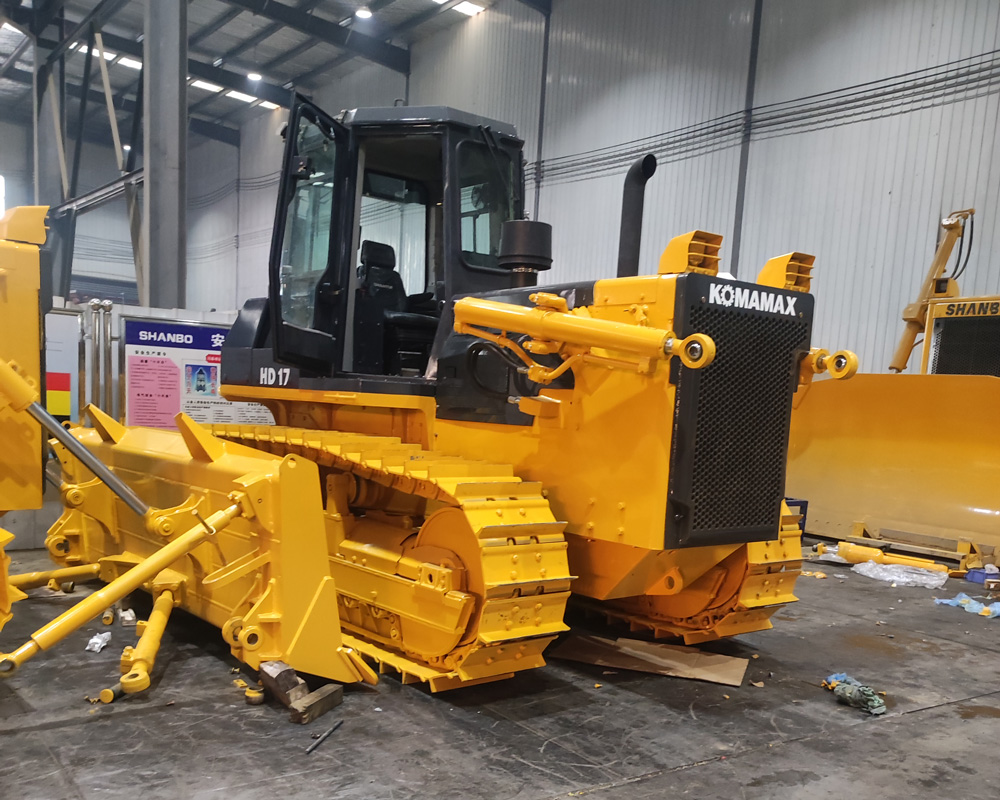
Operating and maintenance conditions should also be clarified before entry: the six-sided integrated cab, rear-mounted air conditioner, and rearview camera are configurations listed in the machine documentation; the external work valve and track rollers, side-opening protective cover, and engine compartment light relate to the convenience of daily inspections. Specific maintenance intervals and inspection items should be based on the accompanying manual; this article does not provide disassembly/repair steps or interval values.
Pre-Entry Checklist
- Whether work content, material type, push distance, and site bearing conditions have been described in writing.
- Whether the overall dimensions of the selected version have been compared with the transport corridor, height limits, and unloading area.
- Whether track shoe width, ground contact length, and ground pressure have been confirmed according to actual ground conditions.
- Whether blade type and width match the material form and pushing method.
- Whether additional work equipment such as a ripper is needed, and whether the selected version has corresponding documentation.
- Whether shift duration, refueling point locations, and power mode usage habits have been communicated.
- Whether operator training, accompanying documentation, and spare parts lists are arranged together with the equipment.
Items Still Requiring On-Site Confirmation
Public documentation cannot replace on-site judgment. The actual bearing capacity of soft and wet sites, slope passage capability, fuel consumption during continuous operation, and pushing efficiency under different materials all need to be verified in combination with the specific site and work organization. If site conditions fall between the standard and super-wetland versions, it is recommended to provide the supplier with ground bearing test results and differences between rainy and dry seasons before determining the version direction. During inquiry, provide material or layer descriptions, workload and schedule, site and transport conditions, shift arrangements, and key configuration requirements for blade and tracks, so that the supplier can propose corresponding versions and supporting conditions.