






















“37-ton class” is often used as a rough label for the capability of a heavy excavator, but tonnage only indicates the machine's weight class; it does not directly equal digging capability, loading cycle speed or mining adaptability. Two machines in the same 37-ton class can differ greatly in the tasks they can actually handle because of differences in work equipment specifications, hydraulic system flow, bucket capacity and undercarriage parameters. This article addresses the tonnage misconception surrounding heavy excavators and explains what additional information should be checked when assessing machine capability.
Why capability can differ at the same tonnage
Operating weight is the combined result of the machine, counterweight, work equipment and some fluids. It reflects the equipment class, but on its own it cannot indicate how much the bucket can load, how much digging force the arm can deliver, or how quickly the hydraulic system can support combined movements. Treating tonnage as the sole basis for selection easily overlooks the factors that truly determine working performance:
- Rated engine power and torque characteristics, which affect power reserve during heavy-duty digging;
- Hydraulic pump configuration and maximum flow, which affect the speed of combined boom, arm, bucket and swing movements;
- Bucket capacity and digging force, which affect single-bucket load volume and the ability to penetrate hard material;
- Undercarriage, ground pressure and gradeability, which affect travel stability on soft ground, slopes and rough sites;
- Transport dimensions and overall machine length, which affect access roads, trailers and on-site swing space.
These items must be checked one by one against the specific product data and cannot be extrapolated from the tonnage figure.

Capability composition of a 37-ton-class crawler excavator
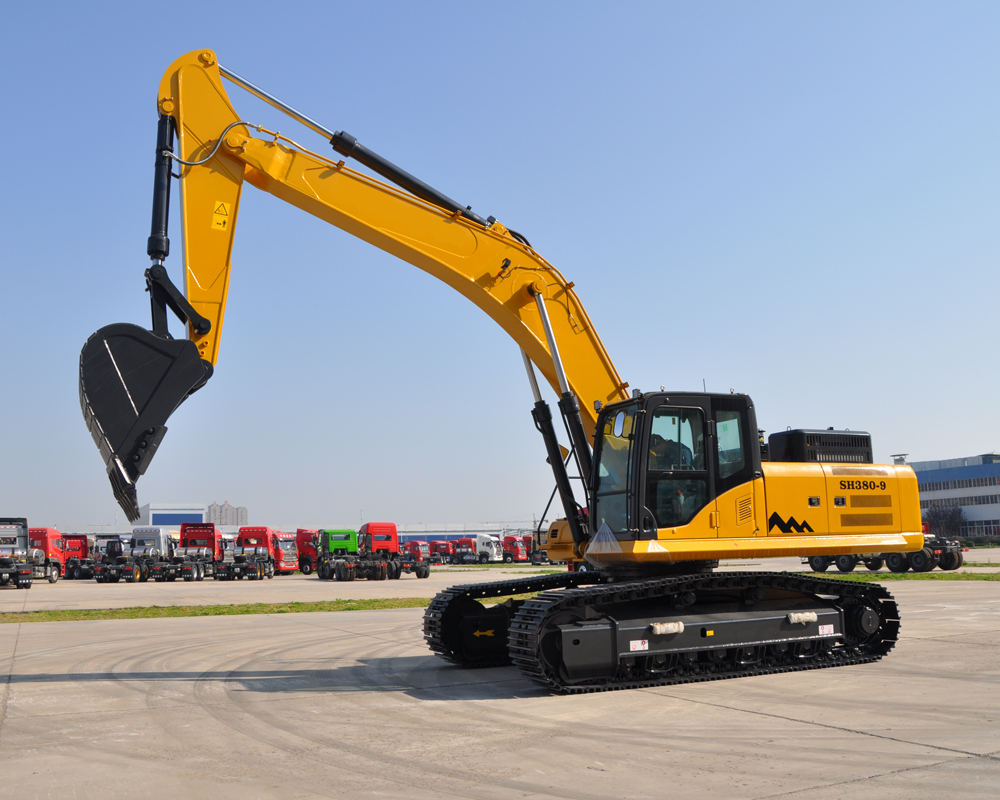
The SH380 associated with this site is a 37-ton-class crawler excavator with an operating weight of 37000kg, powered by a 6LTAA8.9-325 engine rated at 242kW/2000rpm. It has a bucket capacity of 1.62–1.82m³, a bucket digging force of 230kN and an arm digging force of 190kN. Its hydraulic system consists of 2× variable displacement piston pumps plus 1× gear pump, with a maximum operating flow of 2×330L/min. The following relates these data to practical working assessments.
Power and hydraulics: determining continuity of heavy-duty cycles
The rated power of 242kW corresponds to heavy-duty scenarios such as heavy earthwork and open-pit mining. The maximum hydraulic operating flow of 2×330L/min indicates that the system is configured for high-flow combined movements, suitable for cyclic work that alternates loading, digging and swinging. However, flow and power only indicate the configuration direction; actual cycle time also depends on material condition, operating method, loading height and coordination with transport vehicles. The data does not provide productivity figures, so site conditions should be confirmed separately before purchase.
Bucket and digging force: matching material and loading targets
The bucket capacity of 1.62–1.82m³ and bucket digging force of 230kN point to tasks such as large-scale earthwork, quarries and open-pit mines that require a relatively large single-bucket load. When encountering hard rock, frozen soil or dense material layers, digging force alone is still not enough; it is also necessary to confirm the tooth type, the match between bucket capacity and material bulk density, and whether attachments such as a breaker are required. Attachments are supporting conditions of the overall machine solution and should not be judged separately from the host machine's capability.

Undercarriage and travel: soft ground and slopes require more than gradeability
This model has a ground pressure of 62kPa, gradeability of 70% (35°), minimum ground clearance of 565mm and track shoe width of 600mm. These figures can be used for a preliminary assessment of passage conditions on slopes and rough terrain, but matching ground pressure to site bearing capacity and planning travel on soft ground during the rainy season still require confirmation against on-site soil conditions and haul roads. Gradeability is a machine capability indicator and does not mean the machine can operate safely on any slope; actual slope limits should also refer to operating and safety requirements.
Transport and swing space: measure access routes before entry
The overall length is 11161mm, overall width 3200mm, tail swing radius 3438mm and ground contact length during transport 5872mm. For mining benches, urban infrastructure foundation pits and narrow working faces, the tail swing radius and overall width directly determine whether interference exists. Before purchase, the transport route, flatbed trailer dimensions, unloading site and swing range should all be checked together.
| Check item | Data on this site | Related working issue |
|---|---|---|
| Operating weight | 37000kg | Equipment class and transport load |
| Rated power | 242kW/2000rpm | Power reserve for heavy-duty digging |
| Bucket capacity | 1.62–1.82m³ | Single-bucket load and material matching |
| Bucket/arm digging force | 230kN/190kN | Hard material penetration and digging resistance |
| Maximum operating flow | 2×330L/min | Combined movements and cycle continuity |
| Ground pressure | 62kPa | Site bearing capacity check |
| Gradeability | 70% (35°) | Slope access and working face layout |
Which tasks can be considered and which still need confirmation
According to the data on this site, this model is intended for open-pit mining, quarries, large infrastructure, foundation engineering and heavy earthwork. For a specific project, the following conditions can be used for assessment:
- Earthwork excavation and loading coordination: when matching with high-capacity dump trucks, bucket capacity, loading height and vehicle turnaround should be calculated rather than decided by tonnage alone;
- Mining earthwork: the proportion of hard rock, blast fragmentation and bench height determine whether direct excavation is suitable; the data does not provide productivity under rock conditions, so on-site confirmation is required;
- Working face and ground conditions: soft ground, water-bearing layers and slope operations require separate assessment of bearing and stability conditions;
- Continuous work shifts: the 580L fuel tank capacity can serve as a reference item, but actual shift fuel consumption and refueling arrangements depend on working conditions and operating methods; the data does not provide fuel consumption figures;
- Transport and maintenance: overall dimensions, track shoes and swing radius should be checked together with transport vehicles, maintenance space and spare parts supply.
Condition checklist to prepare before purchase
If you plan to request a quote for this type of heavy crawler excavator, it is advisable to organize the following information clearly so that it can be compared against the configuration:
- Material type and condition: earth, crushed stone, hard rock or mixed material, and whether clay or frozen soil is present;
- Work volume targets and shift arrangements: average daily excavation or loading volume, shift duration, and whether multi-shift continuous operation is required;
- Working face conditions: bench height, site bearing capacity, slope, swing space and surrounding interference;
- Transport conditions: access road width, bridge weight limits, flatbed trailer dimensions and unloading site;
- Work equipment and attachments: bucket capacity range and whether a breaker or other attachments are needed;
- Power and maintenance: fuel supply method, maintenance site, spare parts and manual verification.
Tonnage can serve as a first-level screening criterion, but it cannot replace item-by-item confirmation of power, hydraulics, work equipment and undercarriage conditions. The above assessment is based on the public data for this model on this site; actual applicability still needs to be verified against site conditions and operating requirements.