






















When reading large excavator specifications, bucket capacity and digging force are often placed in two separate columns for comparison: a larger bucket seems to load trucks faster, while greater digging force seems better able to bite into hard material. But on the actual working face, the two are a mutually constraining set of parameters. If bucket capacity is enlarged without matching digging force, the bucket cannot cut into hard material or fill completely; if digging force is ample but bucket capacity is on the small side, soft material requires more cycles and the loading rhythm is held back. This article explains, in the form of a parameter interpretation, how these two should be viewed together.
First, clarify what each parameter answers
Bucket capacity answers "how much can be loaded in one pass," in cubic metres; digging force answers "can it cut into and pry up the material in front of it," in kilonewtons. The former affects the number of loading cycles and the volume per unit time; the latter affects penetration capability when encountering dense material, crushed stone or weathered rock. The two are not substitutes but two ends of the same machine's performance across different materials.
Large crawler excavator specifications usually give both bucket digging force and stick digging force. Bucket digging force corresponds to the cutting force when the bucket curls around its hinge point, while stick digging force corresponds to the traction force when the stick retracts; together they determine whether a working cycle can be filled smoothly. Looking at only one of them makes it easy to overestimate or underestimate actual performance.
Why bucket capacity should be read after digging force and machine weight
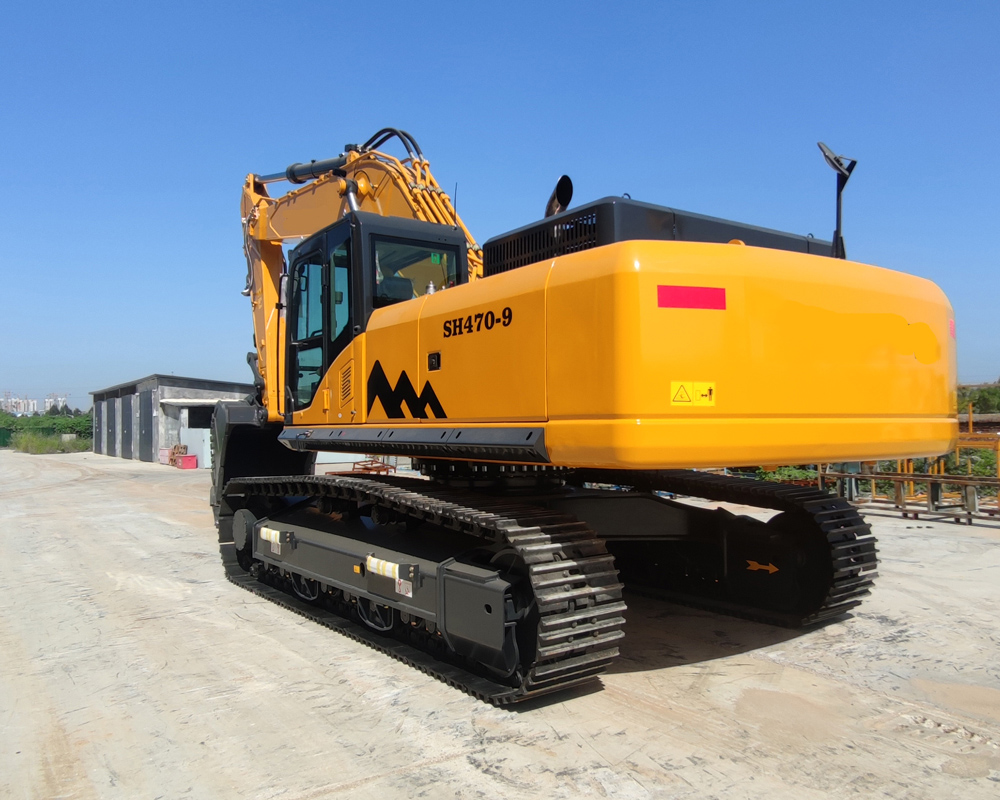
Take the verified data for a 45-tonne crawler excavator on this site as an example: bucket capacity 2.0–2.2 m³, bucket digging force 290 kN, stick digging force 236 kN, operating weight 44,900 kg, rated engine power 250 kW. These figures only make sense together—bucket capacity is not chosen in isolation; it must match digging force, machine weight and undercarriage stability.

2.0–2.2 m³ is a range, indicating that the same machine can be fitted with buckets of different capacities. The lower end of the range corresponds to heavier, denser material, and the upper end to material of lighter bulk density that is easy to fill. If the upper limit bucket is used directly in hard material, cutting resistance rises, fill factor drops and cycles actually slow down; if the lower limit bucket is used long-term in light material, the load per cycle is on the low side and the number of loading passes increases. The 290 kN digging force is specified together with this bucket capacity range, and bucket capacity cannot be enlarged on its own beyond that range.
Machine weight and undercarriage width are not incidental information either. The specifications give an overall width of 3,490 mm, track shoe width of 600 mm and ground pressure of 80.2 kPa. A larger bucket means greater weight of material in a full bucket, and machine weight and undercarriage ground contact area determine whether the machine is stable under that load. When assessing the upper bucket capacity limit, the bulk density of the full bucket load should be factored into the calculation rather than judging by empty bucket volume alone.
For truck loading, estimate bucket capacity and cycle time together
Loading output depends roughly on effective payload per bucket and cycle time. Bucket capacity gives the theoretical volume per bucket, but effective payload also depends on material bulk density and fill factor. Digging force affects fill factor: in dense material, if cutting force is insufficient, the bucket may only fill to 70–80%, creating a gap between nominal bucket capacity and actual payload.
Therefore, when checking equipment against a loading task, it is advisable to confirm three things first: material type and loose bulk density, the payload and body dimensions of the transport vehicles, and the height difference and swing angle between the working face and the discharge point. The specifications give a maximum digging radius of 12,016 mm, maximum digging depth of 7,800 mm and maximum dumping height of 7,615 mm, which can be used to check whether the working face layout falls within the machine's working range. If the discharge point is outside the working range, the stance or transfer method must be adjusted; this cannot be compensated for by a larger bucket.

Ground conditions determine whether to lean toward digging force or bucket capacity
Different ground conditions are sensitive to these two parameters to different degrees. The following approach can be used for conditional judgment; specific values still need to be confirmed against on-site material tests or existing operating records:
- Soft earth and sandy material: cutting resistance is low, and fill factor is mainly affected by bucket capacity and cycle organization, so an upper-limit bucket configuration can be favored.
- Dense clay and compacted backfill: penetration resistance rises noticeably, so first confirm whether bucket digging force is sufficient to fill a bucket before discussing bucket capacity.
- Crushed stone and quarry stripping material: lump size and interlocking affect cutting stability, so the upper bucket capacity limit should be conservative, and bucket structure and tooth configuration should be checked at the same time.
- Mixed ground: the same machine may need to switch between two materials; the bucket capacity range provides room for adjustment, but the basis for switching should come from actual fill conditions, not paper volume.
The above judgments are conditional analysis and do not constitute a commitment of suitability for any particular ground condition. The specifications do not provide test results for specific rock types, lump sizes or moisture content.
How hydraulic and power configuration supports these two parameters
Bucket capacity and digging force are ultimately delivered through the hydraulic system. The specifications for this model give a Linde load-sensing hydraulic system, maximum operating flow of 2×360+27 L/min, travel circuit pressure of 31.4 MPa and swing circuit pressure of 28.4 MPa, with a Cummins QSM11 engine rated at 250 kW/2000 rpm. The role of load sensing is to distribute flow on demand during combined multi-function operation, which affects the control continuity of tasks such as grading and loading that require coordination of swing, boom and stick.
It should be noted that hydraulic pressure and flow figures cannot be directly converted into digging force, nor can cycle time in a given material be inferred from them. Their role is to help judge whether the magnitude of the machine's power and hydraulic configuration sits within the same design range as that bucket capacity and digging force.
Conditions still to be confirmed before purchase
The verified data can support conclusions at the level of bucket capacity range, digging force, power, weight and working range, but it is not sufficient to judge whether this model is suitable for a specific project. Before requesting a quotation or comparing options, it is advisable to organize the following information clearly:
- Material type, loose bulk density, lump size and moisture content; provide screening or bulk density records where necessary.
- Loading or stripping workload, shift duration and target cycle organization.
- Body dimensions and payload of transport vehicles, to check the match between per-bucket load and truck body.
- Working face layout: bench height, swing angle and discharge point position, checked against maximum digging radius and dumping height.
- Transport conditions: overall length 12,090 mm, width 3,490 mm and overall height 3,590 mm, to check site access roads and relocation methods.
- Bucket configuration: the specific choice of bucket capacity within the range, teeth and bucket type, to be confirmed item by item with the supplier.
The coordination of bucket capacity and digging force ultimately comes down to finding a combination consistent with the material, vehicles and working face between "how much to load in one pass" and "whether it can cut in." A larger value for any single parameter does not automatically mean the machine is more suitable for that working condition.
For further information on the working equipment and configuration options of this 45-tonne crawler excavator, see the crawler excavator product page and check it against the conditions above.