






















It is common for quarries, open-pit mines, and large earthworks projects to have both hard rock and loose soil on the same work face. The problem is that these two materials do not impose the same demands on a crawler excavator: hard rock is about whether the machine can penetrate the material and whether the structure can withstand the forces after penetration; loose soil loading is about whether the cycle is fast enough and whether bucket capacity and hydraulic flow can keep up with the loading rhythm. If overall machine capacity is estimated based on only one of these materials, performance on the other material is likely to deviate from expectations. This article discusses exactly this order of judgment: first define the material boundaries, then decide which tier to use for capacity verification.
First Distinguish What Each Material Tests
Hard rock excavation is closer to a question of "penetration capability." Rock strength, joint development, and whether pre-loosening treatment is needed all change the actual resistance the equipment faces. Loose soil loading is closer to a question of "cycle efficiency." The material is already loose and resistance is low, but the amount of material taken per cycle, the coordination of swing and dumping, and the turnaround of matching haul vehicles determine output per unit time.
These two requirements cannot always be equally well satisfied by the same configuration. Therefore, when a site has both hard rock and loose soil, the first question is not "can this machine do the job," but "which part of the work should it handle, and which part is better arranged separately."
Should Capacity Be Based on Hard Rock or Loading?
A more reliable approach is to use the segment with the higher proportion and lower substitutability as the basis for capacity verification, and evaluate the other segment in terms of margin.

- If hard rock excavation is the main task and loose soil loading is only intermittent work, capacity should be based on hard rock conditions, focusing on digging force and structural durability, then confirming whether the cycle is sufficient for loose material.
- If loose soil loading is the main task and hard rock is only a local interlayer, capacity should be based on the loading cycle, focusing on bucket capacity, hydraulic flow, and swing speed, with the hard rock section treated locally or considered for pre-treatment.
- If the two work segments are similar in volume and alternate frequently, consider whether there is a situation where "one machine is barely adequate for both." In this case, splitting the work face or adjusting the process sequence is often clearer than forcing one machine to cover everything.
It should be noted that the above judgment only provides an analytical framework and does not constitute a conclusion on the suitability of any specific model. Actual values still need to be verified item by item based on rock conditions, haul vehicle tonnage, and shift arrangements.
Correspondence Based on Data for a 50-Ton Class Crawler Excavator
Taking the SH500 from this site's product data as an example, it is a crawler excavator with an operating weight of 49,600 kg, equipped with a Cummins QSM11 engine rated at 250 kW / 2000 rpm, a Linde load-sensing hydraulic system with maximum operating flow of 2×380 + 27 L/min, bucket capacity of 2.2–2.5 m³, bucket digging force of 290 kN, arm digging force of 236 kN, and three working modes.
Mapping this data to the two types of requirements above can be understood as follows:
- Hard rock penetration: Bucket digging force of 290 kN and arm digging force of 236 kN are the direct fields for judging penetration capability; the load-sensing hydraulic system synchronizes engine output with hydraulic demand and plays a role in flow distribution when resistance changes. However, the data does not provide actual penetration performance under specific rock strength, so whether hard rock can be excavated directly still needs to be confirmed based on the rock mass and whether pre-treatment is required.
- Loose soil loading: The 2.2–2.5 m³ bucket capacity combined with main pump flow of 2×380 L/min corresponds to the material taken per cycle and response speed; the three working modes can be used to trade off between productivity and energy consumption. However, the loading rhythm also depends on the tonnage and turnaround of matching haul vehicles. The data does not include vehicle matching information, so loading volume per unit time cannot be inferred from it.
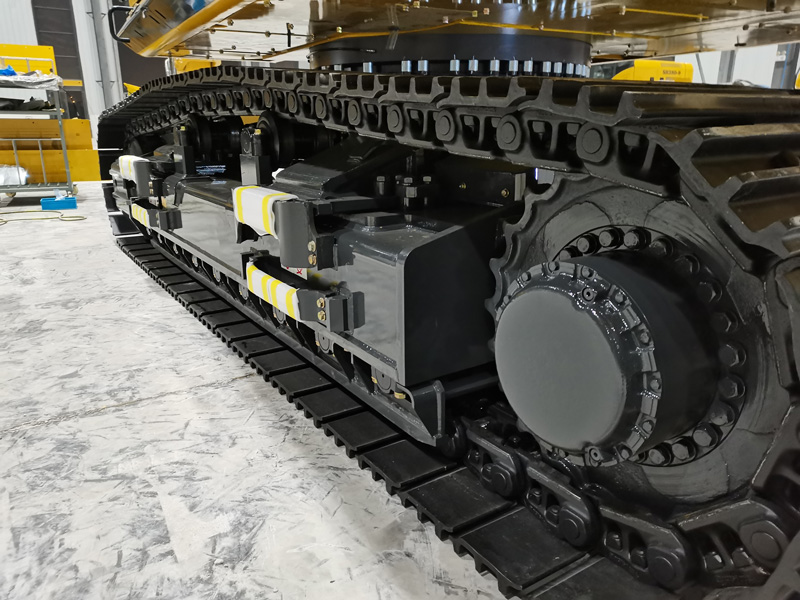
- Continuous heavy load: An operating weight close to 50 tons, reinforced track system, and fully welded undercarriage correspond to stability in hard rock environments and uneven terrain. This is a structural description and does not equal verified continuous operation duration under any specific working condition.
In other words, the data for this model supports the judgment that "it belongs to the 50-ton class and has the above digging force and flow configuration," but does not support the conclusion that "it is suitable for any hard rock or any loading organization." Which material capacity should be based on still depends on site conditions.

Several Constraints Beyond Material
Even with clear material boundaries, several conditions still affect the final value:
- Work face height and positioning: Maximum digging depth of 7,800 mm, maximum digging radius of 12,016 mm, and maximum dumping height of 7,615 mm determine the work face dimensions the equipment can cover and also affect whether frequent repositioning is needed.
- Travel and relocation: Travel speed of 3.2 / 5.3 km/h, gradeability of 70% (35°), overall length of 12,090 mm, and width of 3,490 mm. Relocation distances between work faces and passage widths need to be checked against these dimensions.
- Transport conditions: The overall transport dimensions are relatively large, so transport vehicles and route clearances need to be checked before entry. This data only gives dimensions, not a transport plan.
- Power and refueling: The machine is diesel-powered with a fuel tank capacity of 650 L and hydraulic tank/system capacity of 350 / 406 L. Refueling arrangements within a shift need to be confirmed separately based on site conditions.
Which Situations Indicate Operations Should Be Reorganized
When the following signs appear, rather than continuing to ask "which material should this machine's capacity be based on," it is better to adjust the work organization first:
- The hard rock section requires frequent pre-loosening treatment, while the loading section requires continuous feed, and the two rhythms constrain each other;
- The matching between haul vehicle tonnage and the 2.2–2.5 m³ bucket capacity requires multiple trips to fill, lengthening the cycle;
- The work face dimensions approach the equipment's maximum digging radius boundary, significantly increasing the number of repositioning moves;
- Rock conditions fall outside the data coverage, making penetration difficulty impossible to judge with existing parameters.
These are all condition analyses and do not represent site conditions that have actually occurred. Whether splitting is truly needed depends on measured rock conditions and work volume allocation.
Items to Confirm with the Supplier Before Purchase
Around the question of "which material capacity should be based on," conditions can be stated more specifically during inquiry:
- Material composition: proportion of hard rock and loose soil, approximate rock strength, whether pre-treatment is needed;
- Work volume: planned excavation and loading volume per shift, tonnage and number of matching haul vehicles;
- Site conditions: work face dimensions, passage width, relocation distance, ground bearing capacity;
- Shifts and power: daily operating hours, refueling or energy replenishment arrangements;
- Key configuration: which bucket capacity tier within the 2.2–2.5 m³ range to choose, whether other work equipment is needed, whether track and undercarriage configuration needs adjustment for the site;
- Transport conditions: entry route clearances and unloading site.
The more complete these conditions are, the better the supplier can judge which work segment the model should handle in a specific project and which parameters need key verification. Conversely, if only a vague statement like "it needs to break hard rock and also load" is given, the response received will often remain at the level of general machine introduction.
To further verify the data for this 50-ton class crawler excavator, please visit the SH500 crawler excavator product page.