






















Municipal road subgrade compaction sounds like a routine process, but if the compaction target, lift conditions, and site constraints are not clarified before the equipment enters the site, it is easy for the equipment to arrive and fail to match the working face or the process rhythm. The single-drum vibratory roller is a common equipment category in subgrade compaction. This article focuses on the municipal road subgrade scenario, breaks down the conditions that should be confirmed before entry, and uses verified data for a 12-tonne-class single-drum vibratory roller to explain how these conditions map to equipment judgments.
First Clarify the Subgrade Compaction Objectives and Site Constraints
The objective of municipal road subgrade compaction is usually to compact the fill material to the density state required by the design. In actual operations, this objective is constrained by several conditions: whether the fill material is soil or another material, the single-layer paving thickness, the width and length of the working face, whether surrounding buildings or pipelines impose restrictions, how the compaction process connects with earthmoving transport and leveling, and whether the equipment entry and exit route is permitted.
These conditions determine what operating mass, vibration parameters, and passability the roller needs. Without any one of them, it is difficult to judge whether a given machine is suitable. The following sections break down what needs to be confirmed before entry.
Lifts and Materials: Compaction Energy Must Match Layer Thickness
Lift thickness and material type directly affect the required compaction energy. For larger layer thicknesses, greater centrifugal force and appropriate operating mass are usually needed to transmit vibration energy; for thinner layers or finer materials, excessive energy may instead cause over-compaction of the surface layer or material crushing. Therefore, before entry, the design-required lift thickness range and fill properties should be confirmed first.

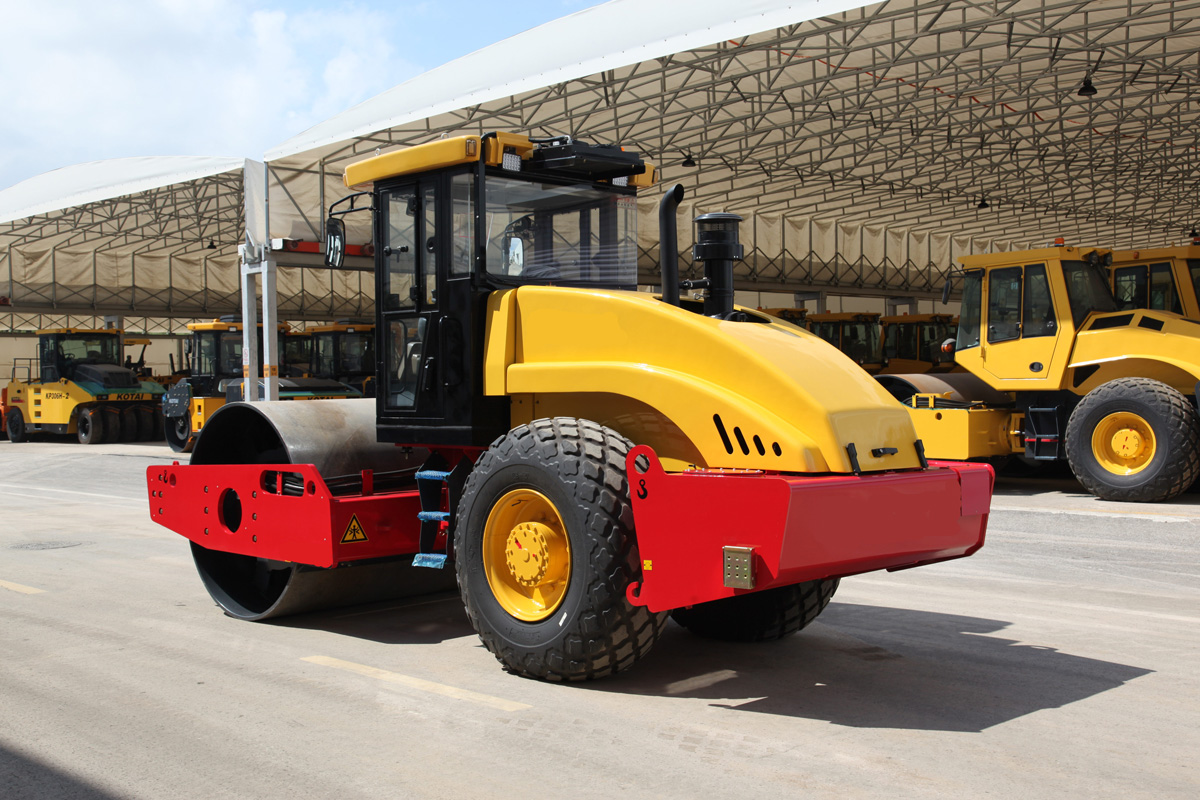
Taking the S125D single-drum vibratory roller as an example, its operating mass is 12 tonnes, the vibratory drum width is 2130 mm, and it is equipped with dual centrifugal forces of 280/162 kN and dual amplitudes of 1.85/0.83 mm, with vibration frequencies of 30/34 Hz. These parameters mean the machine provides two vibration output levels: the higher centrifugal force corresponds to thicker lifts or conditions requiring higher compaction energy, while the lower centrifugal force corresponds to thin layers or stages sensitive to energy. The dual amplitudes combined with dual frequencies leave room for adjustment under different lift conditions.
It should be noted that the above parameters only indicate the adjustment range the machine possesses and cannot directly determine which level should be used for a given material or layer thickness. The actual level selection should be determined based on fill test-section results and design requirements; this is a matter requiring on-site verification after entry.
Working Face Dimensions and Transfer Route
Municipal road subgrade working faces are often strip-shaped, with limited width, and may have manholes, pipelines, or intersections along the route. The roller's turning radius and overall dimensions affect its maneuvering within a narrow working face. The S125D has an overall length of 5970 mm, overall width of 2290 mm, overall height of 3150 mm, and a turning radius of 6500 mm. These data can be used to judge whether turning and steering within the working face are feasible.
Another often overlooked condition on municipal sites is entry and exit transport. The equipment needs to be transported to the site by flatbed truck. Before transport, road width and height limits, bridge and culvert load capacity along the route, and the unloading site should be checked. The roller itself cannot perform long-distance self-propelled transfers, so the transport plan must be arranged in advance.

Coordination of Vibration Parameters with the Compaction Process
The compaction effect of a single-drum vibratory roller is determined jointly by travel speed, vibration level, and number of passes. The S125D has a speed range of 0–9 km/h; actual rolling speed is usually lower than the maximum speed to ensure sufficient time for vibration energy to be transmitted to the lift. During operation, construction should be organized according to the number of passes and speed determined by the test section, rather than simply running at the machine's maximum speed.
In addition, the impact of vibratory compaction on adjacent structures needs to be assessed before entry. In areas near buildings, underground pipelines, or completed structures, whether to use static compaction or a reduced vibration level should be specified in the construction plan and cannot be judged solely from equipment parameters.
Power and Shift Arrangements
The S125D is equipped with a Weichai 105 kW (143 hp) engine, with emissions meeting Tier 2/China Stage II standards. This emission stage may be restricted by environmental access requirements in some cities. Before entry, the non-road mobile machinery emission requirements of the project location should be checked to confirm whether the equipment is permitted for use. This is a condition that is easily overlooked in municipal projects but directly affects entry.
Regarding shift arrangements, fuel replenishment, operator staffing, and coordination with other processes need to be planned in advance. The data does not provide fuel tank capacity or fuel consumption figures, so single-shift refueling arrangements cannot be estimated from it; this item should be confirmed with the supplier before purchase or rental.
Pre-Entry Condition Checklist
- Are the design-required compaction degree indicators and testing methods clearly defined?
- Are the fill material type and single-layer paving thickness range determined?
- Are the working face width, turning space, and distribution of obstacles along the route clear?
- Have the transport route width and height limits and the unloading site been confirmed?
- Have the project location's emission access requirements for non-road mobile machinery been checked?
- Has a vibration control plan been developed for areas near structures?
- Does the test section plan include verification of the number of passes and speed?
Items Still Requiring Confirmation Before Purchase
The above data can support judgments about the basic capabilities of a 12-tonne-class single-drum vibratory roller, but several items still need further confirmation during inquiry or selection: the actual compaction performance of the equipment under different fill materials and layer thicknesses needs test-section verification; fuel tank capacity and endurance data are not listed in the data; whether auxiliary configurations such as cab configuration and watering system meet project requirements must be checked item by item; and after-sales spare parts supply and operator training arrangements should also be considered.
When selecting a single-drum vibratory roller for municipal road subgrade compaction, lift and material conditions, working face dimensions, emission access, and transport arrangements should be confirmed item by item as preconditions, and then the degree of match should be judged based on the equipment's operating mass, vibration parameters, and passage dimensions. Parts with insufficient data should be listed as items to be confirmed rather than drawing conclusions directly from a single parameter.