






















Turning to the specification page of a landfill compactor, crushing width and compaction capacity are often the two most prominent values. The former is a length, the latter a range in tonnes per cubic metre. If they are treated as fixed capability values for side-by-side comparison, it is easy to form the impression that "the wider the better and the higher the compaction capacity the more suitable," but the two fields describe different things and should be read differently. Below they are unpacked in the order in which the data is read.
First, distinguish what each field describes
Crushing width refers to the effective width of the compaction wheels during operation. It determines the lateral range the machine can cover in one pass and is directly related to how travel routes are arranged and how lifts are divided into strips. Compaction capacity is usually given in tonnes per cubic metre and describes the range of compaction achievable on waste material under certain conditions; it is not a fixed value the machine can output unconditionally.
In other words, one field answers "how wide in one pass," the other answers "to what degree it compacts," and the two do not form a simple additive relationship. If procurement staff copy only one of them for comparison, they will miss the operating conditions on which they depend.
Field combination illustrated with a 23-tonne machine
Take the C230H, whose data has been verified on this site: operating weight 23,000 kg, engine power 192 kW, crushing width 3,430 mm, compaction capacity marked as 0.35 to 0.9 tonnes per cubic metre, minimum ground clearance 490 mm, blade height 1,880 mm, maximum speed 11 km/h, overall dimensions 8,100×3,500×3,670 mm. Only when these values are read together can the relationship between the fields be understood.

| Field | Verified value | Role when reading |
|---|---|---|
| Crushing width | 3,430 mm | Judge single-pass coverage width and strip arrangement |
| Compaction capacity | 0.35 to 0.9 tonnes per cubic metre | Understand the compaction range; must be combined with lift and material |
| Operating weight | 23,000 kg | Together with wheel configuration, affects ground contact and compaction |
| Minimum ground clearance | 490 mm | Relates to site passability, not compaction effect itself |
The crushing width of 3,430 mm plus the overall width of 3,500 mm indicates that the working width is close to the transport width, so access roads and working face widths must be reserved according to the machine's overall dimensions. The compaction capacity range spans 0.35 to 0.9 tonnes per cubic metre, a wide spread, indicating that the value is not a single rated figure; where it falls within the range depends on material properties and work organization.
Why the compaction capacity range cannot be treated directly as a promised value
The 0.35 to 0.9 tonnes per cubic metre given in the data is a range, not a guaranteed value achievable on any waste material. The composition, moisture content, lift thickness, number of compaction passes, and travel speed of municipal solid waste all affect actual results. The lower and upper limits differ by more than a factor of two; if only the upper limit is cited during procurement, conditional data is easily mistaken for unconditional capability.
A workable approach is: first confirm the material composition and daily lift thickness at your own site, then ask the supplier where within the range the compaction capacity would roughly fall under those conditions and on what basis. If the supplier cannot provide a condition statement, this field can only serve as a range reference and cannot be used as an acceptance criterion.

Crushing width must also be calculated together with travel routes
A crushing width of 3,430 mm means the working face needs to be advanced in strips, with overlap between adjacent strips; the amount of overlap depends on lift uniformity and driving operation. The width value itself does not tell you how many passes are needed, nor how much area can be covered per unit time. Before procurement, list the daily waste intake, lift thickness, and available working face width together, then judge whether the single-machine travel route can be arranged.
- Whether the net width of the working face can accommodate the machine's 3,500 mm overall width and leave room for turning and reversing;
- How the lift strip width matches the 3,430 mm crushing width;
- The number of strips planned to be covered and the number of passes within a daily shift.
Without on-site data for these three items, it is inappropriate to conclude directly that "the width is sufficient" or "the width is insufficient."
Ground clearance, blade height, and speed fields as supporting evidence
Minimum ground clearance of 490 mm and blade height of 1,880 mm describe the machine's passability in the landfill environment and its ability to cooperate with spreading; they do not form a conversion relationship with the compaction capacity field. Maximum speed of 11 km/h mainly affects transfer and empty-travel arrangements and should not be interpreted as working speed. Reading these fields together is to judge whether the machine matches site conditions, not to score compaction effect.
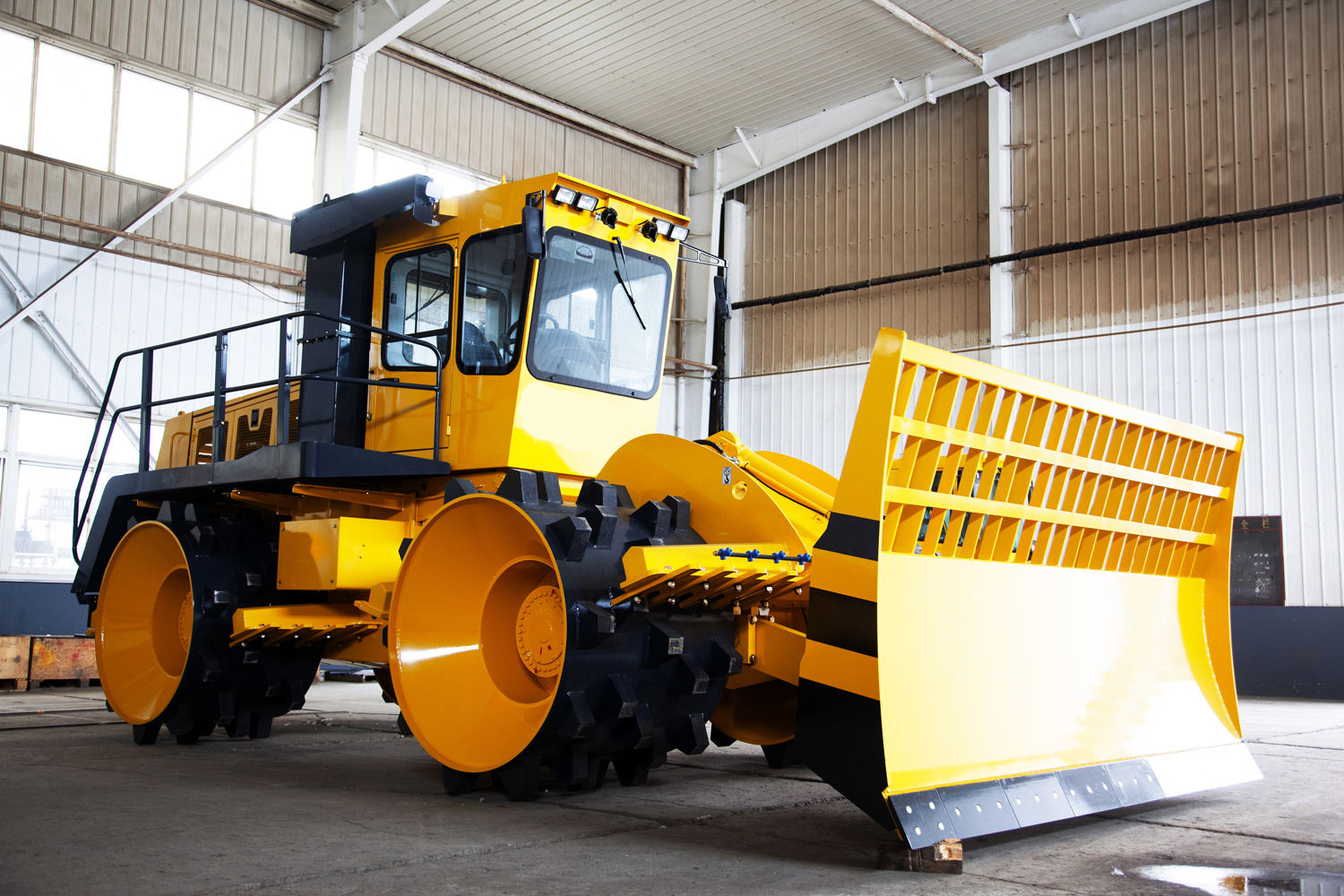
Items not stated in the data that require separate confirmation
The verified data for this product gives the above parameters and application directions, including compaction, crushing, and volume reduction of municipal solid waste at landfills, but does not provide the specific tooth configuration of the compaction wheels, recommended number of compaction passes for different materials, slope operation limits, or details of protective configuration. These directly affect whether the compaction capacity range can be realized and should be confirmed item by item with the supplier before procurement:
- Compatibility of the compaction wheel structure with the waste composition at this site;
- Recommended lift thickness and number of compaction passes, and the test conditions on which they are based;
- Operating limits under site bearing capacity and slope travel conditions;
- On-site protective configuration list and daily inspection items; the inspection interval is subject to the manual.
When requesting a quotation, it is advisable to also provide: daily and peak waste intake, material composition and moisture conditions, planned lift thickness, working face dimensions and bearing conditions, shift arrangements, access road width and height limits, and whether specific protective configuration is required. Only when the crushing width and compaction capacity fields are put back into these conditions do they have comparative significance.