






















High-volume truck loading and continuous heavy-duty operation are among the most typical applications of large crawler excavators. Once the loading cycle is slowed by material supply, swing motion or hydraulic response, the entire transport fleet is left waiting. Buyers therefore often need to judge whether an excavator's hydraulic configuration can sustain long, high-frequency loading cycles. Focusing on this need and drawing on verified information for a 50-tonne crawler excavator on this site, this article explains how to assess the suitability of a load-sensing hydraulic system for loading work and the conditions it requires.
Start with the work objective and site constraints
High-volume loading conditions usually share several features: the material is mainly earth and rock or loose crushed ore, the loading target is dump trucks or mining trucks, fast hydraulic action and coordinated combined movements are required, and cycle counts within a shift are high. The key here is not a single metric but whether the hydraulic system can continuously and stably distribute flow as engine speed varies.
Constraints must also be recognized. Loading efficiency also depends on the working face and vehicle parking position, material lump size, swing angle and operator habits; the hydraulic configuration is only one part. If transport vehicles cannot keep up, even fast hydraulic response is hard to convert into actual output. Therefore, before judging whether load-sensing hydraulics are suitable, first confirm how loading is organized, then look at equipment conditions.
What load-sensing hydraulics solve in the loading cycle
The basic principle of load-sensing hydraulics is to make main pump output vary with the load demand of the actuators, reducing energy loss from excess flow. For loading work, this usually corresponds to three noticeable aspects: combined movements of boom lift, arm retraction and swing are easier to coordinate; during light-load or empty-bucket return, the system does not need to maintain full flow; and during heavy-duty digging, pressure and flow distribution are relatively stable.

It should be noted, however, that load sensing is a hydraulic control method and is not directly equivalent to whole-machine efficiency or fuel consumption. Actual results depend on engine matching, main valve characteristics, operating modes and working habits, and quantitative conclusions should not be drawn without field data.
Corresponding configuration of this 50-tonne model
The associated SH520 on this site is a 50-tonne crawler excavator with an operating weight of 50500kg, a Cummins QSM11 engine rated at 280kW/2000rpm, a bucket capacity of 2.5–3.5m³, a bucket digging force of 292kN, an arm digging force of 251kN, and a Linde load-sensing hydraulic system.
According to the information, the correspondence between this configuration and high-volume loading needs is mainly reflected in the following points:

- The hydraulic pumps are 2× variable displacement piston pumps + 1× gear pump, with a maximum operating flow of 2×360+27L/min and a system pressure of 31.4MPa; the multi-pump configuration helps distribute flow during combined movements.
- The main valve is a Toshiba main valve. The information lists functions such as straight travel circuit, boom and swing priority logic, bucket and boom regeneration circuits, and load holding valves, which are related to movement transitions in the loading cycle.
- The engine uses electronically controlled high-pressure fuel injection and offers three working modes, auto idle and synchronized speed control; the information states that it can reduce unnecessary engine speed under light load. Such functions are related to power matching during continuous loading, but actual fuel consumption still needs verification under field conditions.
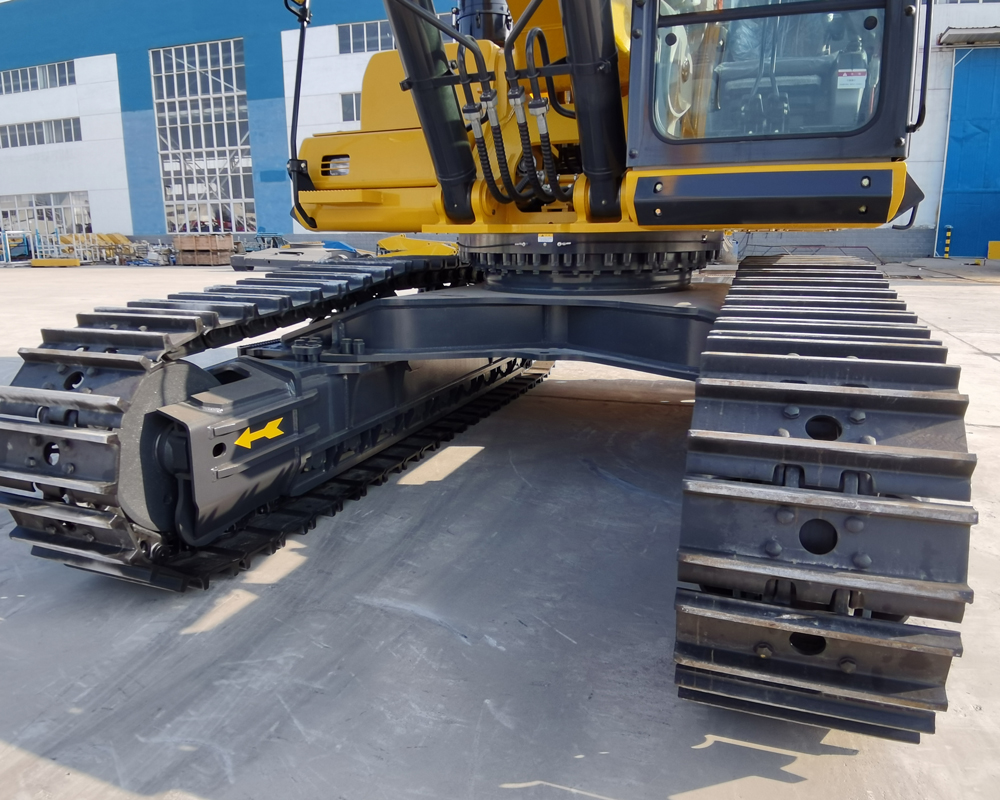
- In terms of structure, the information mentions a "central load-bearing" upper structure, a reinforced X-shaped undercarriage, and a boom and arm using high-strength steel plates at high-stress locations, corresponding to structural durability requirements under heavy-duty cycles.
It should be noted that the bucket capacity of 2.5–3.5m³ is a range; which capacity is actually matched depends on material density and vehicle payload, and it should not be configured solely according to the maximum value.
Trade-offs versus conventional configurations
| Assessment dimension | Situations where load-sensing configuration deserves more consideration | Situations requiring separate confirmation |
|---|---|---|
| Work cycle | Frequent combined movements and stable loading pace required | Single movements, mainly intermittent work |
| Material conditions | Conventional loading of earth and rock, loose crushed ore, etc. | Long-term operation with attachments such as breakers |
| Continuous duration | Long continuous loading time within a shift | Frequent site transfers, short single work periods |
| Supporting organization | Transport vehicles are closely coordinated | Long vehicle waiting times, restricted site |
This table only lists conditions that can be matched from the information; it does not mean that load-sensing configuration is superior to other hydraulic forms in all loading situations. If the material is mainly blasted hard rock, bucket teeth, bucket capacity and digging force should also be evaluated separately.
Application limits and items to confirm before purchase
This model is positioned as a heavy-duty crawler excavator, and the information lists applications such as open-pit mining, large earthworks and earth-rock work in complex geology. However, the following points are not covered by the information or are insufficient to support conclusions, and should be verified item by item before purchase:
- Matching of specific material lump size, loosening factor and loading vehicle tonnage needs to be confirmed by project measurements or material reports.
- Actual response differences of the load-sensing system under different working modes lack field comparison data.
- Fuel consumption, hourly output and maintenance costs: the information does not provide quantitative data that can be cited.
- Transport conditions: overall length 12545mm, width 3490mm, and ground contact length during transport 6723mm; access roads, turning radius and transport vehicle load capacity need to be checked.
- Attachment matching: if a breaker or other attachment is required, hydraulic flow and interface compatibility should be confirmed.
- Maintenance: hydraulic oil capacity is 350/475L and fuel tank 650L; maintenance items and intervals should follow the machine's manual, and this article does not provide specific maintenance interval recommendations.
In other words, load-sensing hydraulics can be one direction to consider for high-volume loading conditions, but whether it suits a given project still has to be judged against material, loading organization and transport coordination.
Conditions to provide when requesting a quotation
If you plan to request a quotation for such equipment, it is advisable to organize the following information clearly: planned material type and density, average daily loading volume or cycle count, working face and vehicle parking layout, transport roads and width/height limits, shift arrangements, whether attachments are needed, and on-site maintenance and spare parts conditions. For bulldozers, the focus is on checking the blade and undercarriage, while for excavators, the focus should be on checking the work equipment configuration, ground conditions and transport conditions. With these conditions clearly stated, suppliers can give more targeted configuration recommendations.