






















When discussing loading with heavy excavators, tonnage is often treated as the only measure: the larger the tonnage, the larger the bucket and the faster the loading. This assumption holds only under certain conditions. Loading is a chain made up of four links: "can it dig, can it load, can it move stably, can supply keep up." Tonnage only indicates the machine class; it cannot replace item-by-item verification of bucket capacity, digging force, dump height and site conditions.
Several things tonnage does not tell you
Among crawler excavators in the roughly 30-tonne class, specification combinations can vary widely: some emphasize bucket capacity, some emphasize digging force, and some offer a longer working range but also a larger swing radius. Machines of similar tonnage may perform differently in actual loading depending on the material, bench height and truck body height. Tonnage is therefore better used as an initial screening range rather than a final conclusion.
- Bucket capacity must correspond to material bulk density: loading loose earth and loading denser ore with the same bucket capacity produces clearly different bucket weights.
- Digging force must correspond to ground conditions: a large bucket does not mean it can penetrate hard material. For hard rock or frozen soil, check the bucket and arm digging force configuration.
- Dump height must correspond to the truck body: if the discharge point is lower than the truck sideboards, loading becomes a process of repeatedly repositioning.
- Machine dimensions must correspond to the site: wheelbase, tail swing radius and minimum ground clearance affect passage and slewing in narrow areas and on soft ground.
Using a 33-tonne crawler excavator to examine specification relationships
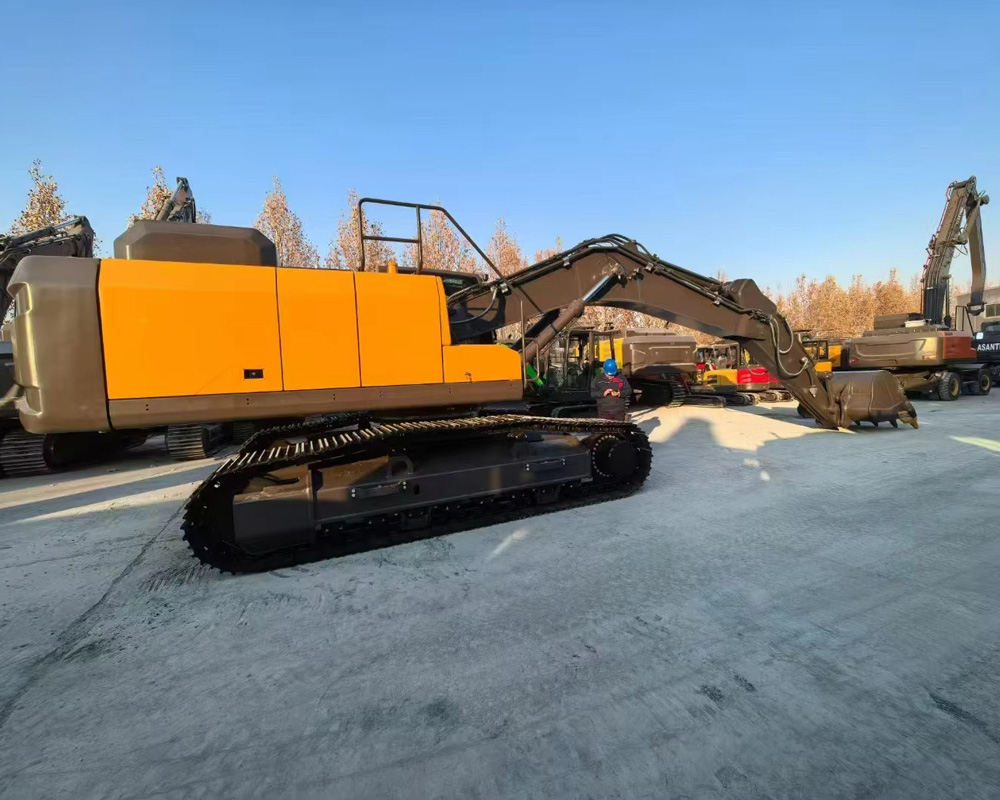
The SH330 referenced in this article is a 33-tonne heavy crawler excavator. The core specifications provided can serve as a sample for understanding the relationships above, but the values below apply only to this model and cannot be generalized to other tonnages or models.

| Field | Verified value | Corresponding consideration in loading |
|---|---|---|
| Bucket capacity | 1.6 m³ | Estimate bucket weight and truck match based on actual material bulk density |
| Maximum bucket digging force | 244 kN | Reflects ability to penetrate material; not equivalent to loading cycle time |
| Maximum arm digging force | 200 kN | Works with bucket force; affects digging posture and depth work |
| Rated power | 194 kW / 2200 rpm | Power reserve corresponds to heavy-duty cycles and climbing; not a direct output conversion |
| Maximum dump height | 7625 mm | Must be checked against target truck sideboard height |
| Maximum digging radius | 10709 mm | Affects positioning of the machine and truck stopping positions |
| Maximum digging depth | 6437 mm | When bench or foundation pit depth exceeds this value, layered excavation is required |
| Gradeability | 35° | Site access road and working face slopes must be checked separately |
| Minimum ground clearance | 470 mm | Reference for passability on soft ground or crushed-stone sites |
| Overall dimensions (L×W×H) | 11015×3200×3168 mm | Affects transport width and working face footprint |
This table shows that beyond tonnage, at least four dimensions—material, ground conditions, truck body height and site—must be checked separately. The 1.6 m³ bucket capacity and 244 kN bucket digging force in the data are a combination on the same machine; neither figure should be moved to another tonnage for comparison.
Loading efficiency is determined by coordination, not by a single machine
In loading operations, the excavator is only one link in the chain. Truck model and body height, vehicle dispatch intervals, working face width and swing angle all affect the actual pace. The 0–11 rpm swing speed and 35 MPa system pressure given in the data indicate that the hydraulic system supports a certain level of motion coordination, but whether operations run smoothly depends on the operator, site layout and truck arrival organization; hourly truck counts cannot be calculated from these figures.

Likewise, the maximum digging radius of 10,709 mm and maximum dump height of 7,625 mm are only geometric limits. If the actual stopping position is constrained by slopes, roads or pipelines, the usable working range will shrink. During selection, the planned stopping position should be drawn on the working face and then checked against these dimensions, rather than looking only at the maximum values in the specification table.
Conditions under which this assumption needs correction
- High material density: with the same 1.6 m³ bucket capacity, bucket weight increases, and it may be necessary to reduce bucket capacity or adjust the loading method; in this case, larger tonnage does not necessarily mean higher efficiency.
- Narrow working face: with an overall width of 3,200 mm and a tail swing radius of 3,480 mm, swing space and safe distances from adjacent equipment must be checked on restricted sites.
- Excessively deep bench: the maximum digging depth of 6,437 mm is a geometric value; foundation pits deeper than this must be excavated in layers, and loading organization must be adjusted accordingly.
- Transport constraints: with an overall length of 11,015 mm, flatbed trailer selection and road width and height limits must be confirmed in advance.
Conditions to confirm before purchase
When checking equipment for a loading task, the following information determines suitability more than tonnage does:
- Material type and bulk density, used to derive bucket weight and bucket capacity requirements.
- Ground hardness and whether crushing or ripping pretreatment is needed, used to judge whether digging force is sufficient.
- Sideboard height and payload of the matched trucks, used to check dump height and bucket capacity.
- Working face dimensions, bench height and stopping position layout, used to check swing radius and digging range.
- Access road slope and road surface bearing capacity, used to check gradeability and ground clearance.
- Shift arrangements and truck arrival organization, used to assess the number of machines rather than single-machine capability.
If any of the above information is missing, it is advisable to verify it before finalizing the configuration. Tonnage can serve as a starting point for screening, but treating tonnage directly as the conclusion that a machine "can load" will overlook material, truck body, site and transport, all of which equally affect the result. The SH330 specifications show that a 33-tonne platform can be configured with 1.6 m³ bucket capacity and 244 kN bucket digging force, but whether this matches a specific project still depends on item-by-item comparison with site conditions.
For further information on this model's configuration and availability, please provide material type, average daily workload, site and transport conditions, shift arrangements and work equipment requirements together with your inquiry so that the configuration can be checked.