






















In daily landfill operations, "how wide is this machine" and "how deep can it compact" are often compared as factory parameters. But the same number means different things under different layering organizations: width determines the work strip covered per pass, while depth relates to the cutting teeth's ability to draw material downward; neither equals compaction density, nor does it mean the machine achieves the same effect under any waste composition. Using verified data for the landfill compactor C300H as a clue, this article explains which on-site arrangements these two values correspond to, and what conditions still need to be supplemented before procurement.
The width value corresponds to work strip division, not just body dimensions
The C300H has a compaction width of 3430 mm and an overall width of 3800 mm. The former refers to the effective coverage width of the four compaction wheels acting on the waste layer, while the latter is the vehicle outline. The two are close, indicating that the equipment's operational coverage is basically synchronized with the body's passing dimensions, so when dividing work strips on site, the body width can be used directly as a reference.
Assuming a work face width of just over ten meters (for condition analysis only, not an actual case), a compaction width of 3430 mm means a one-way pass can cover about three compaction strips, and the number of round-trip overlaps directly affects the single-shift coverage area. Therefore, before procurement, it is necessary to confirm the divisible strip width of the landfill work face and the daily work area, rather than looking only at the compaction width itself. For sites with narrow work faces and many slopes, whether wide coverage leads to waste in turning and overlapping is also a boundary that needs on-site verification.
Spreading depth should be viewed together with cutting teeth and dozer blade
The data states: using high-strength wear-resistant cutting teeth, the compaction spreading depth can reach over 1 meter. The context of this value is the cutting teeth's ability to grip the waste layer during pushing, spreading, and compaction, not that any layer thickness can be compacted to target density in one pass.

Paired with spreading depth is the dozer blade: height 1880 mm, designed as ultra-wide and ultra-high, providing large-capacity pushing force per pass. A tall blade with large capacity helps push loose waste flat and form a thicker work layer; the cutting teeth are responsible for breaking and drawing material at deeper positions. If the on-site layer is originally thin (for example, daily cover soil alternating with waste layers), a spreading depth of over 1 meter is more of a capability margin, and the actual work pace depends on layer arrangement and how covering processes are interspersed.
Therefore, spreading depth needs to be judged together with cutting teeth condition, dozer blade height, and daily waste intake. The data does not provide compaction density under different waste compositions, nor does it explain how spreading depth changes with high moisture content or large amounts of long strips; these need to be listed as items to be confirmed.
Where these parameter fields sit in selection materials
When reading landfill compactor materials, fields directly related to operational organization can be checked in the following order. The table lists only items covered by this article's data; uncovered items are marked as to be confirmed.
| Field | C300H data value | Corresponding operational arrangement |
|---|---|---|
| Compaction width | 3430 mm | Work strip division, number of coverage passes per shift |
| Compaction spreading depth | Over 1 meter (with cutting teeth) | Reference for upper layer thickness limit, frequency of tooth wear inspection |
| Dozer blade height | 1880 mm | Dozing capability, pushing volume per pass |
| Operating weight | 29100 kg | Relationship between ground pressure and site bearing capacity; needs confirmation with wheel width and tooth type |
| Gradeability | 100% | Traffic conditions on landfill slope surfaces; still affected by road adhesion and load distribution |
| Compaction density | Not provided in data | Needs actual measurement and confirmation based on waste composition and layer thickness |
From the table, width and depth can explain how the work face is arranged, but cannot directly answer "whether compaction meets standards." Compaction density is jointly affected by waste composition, moisture content, layer thickness, and number of compaction passes; the data does not provide results under these conditions and cannot replace on-site conclusions.

On-site bearing capacity and slope traffic must be checked separately
The C300H uses four-wheel drive with a rear-wheel proportional differential lock, so when wheels on one side slip, the other side still maintains power output. This configuration corresponds to trafficability requirements on muddy and soft ground. Landfill work faces commonly have loose surfaces and local ponding; four-wheel drive and differential lock are configuration bases related to these conditions.
However, trafficability does not equal sufficient site bearing capacity. The operating weight is 29100 kg, minimum ground clearance is 490 mm, and front-rear wheelbase is 3500 mm; these values affect the equipment's sinking risk on soft foundations and ability to cross obstacles. Before procurement, confirm the bearing capacity of landfill roads and work faces, drainage organization, and slope anti-slip measures; do not assume any slope can be worked merely because gradeability is 100%. Gradeability in the data is an equipment capability parameter; actual passable slope also depends on material adhesion conditions and operating procedures.
What integrated dozing and compaction brings, and what limits it
The data describes that the machine can simultaneously complete waste pushing and compression, i.e., one machine for two uses. For the site, this means dozing and compaction can be linked within the same pass, reducing the need for separately configured dozing equipment. This feature relates to the organization of daily cover operations and layered stacking: the tighter the cycle of layering—dozing—compaction, the shorter the work face exposure time.
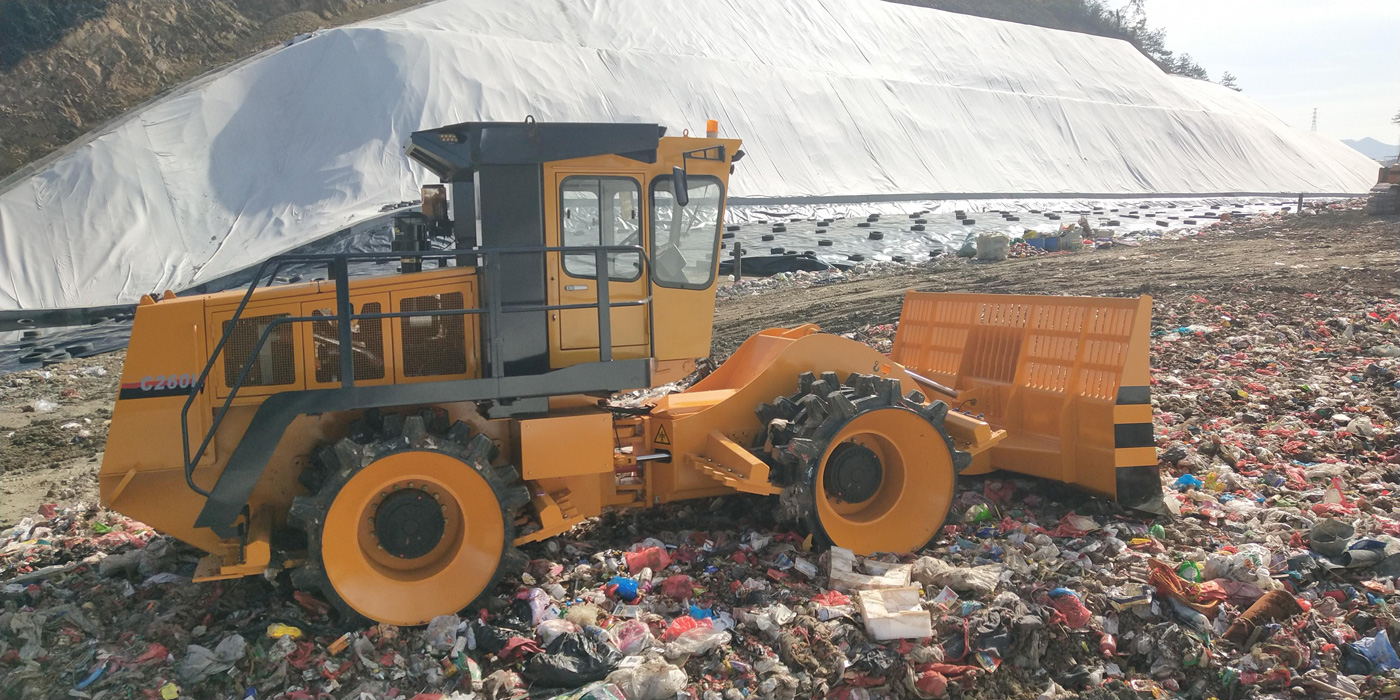
The limitation is that the data does not provide cycle time or efficiency data for this machine under different shifts and waste volumes, nor does it explain specific coordination methods when working with excavators or loaders. Therefore, "one machine for two uses" can only serve as a conceptual approach; actual configuration still needs to be calculated based on daily waste intake, number of work faces, and auxiliary equipment conditions.
Conditions to establish before procurement
Selection of a landfill compactor should not be separated from the landfill's operating conditions. Based on this article's data, at least the following types of information should be prepared during inquiry and proposal verification:
- Waste materials and layering: daily waste intake, waste composition, moisture content, single-layer spreading thickness, daily cover material and covering frequency, used to judge whether compaction width and spreading depth match.
- Site and slopes: work face width, stack slope, road bearing and drainage conditions, used to verify the applicable boundaries of four-wheel drive, ground clearance, and gradeability.
- Shifts and supporting equipment: daily work shifts, coordination with bulldozers or loaders, used to judge whether one machine for two uses can truly compress processes.
- Protection and sanitation: correspondence between configurations such as cab sealing, activated carbon filtration, and spray sanitation systems and on-site odor and mosquito/fly control requirements; the data lists a fully enclosed cab, high-level air intake, and stainless steel tank powered spray mechanism, but does not provide filtration efficiency or chemical dosage.
- Maintenance conditions: the centralized lubrication system covers 12 key working points, a configuration that reduces manual lubrication points; however, lubrication intervals and tooth replacement standards still need to be determined according to the manual and on-site wear inspection, and maintenance cycles cannot be directly derived from the data.
After these conditions are confirmed, reviewing the 3430 mm compaction width and over 1 meter spreading depth can determine whether they are a margin matching the on-site work face or exceed what the actual layering organization requires.