






















Site leveling looks like a single process, but it actually includes pushing, spreading, rough leveling, edge and corner trimming, and final grading. Asking "can a small bulldozer complete it independently" is essentially asking: which of these steps can be done by one small crawler dozer, and which require other equipment or manual finishing. The answer does not depend on machine size, but on site area, push distance, material conditions and leveling accuracy requirements.
Answering the core question first
Under conditions of relatively loose material, short push distance and only rough leveling required, one small crawler dozer can handle the main pushing and spreading work. However, if the site requires long-distance earthmoving, large-area elevation leveling, or has strict requirements for final elevation and flatness, a single machine cannot cover all steps and usually needs to work with loading, transport equipment and survey leveling methods. In other words, it can serve as the main force for leveling work, but whether it can "complete it independently" must be judged against acceptance standards.
Requirements for each step after breaking down the leveling task
- Pushing: moving soil from high points to low points, affected by push distance and material density; the longer the distance, the more noticeably single-machine efficiency drops.
- Spreading and rough leveling: layered spreading and scraping with the blade, requiring blade width to match site scale and the operator to control layer thickness.
- Edges and finishing: near structures, slopes and manhole covers, the dozer blade is difficult to control precisely, generally requiring manual work or small tools.
- Elevation control: requires survey setting-out coordination; the dozer itself only provides rough leveling capability and cannot replace surveying.
What the published specifications of a small crawler dozer can indicate
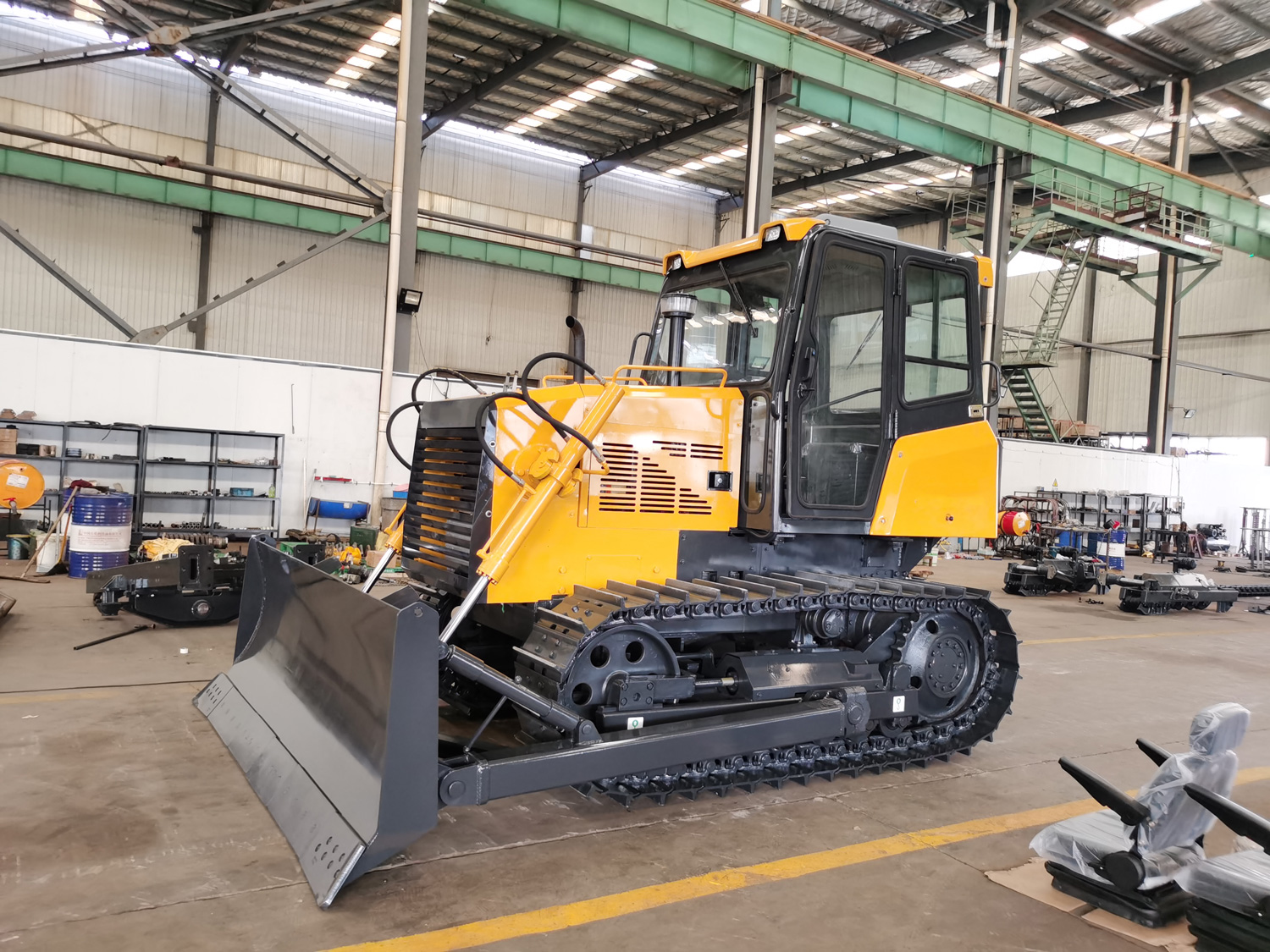
Taking the SD10 from this site's product information as an example, it is a 125HP-class small bulldozer with an operating weight of 10000kg, maximum drawbar pull of 95kN, 450mm wide track shoes, ground pressure of 54.4kPa, overall dimensions of 4400×2960×3030mm, blade width×height of 2960×960mm, maximum lift height of 830mm, maximum digging depth of 350mm, a 4F+2R mechanical transmission, forward speed of 2.6–10.4km/h and reverse speed of 3.7–6.7km/h.

| Leveling step | Corresponding parameters | Inferred operating conditions |
|---|---|---|
| Short-distance pushing | Maximum drawbar pull 95kN, operating weight 10000kg | Suitable for earthmoving on small and medium sites; specific push distance must be verified according to material and site |
| Rough leveling and spreading | Blade 2960×960mm, lift height 830mm | Blade width determines single-pass coverage; layer thickness must be controlled on site |
| Travel on soft ground | Track shoes 450mm, ground pressure 54.4kPa | Relatively low ground pressure is friendlier to general soft ground; extremely soft ground still requires separate assessment |
| Maneuvering in narrow sites | Dimensions 4400×2960×3030mm | Compact dimensions facilitate operation and transfer in confined spaces |
These data support its use as the main equipment for small municipal sites, farmland improvement and rough site leveling, but they cannot be used to infer that it can complete shaping in one pass on any soil type or any area, nor can they be used to infer leveling accuracy or operating efficiency.
When a single machine is sufficient and when supporting equipment is needed
The judgment can be divided into two directions:

- Small workload, short push distance and rough leveling as the target surface: one small bulldozer plus survey setting-out can usually cover the main work.
- Large cut-and-fill volume, long haul distance, and need for layered compaction or fine leveling: the bulldozer handles pushing and spreading, while earthmoving off site, compaction and fine leveling require other equipment or process coordination.
In addition, material conditions significantly change the result. Dry loose soil and sandy soil are relatively easy to push and spread; clayey soil and soil with high moisture content tend to stick to the blade and clump, requiring the operator to adjust layer thickness and working method. If there are underground pipelines, manhole covers or existing structures on site, the avoidance range must be clarified before blade work.
Blade and rear attachment choices affect the leveling method
Information shows that this model can be equipped with straight, curved or coal blades, and the rear can be fitted with fixed towing equipment or a three-shank ripper. For leveling tasks, the blade type mainly affects how material is controlled during pushing and spreading; the ripper is used to handle harder surface layers or material that needs loosening. The specific configuration must be determined according to site material and whether a loosening step is needed; it should not be assumed that all configurations are available at the same time.
Conditions to verify with the supplier before mobilization
- Site leveling area, cut-and-fill volume and maximum push distance;
- Main material type, moisture content and whether stone or construction waste is present;
- Target surface accuracy requirements and whether survey, compaction and fine leveling steps are included;
- Transport method and access roads, and whether overall dimensions and weight meet transport and site bearing conditions;
- Blade type, rear attachments and spare parts supply;
- Information required for operation and daily inspection; maintenance items are subject to the accompanying manual.
Once these conditions are clearly listed, it can be judged whether a small bulldozer will handle all leveling work or serve as the main force for pushing and rough leveling in coordination with other steps. When requesting a quotation, provide material type, leveling area, push distance, site and transport conditions, shift arrangements, and blade and attachment requirements so the supplier can propose a corresponding configuration.