






















The challenge of high-altitude, heavy-duty excavation often lies not in a single dig but in whether the machine can deliver stable output throughout a full day and across consecutive shifts. As altitude rises, air density drops and the intake conditions of a turbocharged engine change; at the same time, heavy-duty mining and large-scale earthmoving mean frequent full bucket loads and dense swing-and-dump cycles, placing higher repeated loads on hydraulic system pressure and structural components. Equipment continuity is therefore not a single metric but a set of conditions that must hold simultaneously.
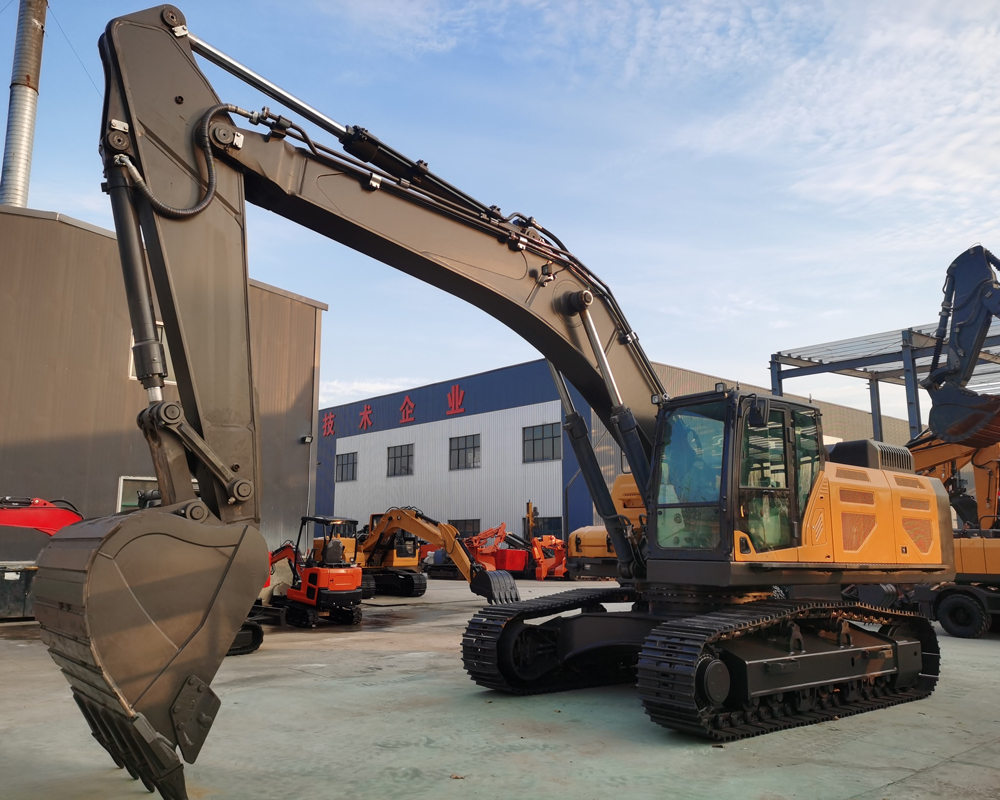
Using the verified specifications of a 38-ton crawler excavator featured on this site as a reference, this article explains under what conditions such equipment merits inclusion in a plan, which aspects the available data can support, and which must be confirmed item by item before purchase and mobilization.
Breaking "continuity" into verifiable conditions
Continuity can be broken down into four links: power, hydraulics, structure and maintenance. If any one link becomes a bottleneck, the machine's cycle rhythm is interrupted. Against the specifications of the 38-ton crawler excavator, the corresponding information for each link is as follows:
| Link | Corresponding information in the specifications | Implication for continuous operation |
|---|---|---|
| Power reserve | SL 9 turbocharged engine, rated power 219kW (294.2HP), rated speed 1900rpm | Turbocharging and power reserve are the starting point for discussion when high-altitude intake conditions change |
| Hydraulic output | System pressure 35MPa, dual-pump confluence | Determines boom and arm response and the smoothness of swing start and stop |
| Structural load capacity | Integrally welded boom, forged structures at key hinge points, heavy-duty bucket with wear-resistant steel and thickened side plates | Corresponds to structural integrity concerns under repeated heavy-duty operation |
| Service accessibility | Ground-accessible centralized filter group, large-capacity fuel tank, intelligent LCD monitoring | Affects between-shift inspection and downtime organization |
Power form: turbocharging is only the starting point
The machine is equipped with an SL 9 turbocharged engine rated at 219kW and 1900rpm. The specifications note that turbocharging technology helps maintain performance in complex environments such as high altitudes, and that an optimized thermal management system supports prolonged high-intensity operation.

It is important to distinguish: these are design statements in the product literature, not a verified power-retention rate at a specific altitude and temperature. Whether high-altitude adaptability holds still needs to be verified against project altitude, ambient temperature and the derating curve provided by the manufacturer. If the literature contains no performance data for the corresponding altitude, it should be listed as an item to be confirmed rather than assumed that the machine can operate continuously at full load at any altitude.
Hydraulics and cycle rhythm: what pressure figures mean for the job
The 35MPa high-pressure hydraulic system uses dual-pump confluence; the specifications state that boom and arm response is faster, swing start and stop are smoother, and torque reserve supports precise operation. For heavy-duty loading and deep foundation excavation, this means there is documented basis for discussing the smoothness of motion transitions in each dig-swing-dump cycle.
However, cycle rhythm also depends on material looseness, loading match equipment, working face layout and operator skill. Hydraulic parameters cannot be converted into hourly output on their own, and this article makes no such estimate. At purchase, the supplier can be asked to explain the hydraulic settings and commissioning approach for the target material and altitude conditions.

Structure and working range: two types of demand—heavy load and deep foundation
The working range listed in the specifications includes a maximum digging radius of 11178mm, maximum digging depth of 7372mm, maximum digging height of 10511mm and maximum dump height of 7572mm, with a bucket capacity of 1.7m³, maximum bucket digging force of 244kN, maximum arm digging force of 200kN and maximum gradeability of 35°. These figures support working-range judgments for two task types: deep foundation excavation and bulk material handling.
Structurally, the integrally welded boom is precision-bored and shot-peened, key arm hinge points use forged structures, the track frame is designed to reduce mud accumulation, and the heavy-duty bucket uses wear-resistant steel and thickened side plates. These descriptions point to structural integrity under abrasive materials and repeated heavy loads, but the literature does not give structural fatigue life or overhaul intervals, so maintenance-free duration should not be inferred from them at purchase.
Continuous operation depends on between-shift maintenance organization
The specifications state that the intelligent LCD display provides real-time engine speed, temperature and oil pressure data, the centralized filter group is accessible from ground level, and the large-capacity fuel tank reduces concerns about refueling frequency. For multi-shift continuous operation, such design features affect the accessibility of inspection and maintenance, not the maintenance interval itself.
Specific filter replacement intervals, oil requirements and inspection items must still be based on the accompanying manual and the manufacturer's maintenance handbook. This article does not provide maintenance intervals or disassembly/repair procedures; on site, pre-shift inspection, oil monitoring and filter replacement should be built into the work organization rather than handled only after a fault occurs.
Applicable limits and pre-mobilization checklist
Based on the specifications, the machine merits comparison under the following combination of conditions: large-scale earthmoving, heavy-duty mining, major infrastructure and deep foundation projects, where the project has clear requirements for single-machine working range and structural durability. Conversely, if the workload is scattered, relocations are frequent, or site bearing capacity and transport routes cannot accommodate a 38-ton machine, these constraints should be resolved first rather than comparing digging capability alone.
- High-altitude adaptability: whether the target altitude and ambient temperature match the manufacturer's derating data.
- Material conditions: abrasiveness, lump size and whether supporting breaking or ripping operations are needed.
- Transport and site: overall dimensions 11285×3190×3664mm; whether transport routes, turning radius and ground bearing capacity are adequate.
- Loading match: whether the matching transport vehicles and working face layout can keep pace with the 1.7m³ bucket cycle.
- Power and hydraulic commissioning: whether settings are checked against site altitude and material before delivery.
- Maintenance documentation: whether the manual, filter and oil lists, and monitoring system alarm descriptions are complete.
When requesting a quotation, it is advisable to provide material type and density, daily excavation and loading volume, site altitude and temperature range, transport routes and bearing conditions, shift arrangements, and requirements for work equipment and key configurations. Continuity is ultimately determined by these conditions together; no single parameter can replace on-site verification.