






















When the same mid-size crawler bulldozer is divided into standard, extended, super-wetland, coal, and other versions, the easiest thing for a buyer to do is look only at horsepower and pick the version that sounds most general. But the version split itself shows that the transmission, undercarriage, and blade can be shared across the same machine; what really separates the versions is the operating condition—what material is pushed, how much load the ground can bear, how far a single push goes, and whether the site has corrosion or dust. This article uses multi-version data for a 178 hp mid-size crawler bulldozer to break needs into verifiable machine conditions.
First, break the job objective into four types of questions
Bulldozer selection should not start from the first row of a specification table. Four questions should be answered first. They determine whether to look at power, undercarriage, or blade later.
- What is being pushed: general earthwork, clay or frozen soil, bulk materials such as coal, or sanitation materials such as refuse. Material density and abrasiveness differ, so blade form and undercarriage wear requirements differ.
- Can the ground bear it: dry hard ground, soft foundation after rain, and swampy wetland differ by an order of magnitude in ground pressure requirements. This is the core dividing line between the standard and super-wetland versions.
- How far is a single push, and is work continuous: short-distance stockpiling and medium-distance continuous grading place different emphasis on body length, speed, and operator comfort.
- What other site constraints exist: dust, corrosion, night work, and cab protection requirements are often addressed by attachments and optional configurations rather than by changing the whole machine.
These four questions have no standard answers, but they can break “I want a mid-size bulldozer” into several groups of verifiable conditions and prevent treating one version as a universal machine.
Basic capability corresponding to the 178 hp class
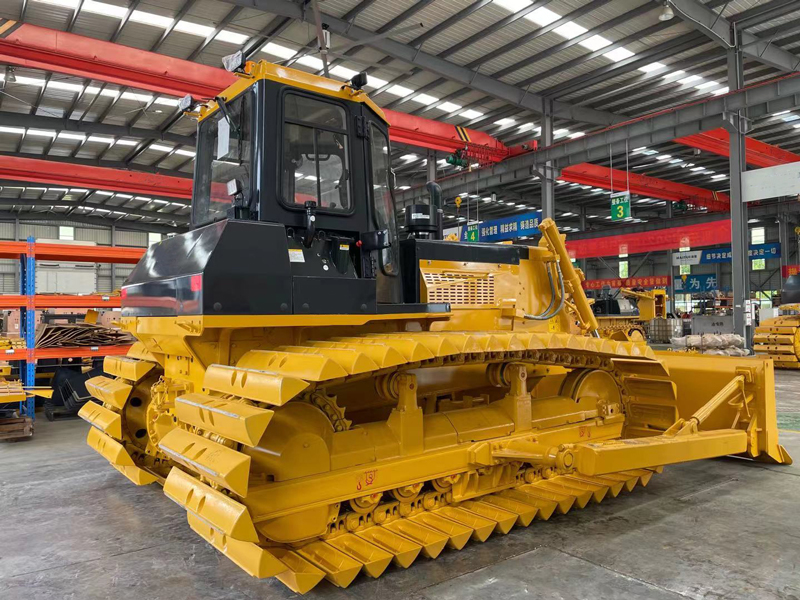
The series data shows that the standard version has an operating weight of 17,000 kg, a WP10 electronically controlled engine, rated power of 131 kW (178 hp)/1850 rpm, compliance with China National Stage IV emission standards for non-road machinery, and a fuel tank capacity of 315 L. The transmission and undercarriage systems are self-manufactured, and the main frame uses a full box-section structure. The standard version has a minimum turning radius of 4,466 mm, ground clearance of 400 mm, and ground pressure of 58 kPa.

These data indicate the basic positioning: 178 hp falls in the power range of a mid-size bulldozer, and with the full box-section main frame, the data positions it for earthmoving, excavation, and backfill projects in highways, railways, mines, and airports. It should be emphasized that “suitable for” here is a product positioning description, not a guarantee that a certain efficiency can be achieved under any soil type, any slope, and any push distance; actual capability still depends on material condition, ground bearing, and work organization.
Version differences first appear in undercarriage and ground contact conditions
Among multi-version data, the undercarriage is the first thing worth comparing because it directly corresponds to the question “can the ground bear it.”
| Version | Operating weight | Ground pressure | Track shoe width |
|---|---|---|---|
| Standard | 17,000 kg | 58 kPa | 510 mm |
| Coal | 17,500 kg | 55 kPa | 510 mm |
| Extended | 17,100 kg | Not listed in data | 510 mm |
| Super-wetland | 16,900 kg | 22 kPa | 960 mm |
The super-wetland version increases track shoe width to 960 mm and reduces ground pressure to 22 kPa. The data positions it for swamps, soft wetlands, wetland improvement, and river improvement projects, and it uses boat-shaped ribbed wide track shoes and an ultra-low ground pressure undercarriage. For projects on soft foundations in the rainy season or long-term work on wet soft ground, this item is worth checking before horsepower. Conversely, if the site is dry hard earthwork, whether the increased ground contact area from wide tracks is worthwhile must be judged together with steering flexibility and transport width—the super-wetland version has overall dimensions of 5,262 × 4,150 × 3,074 mm, so transport and access road widths must be confirmed in advance.
The extended version optimizes body structure and speed configuration on the basis of the standard model, with an operating weight of 17,100 kg, and the data positions it for medium-distance continuous earthmoving and grading on general engineering sites. It suits scenarios where “longer push distance and need for continuous work” is the main issue; however, its ground pressure is not listed in the data, so if it is to be used on soft foundation, confirmation with the supplier is needed before judgment.

Blade form follows the material
The standard version can be equipped with an angle blade, straight blade, or U-blade, corresponding to blade widths of 4,011/3,455/3,556 mm, blade heights of 1,040/1,149/1,120 mm, blade lift height of 1,005 mm, and blade depth of 540 mm; the straight blade is standard, and a three-shank ripper can be fitted, which the data describes as used for breaking clay and frozen soil. The coal version is equipped with a 4,150 mm wide and 960 mm high coal blade, with blade lift height of 1,095 mm, aimed at bulk material handling in power plant and port stockyards.
The key here is not which blade is “better” but the material and process: general earthmoving uses a straight or angle blade; when side discharge or slope trimming is needed, the suitability of the angle blade must be confirmed separately; when loose bulk material requires maximum volume per push, the wide and low coal blade better fits stockyard work; when clay or frozen soil needs loosening first, the ripper is a matching attachment, not a difference in the machine version itself. The super-wetland version uses a straight blade with a width of 4,150 mm and height of 1,245 mm, matched to the wide-track undercarriage.
Driving environment and maintenance conditions are soft check items before purchase
The data mentions that the series uses a hexagonal cab, with interior space and visibility as described highlights, and FOPS/ROPS can be configured as needed; it is equipped with electronically controlled hand and foot throttles, an intelligent display and control terminal, and heating and air conditioning. Here it is necessary to distinguish “electronically controlled throttle” from “pure electric power”: the former is a control method, the latter is a power form, and the machine cannot be inferred to be electric from the configuration name. The series power data clearly states a WP10 electronically controlled engine, which is a fuel model.
Regarding maintainability, the data lists that the wiring harness is protected by corrugated tubing with divider lines, the side covers can be opened wide, the fuel filter and air filter are arranged on the same side, and lubrication points such as the fan shaft and equalizer beam are exposed. These designs affect the convenience of daily inspection and lubrication, but specific maintenance intervals, filter replacement intervals, and inspection steps should still be based on the accompanying manual; this article does not give unverified interval figures. During purchase, “whether maintenance points are accessible and whether filters are centralized” can be used as on-site check items.
Applicable boundaries and matters still to be confirmed
Based on the data, conditional judgment directions can be given rather than direct conclusions:
- For dry hard sites mainly involving general earthmoving and grading, the standard or extended version is the priority direction for checking; when push distance is longer, then check the extended version’s speed configuration.
- For wet soft ground, poor bearing after rain, or long-term work in swampy wetland, the super-wetland version’s 22 kPa ground pressure and 960 mm track shoes are the core basis, and transport width and steering space must also be checked.
- For bulk stockyards such as power plants and ports, the coal version’s coal blade and wide track configuration better fit the material form; however, material stack height, site slope, and dust conditions still need on-site confirmation.
- For breaking clay and frozen soil, the ripper is a matching attachment, and its matching with the host version and the actual suitability of the data item of 570 mm lift height need to be confirmed.
Parts not covered by the data should be listed as to be confirmed: actual push efficiency of each version under specific soil types, fuel consumption level, slope working capability, undercarriage wear under long-term wetland operation, and complete parameters of other versions such as the sanitation version. These should not be extrapolated from horsepower or ground pressure alone.
Information recommended to prepare before inquiry
When inquiring about this mid-size crawler bulldozer, stating the conditions clearly is more useful than reporting only a horsepower: material type and density (earthwork, bulk material, clay or frozen soil, or sanitation material), ground bearing and whether wetland operation is needed, single push distance and shift arrangement, site slope and transport road width, whether a ripper or special blade is needed, and cab protection and night lighting requirements. Only then can the supplier determine whether the standard, extended, super-wetland, or coal version should be used and explain which configurations are optional. The final configuration and parameters are subject to the technical documents confirmed by both parties and the accompanying manual.