






















When you pick up a specification page for a super-large mining excavator, the first lines you notice are usually rated power and bucket capacity, followed by several dimensions in millimeters. What really affects judgment is whether these two groups of numbers match: power determines how hard a material can be cut per unit time, while working range determines where the machine can stand and still reach the working face. Read separately, it is easy to conclude "enough power, large range"; read together, you can spot the questions the document does not answer.
Set the reading objective first: can the cycle be completed from a given position?
Specification pages for super-heavy mining excavators typically provide three groups of numbers: engine power and displacement, bucket capacity range and digging forces, and maximum dimensions in each direction. These three groups answer three different questions—whether power can sustain continuous heavy-duty cycles, whether the loading configuration matches haul trucks, and whether the stance and working face are feasible. Only the third question is directly tied to the site; the first two cannot be concluded in isolation without specific material and truck-matching conditions.
Therefore, the reading order should not follow the page from top to bottom but should be determined by operating conditions: first see where the machine can stand, then whether digging and dumping can be completed from that position, and finally return to whether power is sufficient to maintain cycle rhythm. The following breaks this down in that order.

Working range fields must be read together: radius, depth, and dump height are not independent
Taking the SH1250LC data referenced in this article as an example: maximum digging radius 13875 mm, maximum digging depth 8165 mm, maximum digging height 12480 mm, and maximum dump height 8065 mm. These four figures come from the same set of working equipment positions; change any one operating condition, and the other three usually no longer hold simultaneously. Looking only at maximum digging radius tells you the farthest reach but not whether a full bucket can still be achieved at that distance.
Tail swing radius 5100 mm should be read together with overall width 5385 mm and overall length 14845 mm to judge clearance between the machine position and haul roads or bench edges. In deep-pit operations, the pair of digging depth and dump height actually determines whether "dig to what depth and lift to what height to dump into the truck body" is convenient; if maximum dump height is higher than common haul truck body height, the document itself does not indicate margin—the actual working-face elevation difference arrangement must also be considered.

Power and digging force: the input side of the heavy-duty cycle
The SH1250LC data gives rated power 680 kW (1800 rpm), engine displacement 26.1 L, bucket digging force 610 kN, stick digging force 532 kN, traction force 745 kN, gradeability 70% (35°), and travel speeds 2.4 and 3.5 km/h. This group of numbers indicates force reserve when cutting into hard material and traction conditions on the travel side; it cannot be directly converted into production rate, nor can it replace an assessment specific to rock type, loosening factor, and blast fragmentation.
Putting 610 kN together with a 7.5–10 m³ bucket capacity range is a reminder: bucket capacity itself is a range, and different bucket types correspond to different materials and truck matching. The document does not give the specific bucket type, material bulk density, and fill factor for each capacity, so "how many tons this bucket can hold" must be calculated separately based on bank volume and loosening factor—it cannot be read directly from the specification page.
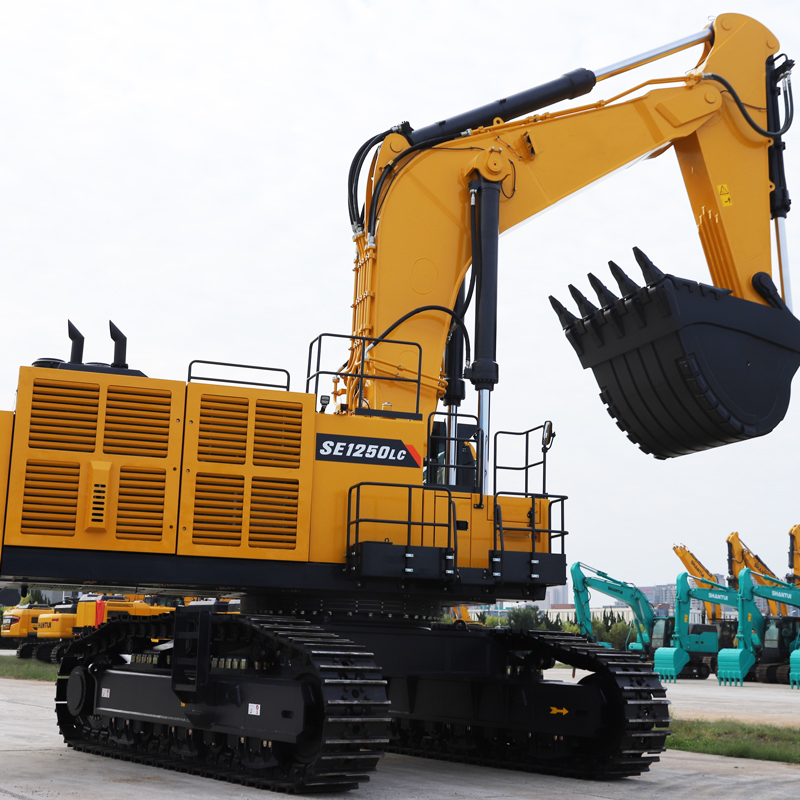
A reading order based on field relationships
| Reading step | Fields to read first | What they are used to judge |
|---|---|---|
| Step 1 | Maximum digging radius, maximum digging depth, overall width, tail swing radius | Whether the machine position is feasible and whether there is clearance at deep pits and bench edges |
| Step 2 | Maximum dump height, maximum digging height, bucket capacity range | Whether the vertical digging and dumping flow is smooth and how it matches haul trucks |
| Step 3 | Rated power, displacement, bucket and stick digging forces, traction force | Input-side capability for heavy-duty cycles, plus travel and gradeability conditions |
| Step 4 | Operating weight, track shoe width, ground pressure | Ground bearing and transport dimensions, checked back against site conditions |
What the document cannot provide must be confirmed separately before purchase
- Ground strata and fragmentation: 610 kN and 680 kW only indicate force and power values; actual penetration performance in hard rock, frozen soil, or strongly weathered layers must be judged based on on-site materials. The document does not provide test data for corresponding conditions.
- Transport and relocation: Overall length 14845 mm, overall width 5385 mm, and overall height 4475 mm; disassembly method for transport, oversize permits, and route clearances must be verified separately and are not covered in the document.
- Ground bearing: Ground pressure 147 kPa corresponds to a certain track configuration; whether soft ground or backfilled areas can support travel must be combined with on-site measurements—do not extrapolate this value directly to other ground.
- Truck matching: The bucket capacity range and the body volume and number of haul trucks must be calculated based on actual cycle organization; the document does not provide matching recommendations.
- Maintenance and protection: The document does not provide maintenance intervals, wear-part life, or special protection configurations; request the manual or configuration list separately for comparison.
Who should read this document and what can be concluded after reading
If the project involves large open-pit mine stripping, deep-pit bulk excavation, or large-scale foundation excavation, and the site can accommodate a super-heavy machine position and supporting haulage, this specification page is sufficient for preliminary screening: after cross-checking working range and power fields, you can judge whether the machine is worth advancing to the next technical discussion. Conversely, if the working face is narrow, the ground is soft, or haul roads are constrained, power and bucket capacity figures alone do not indicate suitability; site and transport conditions should be resolved first before discussing configuration.
When requesting a quotation, it is recommended to provide: material type and fragmentation, daily production and shift arrangements, working face and bench dimensions, haul truck specifications and number of units, site bearing capacity and access routes, and power and hydraulic configuration preferences. Bulldozers are judged by blade and tracks; for excavators, working equipment, ground conditions, and transport conditions must be placed in the same requirement document so that the numbers on the specification page have a basis for comparison. Product page reference: SH1250LC super-heavy mining excavator.