






















In roadbed compaction construction plans, the number of passes is often treated as a directly quotable figure: for the same soil type and the same machine, the previous project used a certain number of passes, so the next project copies it. However, when applied to sections with different lift thicknesses, different soil moisture contents, and different steel wheel widths and vibration parameters, the same number of passes may not achieve the required density and may cause over-compaction or under-compaction. The problem is not the number of passes itself, but that it must be determined together with layer conditions and steel wheel conditions.
The following explains, in the order of "define layers first, then match the steel wheel, and finally determine passes," which conditions must be clarified first in roadbed compaction tasks, and what the published parameters of a single-drum vibratory roller can help us judge.
Layer conditions determine the starting point of rolling organization
For the same roller, the transmission depth of vibration energy in the soil layer differs when compacting thin layers versus thick layers. The thicker the lift, the more limited the depth affected by a single pass, requiring more passes to accumulate or a reduction in layer thickness. Therefore, before determining the number of passes, several basic conditions must be clarified:
- Single-layer paving thickness and total fill height, and whether the layering plan has been determined according to soil type;
- Soil category (e.g., ordinary fill, gravel, improved soil) and its optimum moisture content range;
- Actual moisture content and weather conditions during compaction, and whether watering or drying is needed after rain or in dry conditions;
- Compaction quality requirements, such as the design-required degree of compaction or porosity index.
When these conditions are unclear, any number of passes is only a reference value. A reasonable approach is to build a test section before formal construction, trial-compact with the selected equipment and selected lift thickness, and sample and test at different pass counts to find the minimum pass combination that meets the index. The test section can also expose moisture deviation and excessive layer thickness problems.

Steel wheel conditions determine how much each pass covers
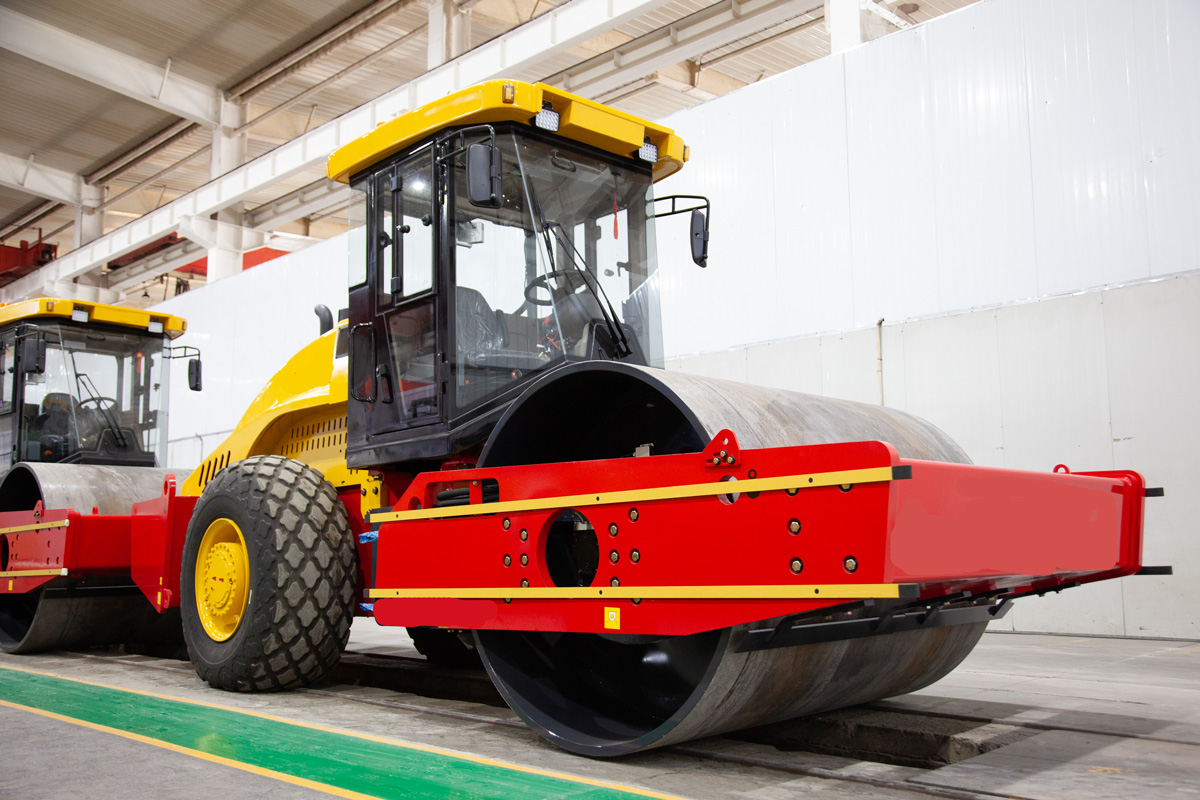
The number of passes depends not only on the soil layer but also on parameters such as steel wheel width, vibration frequency, amplitude, centrifugal force, and static linear load. Taking the verified data of a single-drum vibratory roller on this site as an example: operating weight is 17.5 tons (17500 kg), engine power 184 HP, steel wheel width 2110 mm, steel wheel diameter 1540 mm, static linear load 488 N/cm, dual-frequency vibration, vibration frequency 28/33 Hz, amplitude 1.9/0.9 mm, centrifugal force 350/245 kN, gradeability 45%, turning radius 6500 mm, and travel speed 0–9 km/h.
These data help with several things:
- Estimating overlap width and travel route: The 2110 mm steel wheel width determines the single-pass compaction width. In actual organization, overlap between adjacent compaction strips must be considered, and the number of routes directly affects how the total number of passes is executed.
- Distinguishing the use occasions for high and low amplitude: The two amplitude settings of 1.9 mm and 0.9 mm and the two frequency settings of 28 Hz and 33 Hz correspond to different lift thicknesses and soil conditions. Thick fill layers usually rely more on high amplitude, while thin layers or surface layers close to the design elevation must consider the impact of vibration on already compacted structures. Which setting to use for a specific layer still needs to be based on test section results.
- Judging site traffic and transfer conditions: The 45% gradeability and 6500 mm turning radius relate to whether the roller can complete compaction routes near roadbed slopes and within narrow work areas, not just affecting entry transport.
It should be noted that static linear load, amplitude, and centrifugal force are equipment-side conditions and do not directly equal compaction effect. Actual compaction depth and number of passes also depend on soil, moisture content, and rolling speed, and must be confirmed through on-site testing.
Dual frequency and dual amplitude do not mean parameters are automatically selected well
The significance of the dual-frequency and dual-amplitude configuration is to leave adjustment room for construction organization, not to say the equipment will automatically adapt to all soil layers. In actual use, it must be clear: which layer the current lift belongs to, whether the goal is compaction or surface finishing, and whether the underlying layer is already stable. Using the high-amplitude setting on a thin layer may cause surface over-compaction or disturbance; using the weak vibration setting on a thick layer may fail to compact to the design depth.

Therefore, the role of equipment parameters is to help us judge whether this machine's adjustment range covers the needs of each layer in the project, not to replace the construction plan. Before purchase, list the layer thickness, soil type, and compaction standards together, then confirm one by one against the amplitude and frequency settings.
Rolling speed and number of passes are calculated together
The travel speed range of 0–9 km/h gives the boundary of operating speed. In compaction operations, too high a speed reduces the number of vibrations per unit area, equivalent to reducing effective compaction work; too low a speed affects crew progress. The number of passes, speed, overlap, and rolling route need to be arranged as a whole; a number of passes cannot be agreed upon alone while ignoring actual travel speed.
In operation organization, the connection between the roller and paving, watering, and testing processes must also be considered. If paving speed and rolling speed do not match, waiting or missed compaction is likely, and the actually executed number of passes may be lower than the planned value.
Several conditions to verify before entering the site
If organizing roadbed compaction with this 17.5-ton single-drum vibratory roller, it is recommended to verify the following before purchase or site entry:
- Whether the roadbed width and work face length of the work section match the 2110 mm steel wheel width and 6500 mm turning radius;
- Whether the paving thickness and soil type of each layer fall within the dual-frequency and dual-amplitude adjustment range, requiring test section verification;
- Site slope and temporary road conditions, confirming gradeability and transfer routes;
- Shift arrangements and rolling speed, used to estimate actual coverage capacity and pass execution;
- On-site testing methods and sampling frequency, used to determine the minimum number of passes;
- Inspection requirements for maintenance items such as the engine and hydraulic system, subject to the accompanying manual; this article does not provide specific maintenance intervals.
If the project involves special soil, soft foundations, or vibration-sensitive areas near structures, a separate assessment is required; whether to use vibratory compaction cannot be decided solely on general parameters.
Conditions to provide when requesting a quotation
The essence of roadbed compaction equipment selection is to match equipment configuration to layer conditions, soil conditions, site conditions, and quality requirements. When contacting a supplier, it is recommended to provide: layer thickness and total fill height, soil category and moisture control method, compaction degree requirements, work face dimensions and slope, daily work volume and shift arrangements, whether transfer transport is needed, and configuration requirements for steel wheel width and vibration settings. The more specific the conditions, the easier it is to judge whether the existing configuration is sufficient, rather than ordering based only on tonnage or engine power.
The product information for this single-drum vibratory roller on this site can be viewed through the neutral product page: 17.5-ton single-drum vibratory roller. The parameters on the page should be verified against the actual delivery configuration; the data listed in this article are based on that product information.