






















Landfill compaction and roadbed compaction are often discussed together because both involve "compacting loose material." However, when it comes to equipment selection, the objects, sites, and risks they face are completely different. Directly applying roadbed compaction experience to landfills can easily lead to misjudgments regarding compaction wheel structure, trafficability, and protective configurations.
This article uses a comparative approach to break down the differences between the two types of operations and then establishes the basis for selecting a landfill compactor. The specific parameters mentioned only correspond to verified C260H data on this site; other conditions need to be confirmed on-site.
First, the compaction object: municipal solid waste and roadbed fill are not the same material
Ordinary roadbed compaction deals with engineering fill such as soil, gravel, and stabilized soil, where lift thickness and moisture content are typically controlled by construction specifications, and the goal is to achieve specified density. Landfill compaction faces municipal solid waste, which has complex composition and irregular shapes, and the compaction process also involves crushing and volume reduction requirements.
This means landfill compaction equipment must not only "compact" but also crush and spread the waste during travel and rolling. Ordinary smooth-drum rollers primarily use static or vibratory compaction and have limited crushing and traction capability on loose waste. The difference in compaction wheel structure originates here.

Second, site conditions: landfill ground bearing and trafficability requirements are more specific
Roadbed compaction sites are usually layered structures that have been treated, allowing rollers to travel back and forth on relatively flat working surfaces. The landfill working surface is a waste pile with soft ground and common uneven settlement, so equipment ground clearance and chassis protection directly affect whether normal travel is possible.
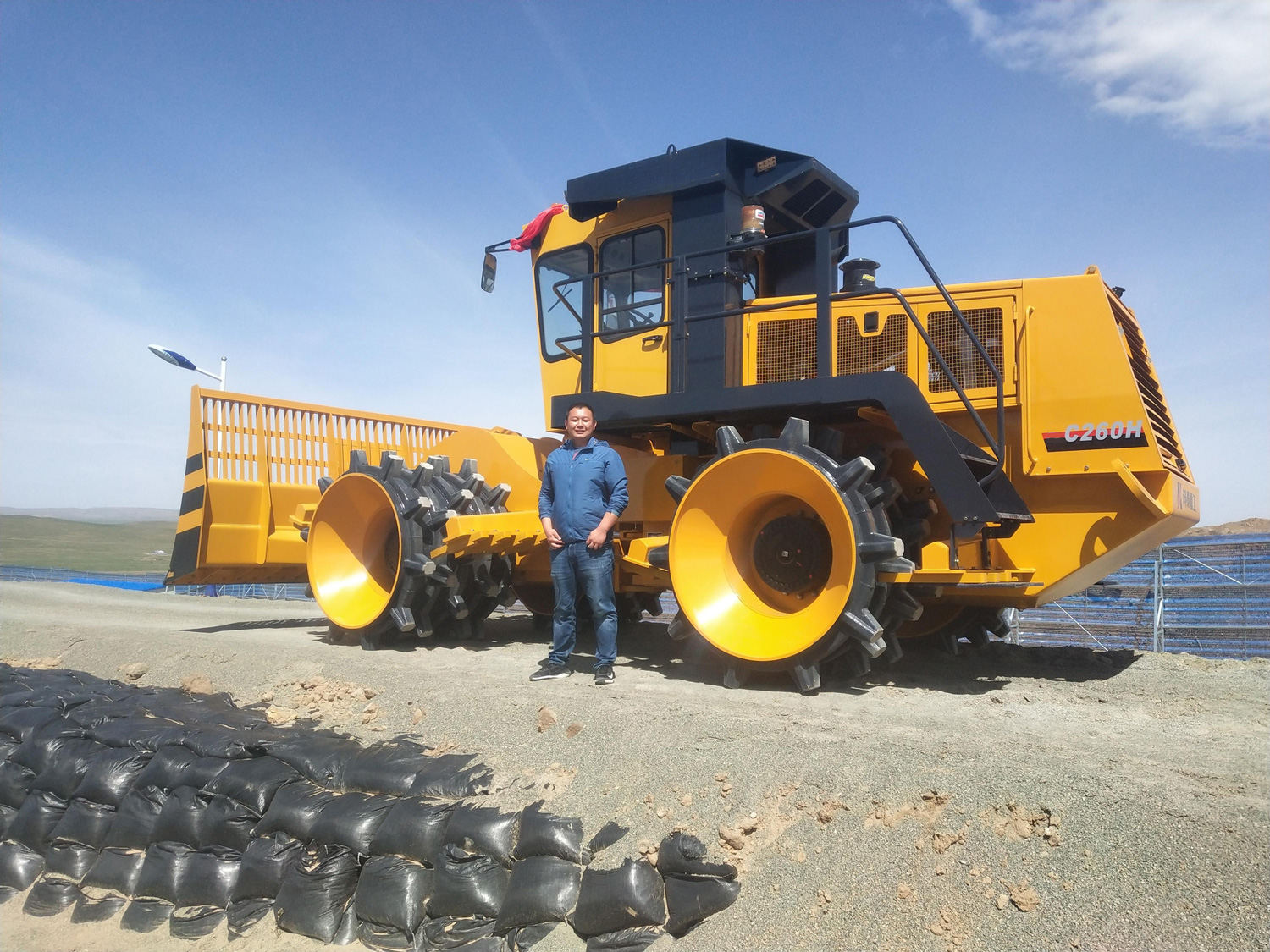
The C260H data lists a ground clearance of 490mm and a blade height of 1880mm. These two fields correspond to the clearance space between the equipment bottom and the waste surface during landfill operations, and the front blade's ability to manage loose waste. Ordinary roadbed roller data typically does not emphasize these two items because the working objects are different.
Equipment structure differences: compaction wheels, blades, and protective configurations each serve specific roles
Landfill compactors generally have dedicated compaction wheels that crush and compact waste through wheel teeth. The C260H has a crushing width of 3430mm and a compaction capacity rated at 0.35–1.0+t/m³. Looking at these two parameters together, the former corresponds to the width covered in a single pass, and the latter corresponds to the compaction capacity range given in the data. The actual achievable level also depends on lift thickness, waste composition, number of passes, and operational organization.
Equipment evaluation for ordinary roadbed compaction focuses more on steel drum or tire configuration, vibration parameters, and matching lift thickness. The two differ significantly in "what structure is used to compact" and cannot be compared horizontally based on tonnage or power alone.

| Comparison Item | Landfill Compaction | Ordinary Roadbed Compaction |
|---|---|---|
| Primary Material | Municipal solid waste, complex composition | Engineering fill such as soil, gravel, stabilized soil |
| Core Operational Objective | Compaction, crushing, volume reduction | Achieve specified density |
| Site Characteristics | Waste pile, soft, uneven | Layered filling working surface |
| Key Structures | Dedicated compaction wheels, blade, ground clearance | Steel drum or tires, vibration configuration |
Which landfill requirements does the C260H data address?
The C260H has an operating weight of 26,000 kg, engine power of 192 kW (262 HP), and emission standard Tier 3. The data positions it as a 26-ton heavy-duty landfill compactor, suitable for scenarios including municipal solid waste landfills, waste crushing, waste volume reduction, and large solid waste treatment projects.
Mapping parameters to operational needs:
- Crushing width of 3430mm corresponds to the coverage width per pass, affecting work zone layout and back-and-forth pass arrangements;
- Compaction capacity of 0.35–1.0+t/m³ is the range given in the data; actual compaction results need to be confirmed based on lift thickness and number of passes;
- Ground clearance of 490mm and blade height of 1880mm correspond to trafficability on the waste surface and front-end management capability;
- 192 kW power corresponds to travel and compaction wheel drive requirements under heavy-load conditions, but fuel consumption and operational efficiency are not supported by data and cannot be directly promised.
It should be noted that compaction capacity is not a fixed value. Waste composition, lift thickness, moisture content, and number of passes all affect the final result. The range in the data should be understood as a reference interval under specific conditions, not a guaranteed value achievable on any site.
Selection boundaries and items to confirm
A landfill compactor is not a substitute for an ordinary roller, nor must all landfills be configured to the same specifications. The following conditions need to be confirmed item by item before purchase:
- Daily waste intake and work shifts, determining equipment quantity and continuous operation arrangements;
- On-site organization of lift thickness and number of compaction passes;
- Bearing conditions, slope, and rainy-season trafficability of the landfill working surface;
- Site requirements for equipment protection, cab configuration, and emission standards;
- Transport corridor and access road restrictions on equipment dimensions; C260H dimensions are 8100×3800×3670mm;
- Whether the specific configuration of compaction wheels and blade matches on-site materials, to be verified with the supplier.
If the working object is mainly construction spoil or inert landfill material with weak crushing demand, the selection logic will differ from municipal solid waste landfills. Such cases should be checked separately and cannot directly apply the comparative conclusions of this article.
Information to prepare before requesting a quote
When contacting the supplier, clearly organize the landfill's daily processing volume, main waste composition, lift thickness, working surface bearing capacity and slope, shift arrangements, emission requirements, and transport conditions, then verify compaction wheel configuration, protective configuration, and delivery scope. A parameter table can only answer "what the equipment has"; site conditions determine "whether this configuration is suitable."
For more landfill compactor information, please visit the landfill compactor page.