






















When earthmoving equipment is mobilized, the most common problems are often not whether horsepower is sufficient, but a mismatch between blade type and material, or track shoe width and site bearing capacity not being calculated clearly, or transport dimensions only being found to exceed limits on site. Lining up the check items in working order can expose a lot of rework and waiting in advance.
The following uses public data for a mid-size crawler dozer as an example to explain how to use this checking sequence. The parameters in this article come only from that model's data; different configuration versions do not mean that every machine has all of them.
Step 1: Define the material and pushing task first, then match the blade
Pushing distance, material looseness, and stockpiling method determine whether the blade should be a straight blade, angle blade, or U-blade. If the material is low-density bulk material such as loose coal or slag, a blade with small capacity will limit the amount pushed per pass; if it is crushed stone and weathered rock, the wear resistance and impact resistance of the cutting edge and push arms deserve more attention.
The model data gives standard-version blade width options of 3725, 4635, 3800, and 3725 mm, corresponding to straight, angle, U, and semi-U blades; blade heights of 1315, 1055, 1343, and 1374 mm; blade lift height of 1210 mm and blade depth of 540 mm. There is also a coal version with a 4200 mm wide coal blade, blade height of 1350 mm, operating weight of 24000 kg, and ground pressure of 57.5 kPa, lower than the standard version's 23450 kg and 66 kPa. This difference is consistent with the direction of wide, low-specific-pressure coal pushing.

When checking, blade width and working face width can be considered together: for narrow stockpiles, an angle blade can push at an angle without pushing the full width; for large-area spreading, a wider straight or U-blade is needed to reduce back-and-forth travel. These are condition analyses; actual selection still depends on the material and site organization.
Step 2: Undercarriage and ground contact conditions
Site bearing capacity and passability mainly depend on ground pressure and track configuration. The standard version of this model offers track shoe widths of 560, 610, and 660 mm, ground contact length of 2730 mm, ground pressure of 66 kPa, and ground clearance of 405 mm. Wider track shoes are usually used to reduce ground pressure, but the data does not give the specific pressure value for each width, so the actual configuration must be confirmed with the supplier.
If the site is soft ground, wet ground after rain, or backfill, standard track shoes may not be enough. This series also has wetland configurations, but the data tied to this model in this article does not list the wetland version's ground pressure and track shoe parameters, so it cannot be claimed on that basis that it is suitable for soft wet sites. Such requirements should be raised first, and then the corresponding version should be checked.

Step 3: Transport and relocation: dimensions and weight must be measured in advance
The overall dimensions are 5495×3725×3402 mm. This width is usually distinguished by whether the main machine is without the blade or by blade position; actual transport dimensions need to be confirmed according to the transport state. The operating weight is 23450 kg, and road transport requires checking flatbed load capacity, height and width limits, and bridge and culvert conditions along the route.
For projects with frequent relocation, it is also necessary to confirm whether track shoe width affects the loading platform and ramps. These are organizational conditions before entry and cannot be replaced by the equipment itself.
Step 4: Shift power and maintenance check items
This model is equipped with a WP12/QSNT-C235 electronically controlled engine, rated power 175 kW/1800 rpm (235 HP), compliant with China III off-road emission standards, with a fuel tank capacity of 450 L and hydraulic tank capacity of 110 L. An electronically controlled engine is fuel-powered and is not the same as a pure electric solution; if the project has additional requirements for emissions or energy form, the power form should be discussed separately rather than inferred from the model.
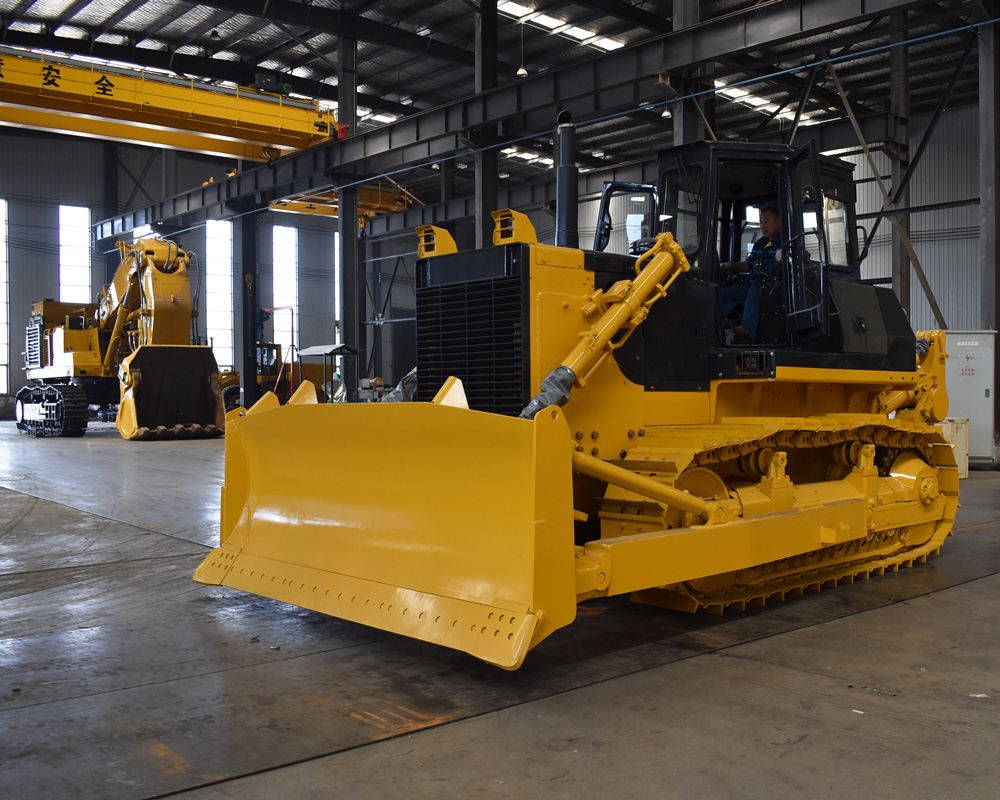
For maintenance, the data mentions a large open side guard, externally located lubrication and maintenance points, and corrugated tube protection for wiring harnesses; these designs facilitate daily inspection and servicing. However, specific maintenance intervals and disassembly inspection steps still need to follow the accompanying manual; this article does not provide disassembly, repair, or safe operation steps. Before entry, the following can be confirmed: spare parts channels for engine oil and filters, hydraulic oil grade, site conditions for track tension checks, and operator training arrangements.
Pre-entry checklist
- Whether material type, loose density, single-pass pushing distance, and working face width are clear;
- Whether blade type and width match the actual stockpiling method;
- Whether site bearing conditions have been checked, whether track shoe width is sufficient, and whether wetland working conditions require a separate version request;
- Whether overall transport dimensions, weight, and flatbed conditions have been confirmed;
- Whether fuel supply points, shift arrangements, and emission requirements are clear;
- Whether maintenance point locations, spare parts channels, and operator training are arranged;
- Whether attachments such as rippers, winches, and protective structures are needed, and who confirms their compatibility with the main machine.
Conditions to provide when requesting a quote
When requesting a quote from a supplier, it is recommended to also provide material type and density, average daily pushing volume or working face length, site bearing and slope conditions, whether a wetland or rock working condition version is needed, transport method and relocation frequency, shift and fuel supply arrangements, and specific configuration requirements for the blade and tracks. Only then can the supplier determine which configuration version corresponds to the actual work, rather than quoting only by horsepower.
The parameters listed in this article all come from that model's data and are suitable for solution analysis. Whether a specific configuration can meet the needs of a particular site still requires on-site survey and supplier confirmation.