






















Municipal earthwork projects often face a contradiction: the workload may look substantial, but the site may not provide the space large equipment requires. Pipeline trenches sit close to existing roads, room to maneuver inside fencing is limited, and earthwork must be coordinated with transport vehicles and support operations. If equipment is specified on the principle that "bigger is better for loading," the machine may first be constrained by swing radius and transport height after mobilization. This article addresses exactly this type of urban municipal earthwork scenario: should equipment specifications be set according to the largest number in the project, and under what conditions is a mid-size crawler excavator more worth considering?
First Clarify the Objectives and Site Constraints of Municipal Earthwork
The goal of municipal earthwork excavation is usually not a single large-scale stripping operation, but rather excavating, stockpiling, and loading out soil from trenches, foundation pits, or road cuts according to plan, without damaging surrounding roads and utilities. This creates several types of constraints:
- Lateral work space is limited, and swing and dumping directions often have only one or two options;
- Excavation depth and dumping height must match the actual height of transport vehicle beds;
- Equipment must relocate between multiple work points, so overall machine dimensions and transport conditions must be considered together;
- When tasks overlap, loading rhythm must coordinate with support and backfill operations, rather than simply pursuing maximum single-bucket capacity.
These constraints mean that selection cannot rely only on tonnage or bucket capacity; working range, power reserve, and structural durability must be placed on the same checklist.
Why "Specifying to Maximum Size" Often Goes Astray in Municipal Scenarios
Maximum-size equipment has clear advantages in open stockyards and mine stripping, but inside urban fencing, machine dimensions, tail swing radius, and transport weight all become additional costs. There are three common deviations:

- Looking only at bucket capacity and engine power while ignoring whether maximum digging reach and minimum swing radius fit the work area;
- Specifying equipment based on total earthwork volume while ignoring that loading cycles per unit time are limited by vehicle dispatch and site constraints;
- Treating long-term benefits such as high-altitude adaptability and wear-resistant structures as inevitable advantages for short-term construction without checking site conditions.
This does not mean large equipment cannot be used on municipal projects, but rather that specifications should correspond to actual working conditions: when excavation depth, swing space, and transport height are within medium ranges, a mid-size crawler excavator is easier to organize for multi-point and overlapping operations.
The Mid-Size Crawler Excavator's Approach
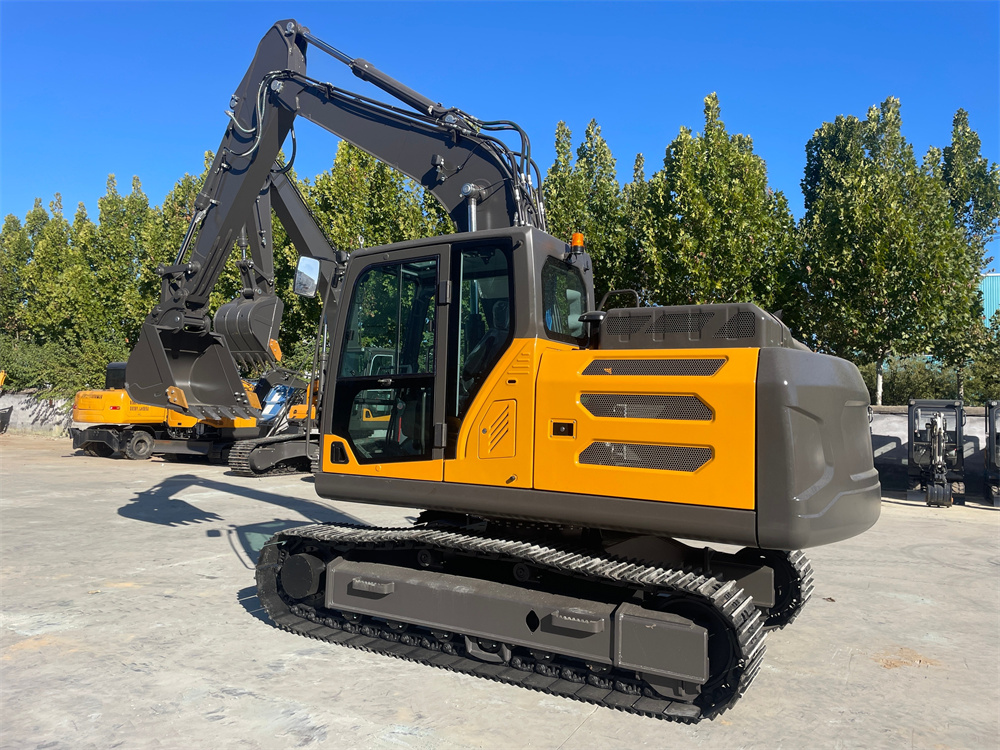
Take the 15-ton class crawler excavator SH150 listed on this site as an example. Its documentation reflects the configuration logic of a mid-size machine: power, hydraulics, and working range are organized around conventional earthwork and municipal engineering, rather than leaning toward extra-large loading capacity. The following matches each requirement item by item.
Match Working Range to Trenches and Loading Height First
The most direct checks for municipal excavation are maximum digging depth and maximum dumping height. The machine's documentation lists a maximum digging depth of 5343 mm, maximum vertical digging depth of 4790 mm, maximum dumping height of 6025 mm, maximum digging radius of 8198 mm, and minimum swing radius of 2770 mm. For pipe trenches, road cuts, and general foundation pits, these ranges must be compared item by item with design depth and transport vehicle bed height; the minimum swing radius relates to whether tail sweep inside fencing is restricted. Whether a specific project is satisfied must still be based on on-site measurements and design drawings.
Power and Hydraulic Configuration Serve the Loading Cycle
The machine has a rated power of 110 kW (148 HP), bucket capacity of 0.6 m³, maximum bucket digging force of 91 kN, maximum arm digging force of 55 kN, and system pressure of 32 MPa. The documentation mentions dual-pump confluence technology used to increase flow to each cylinder and shorten cycle time, and built-in cushioning structures in the main cylinders to reduce impact. For the "dig—swing—dump—return" cycle in municipal earthwork, the significance of these configurations is smoother action coordination at medium bucket capacity, rather than pursuing maximum single-bucket cutting volume. Loading efficiency also depends on vehicle positioning, soil type, and operator coordination; the documentation itself does not provide productivity conclusions.

Structural Design Supports Multiple Tasks and Relocation
Municipal projects often use one machine for excavation, stockpiling, and local grading. The documentation mentions that the flat-bottom bucket design helps finish surfaces evenly, the bucket cutting edge uses wear-resistant steel with reinforced teeth and side cutters; the track frame cross-section has been redesigned to reduce mud accumulation, and joint points use forged structures. These are configurations oriented toward structural durability and maintenance convenience, suitable for scenarios with varied tasks and high equipment utilization, but actual service life still depends on material abrasiveness and maintenance conditions.
Operation and Maintenance Conditions Affect Shift Organization
The cab has enlarged front, side, and rear windows to reduce blind spots, and is equipped with an LCD display and air conditioning; the oil filter, pilot filter, fuel filter, and water separator are located at ground level for easy daily inspection. The GPS satellite system supports remote diagnostics, fault alarms, and maintenance reminders. For municipal construction, these configurations relate to multi-shift operations and in-city equipment management, but whether remote functions can be used and how maintenance reminders are set must be confirmed with the supplier; specific maintenance intervals cannot be inferred from this.
Items Not Covered in the Documentation That Must Be Confirmed Before Purchase
The above parameters come from product documentation and can indicate the machine's basic specification boundaries, but they are not sufficient to judge whether it suits all municipal working conditions. Before purchase or mobilization, at least the following should be checked:
- Whether actual excavation depth and trench width match maximum digging depth and swing radius;
- The relationship between transport vehicle bed height and maximum dumping height;
- Digging force and tooth configuration for site ground conditions (backfill, gravel, clay, or local hard layers);
- Whether overall transport dimensions of 7737×2500×2847 mm and operating weight of 15000 kg meet urban road transport and on-site height restrictions;
- Whether the maximum gradeability of 30° covers entry ramps; actual ramp traction conditions must be assessed separately;
- For high-altitude or special-environment operation, the adaptability of the turbocharger and cooling system must be verified against specific altitude.
These conditions cannot be directly confirmed from a parameter table; when information is missing, it should be raised with the supplier rather than inferred from tonnage size.
Inquiry and Selection Checklist
If a municipal earthwork project is comparing mid-size crawler excavators, it is advisable to organize the questions into checkable items before communicating with the supplier:
- Work objectives: excavation volume, trench or foundation pit dimensions, planned schedule, and shift arrangements;
- Site conditions: available swing space inside fencing, entry/exit ramps, surrounding utilities, and road load capacity;
- Loading coordination: transport vehicle model and bed height, vehicle positioning method, and whether side dumping is needed;
- Material conditions: soil type, whether stone or hard layers are present, and whether breaking or loosening operations are involved;
- Transport and relocation: overall machine dimensions and weight versus transport vehicle compatibility;
- Configuration check: whether the working equipment (bucket, arm), track shoe type, cab, and remote management functions are the actual configuration of the model in this article.
For this product, you can view the 15-ton class crawler excavator product documentation page and confirm each item against the above conditions. Final equipment selection should be based on site conditions, the supplier's written parameters, and the contract configuration list; this article is for solution analysis only and does not represent that any customer has adopted the equipment or achieved construction results.