






















Dozers of similar mid-size rating and horsepower may push normally on general earthwork projects but get stuck, slip or even fail to reach the work face on soft wet ground or waste piles. The problem is usually not power but ground bearing capacity, material form and work organization. Using multi-version documentation for a 260-hp mid-size dozer as a thread, this article explains the order of judgment for defining a version by application.
First distinguish the four conditions that determine the version
Version differences are not plus-or-minus items on a spec sheet but responses to site conditions. Before purchasing, at least the following four types of conditions should be clarified:
- Ground conditions: undisturbed soil, backfill, soft foundation, sand or forest humus layer, directly related to ground pressure and track shoe width.
- Material form: ordinary earthwork, frozen soil and clay, gravel hardpan, household waste, determining how the blade and ripper should be configured.
- Work organization: pushing, rough grading, stockpiling loose material, or short-distance transfer with loading equipment.
- Safety and protection: forestry requires rollover protection, sanitation work requires preventing debris from entering the engine and radiator.
Until these four conditions are clear, comparing horsepower, bucket capacity or price is of limited value.
Standard version: the baseline for general earthwork and site grading
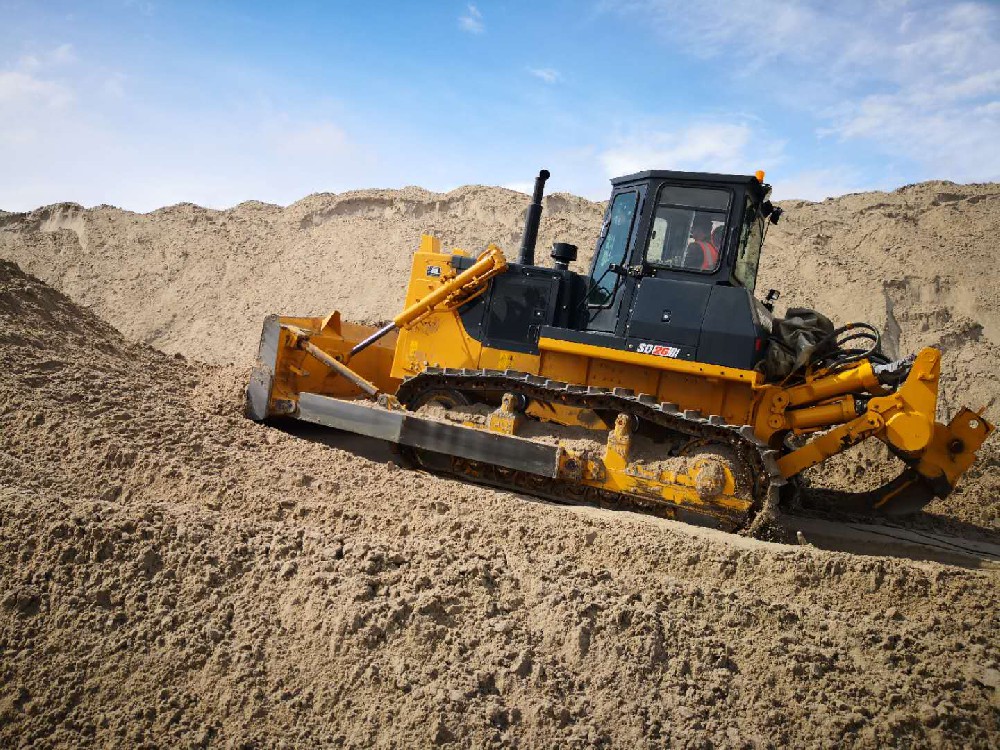
If the work face is conventional earthwork, road subgrade, site grading and loose material pushing, the standard version is usually the starting point. The standard version in this series has an operating weight of 23,450 kg, ground pressure of 66 kPa, engine net power of 194 kW (260 hp), a standard straight-tilt blade with 4.6 m³ capacity, blade width of 3,725 mm and height of 1,315 mm. The semi-rigid suspension undercarriage expands track ground contact area to improve traction.

The selection question these data address is whether the push distance and material density fall within a reasonable range for a mid-size machine. The documentation does not give efficiency conclusions for different haul distances, so the actual configuration must still be checked with the supplier against haul distance, slope and shift arrangements; output cannot be inferred from horsepower alone.
Soft wet ground: look first at ground pressure and track shoe width
On soft foundations, wetlands and rainy-season construction sites, the core issue is whether the machine can stand firm and effectively transmit power to the ground. This series offers a wetland version, while the standard version can be fitted with 560, 610 or 660 mm track shoes, with a ground contact length of 2,872 mm. Wider track shoes change ground contact area and ground pressure, but the documentation does not give specific ground pressure values for each width; this item must be confirmed with the supplier.
The judgment path can proceed in the following order:
- First confirm the bearing capacity of the original ground and whether a cushion layer or access road is needed;
- Then check whether the ground pressure at the selected track shoe width suits the site;
- Finally confirm whether the push route includes slopes and backfill areas, to avoid slipping during full-load pushing.
This series also has a forestry version, with documentation giving ground pressure of 64 kPa, 610 mm widened tracks and a dedicated logging rollover-protection cab, suitable for rainforest logging, forest road reconstruction and similar scenarios. This shows that the wetland and forestry versions address different operating constraints and cannot substitute for each other simply because both emphasize "widened tracks."

Sanitation and rock: when the material changes, the work equipment must change too
Sanitation work such as waste piles and stockpiling bulk materials focuses on protection and stability during continuous operation. The documentation mentions that external side guards prevent the engine and radiator from being blocked and damaged by debris, a configuration corresponding to sites with more loose material and debris. However, the specific parameters, protection level and applicable pile conditions of the sanitation version in this series are not detailed in the documentation; the complete documentation for the corresponding version should be obtained from the supplier before judging.
Rock and hardpan work depends on the ripping configuration. This series can be fitted with a three-shank ripper with maximum penetration depth of 666 mm, maximum lift height of 555 mm and shank spacing of 930 mm; there is also a single-shank ripper with adjustable digging angle, which the documentation states is used for loosening frozen soil, clay and gravel strata. Whether to specify a ripper depends on whether breaking is needed before pushing; not all earthwork projects require one.
Consolidate the choice into a single judgment path
| Site conditions | Check first | Confirm with supplier |
|---|---|---|
| Conventional earthwork, site grading | Standard version, straight-tilt blade, push distance | Work organization and supporting equipment at different haul distances |
| Soft wet ground, rainy-season sites | Wetland version or widened track shoes, ground pressure | Ground pressure values for each track shoe width |
| Forestry logging, forest roads | Forestry version, rollover-protection cab, widened tracks | Forest slope and self-recovery configuration |
| Waste piles, bulk material stockpiling | Sanitation version, side guards and other protection | Complete parameters and protection scope of that version |
| Frozen soil, clay, gravel hardpan | Ripper type and penetration depth | Material hardness and ripping sequence |
To use this table, first locate the site conditions, then look at the corresponding version, and finally list the unconfirmed items as a checklist. The versions listed in the table all come from the same series documentation, but the complete parameters of each version are not equivalent; standard-version data cannot be directly applied to the wetland or sanitation versions.
Several things to settle before purchasing
This series uses a Weichai WP12G280E304 engine with 11.596 L displacement and China-III emissions, matched with a power-shift transmission and torque converter; fuel tank capacity is 450 L and hydraulic tank capacity is 110 L. The drivetrain and cooling system documentation emphasizes stability under full load and high-temperature environments, but actual fuel consumption and continuous operating duration still depend on the application, and the documentation does not give quotable values.
When requesting a quotation, it is advisable to provide: material type and density, average daily push volume or work area, ground bearing capacity and whether an access road is needed, haul distance and slope, shift arrangements, whether ripping or special protection is required, and transport dimensions and site access road conditions. Blade type and track shoe width should be decided after these conditions are clear, avoiding the mistake of fixing the configuration before finding the application.
Finally, a note: this article is based on multi-version product documentation for this series and is a conditional selection analysis, not a record of completed project cases. The actual suitability of the wetland, sanitation, rock and other versions must still be verified against the complete technical documentation for the corresponding version and site conditions.