






















When two requirements appear on the same work face, selection becomes difficult: the pit must be dug to a certain depth, the soil must be dumped into truck beds at a relatively high position, and hard soil or weathered rock may need to be cut through. At this point, comparing only bucket digging force or looking only at digging depth covers just part of the operation. A more practical approach is to break the site operations into two groups of conditions—"cutting soil and breaking rock" and "working range"—and then check each against verified data for the same machine.
First, distinguish which part of the operation each capability governs
Cutting soil and breaking rock depends on the force the bucket and arm can apply to the material; deep excavation and high-level dumping depend on the spatial range the working equipment can reach. Both are determined jointly by the whole machine, hydraulic system, and working equipment, but they correspond to different site constraints.
- When encountering hard compacted soil, weathered rock, or undisturbed soil that must be cut, first check whether bucket digging force and arm digging force match the material difficulty.
- When pit depth exceeds the usual range or the dump point is higher than a standard dump truck, first check whether maximum digging depth, maximum digging height, and maximum dump height can cover the operation.
- When truck loading coordination is tight and slewing is frequent, slewing speed and system pressure also affect motion continuity.
These two groups of conditions often exist simultaneously; one cannot be fixed first and the other added later.

How the data correspond for a 21-ton crawler excavator
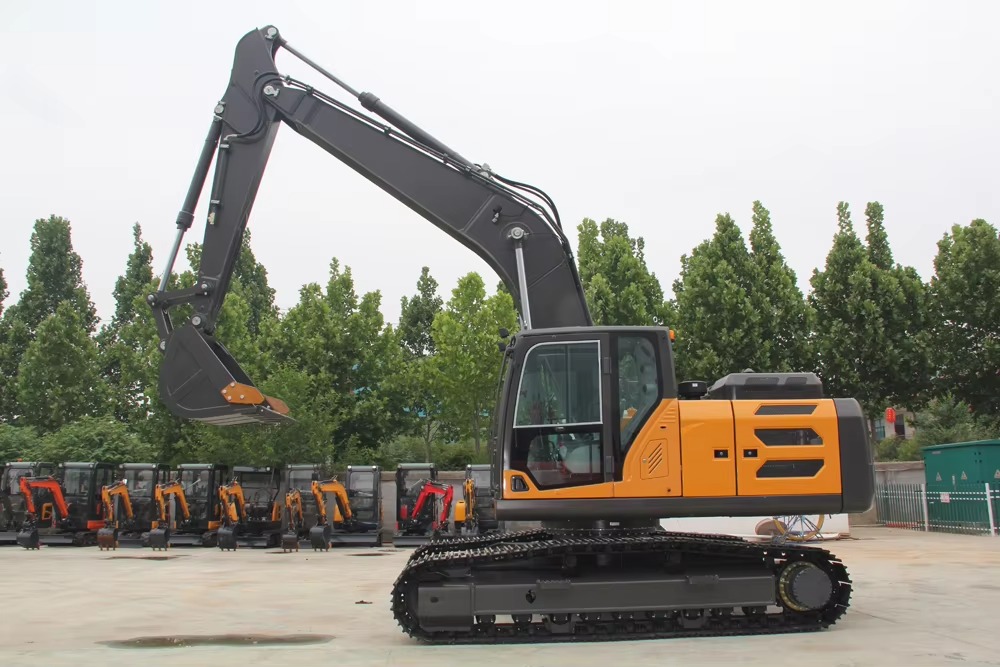
The 21-ton crawler product in this site's medium and large excavator catalog is equipped with a 1 m³ standard bucket and a 129kW (173HP) engine, rated speed 2200rpm, system pressure 32MPa. Its published data divides capability into several verifiable items:
| Data item | Verified value | Corresponding operation judgment |
|---|---|---|
| Maximum bucket digging force | 140kN | Bucket tip force when cutting soil and breaking soft rock |
| Maximum arm digging force | 99kN | Force when pulling the arm to dig and trimming slopes |
| Maximum digging depth | 6480mm | Depth coverage for deep foundation pits and trench excavation |
| Maximum digging height | 9410mm | Excavation face height and dumping height during loading |
| Maximum dump height | 6730mm | Height margin for dumping into dump truck beds |
| Maximum digging radius | 9850mm | Horizontal distance between machine position and excavation point |
These values describe the working range of this model under the conditions given in the data; they do not mean the same cutting effect can be achieved in any ground condition. The 140kN bucket digging force is used to judge whether the bucket can penetrate a certain material, but material density, joint development, and operating method must also be considered. The data itself does not provide a material suitability table.
When deep excavation and dumping are equally important, range parameters are more easily overlooked than single force values
In truck loading coordination, a common problem is that digging depth is sufficient but dump height is not, so the boom must be raised to its limit each time, slowing movements and lengthening cycle time. This model's maximum dump height of 6730mm and maximum digging height of 9410mm can leave dumping margin above a standard dump truck bed; maximum digging depth of 6480mm and maximum vertical digging depth of 5925mm correspond to depth conditions for vertical excavation of foundation pit sidewalls.

Tail swing radius of 2880mm and minimum swing radius of 3555mm are fields to review together when planning machine position. For foundation pits in urban municipal work or confined sites, swing range directly affects whether the machine can work close to existing structures. Overall dimensions of 9590×2980×3185mm, minimum ground clearance of 470mm, and maximum gradeability of 30° are used to judge access road and work face passage conditions, but these values cannot replace verification of actual road conditions.
Hard-material work also requires checking whether the hydraulic configuration supports combined motions
The data shows this model uses dual-pump confluence technology to increase oil flow to the boom, arm, and bucket; the specific brands and models of core hydraulic components such as the main pump, main valve, and swing motor are not listed in this article's data. The on-site behavior corresponding to dual-pump confluence is response speed during combined digging, slewing, and dumping motions, which is related to truck loading cycle continuity. However, "faster response" is a statement in the data and does not constitute an efficiency commitment for any specific site; actual pace is still affected by operator skill, truck dispatch, and material condition.
Which conditions must be verified before ordering
The following items cannot be derived directly from the available data and require on-site or supplier confirmation:
- The type and condition of the material to be excavated, including whether it is highly weathered rock and whether it contains large boulders. A bucket digging force of 140kN does not constitute a conclusion of suitability for hard rock.
- Dump truck sideboard height and height difference at the machine position, used to check whether the 6730mm dump height leaves margin.
- Foundation pit support type and whether the minimum swing radius of 3555mm conflicts with the retaining structure.
- Access road width, longitudinal slope, and load-bearing conditions, and whether they meet transport requirements beyond the 2980mm machine width and 30° gradeability.
- Local altitude, low temperature, and other environmental conditions. The data mentions turbocharging technology can adapt to high-altitude and low-temperature environments, but does not give specific altitude and temperature limits.
- Whether attachments such as hydraulic breakers or long booms are needed; the data does not list an attachment compatibility list for this model.
Inquiring by operation conditions is more effective than comparing prices by single specifications
If the site truly has both deep excavation and high-level dumping, writing operation conditions as a checklist during inquiry makes it easier to get verifiable responses than reporting only a tonnage: material type and excavation depth, dump height and truck type, swing space at the work face, shift and continuous operation duration, access road conditions, and whether attachments are needed. This 21-ton model's 1 m³ bucket capacity and 129kW power are base machine configurations; whether it suits a specific project still depends on item-by-item comparison against the above conditions.