






















When selecting equipment for heavy-duty haulage in mines, the first question usually arises: why do track dozers with similar horsepower differ significantly in price and configuration, and why do they perform differently on site? What truly needs to be broken down first is not "which machine is more powerful," but whether the material is loose or rocky, how long the haulage distance is, under what conditions the blade and undercarriage are configured, and whether the equipment must sustain continuous shifts. These conditions determine the class and also determine which version within the same series should be considered.
Answering the core question first: what determines the class
The "class" for heavy-duty haulage can be understood as the machine's ability to work continuously under specific materials and job organization, rather than a single power figure. It is determined jointly by at least four groups of conditions:
- Material state: loose earth, weathered rock, stony soil, or crushed stone directly relates to blade type and undercarriage strength.
- Haulage organization: single-pass haulage distance, cycle route, and whether ripping is needed affect power reserve and transmission matching.
- Site and bearing capacity: mine road conditions, slope, and ground contact conditions affect track shoe width and trafficability assessment.
- Work shifts: whether operation is continuous day and night and how long maintenance windows are affect requirements for reliability and maintenance accessibility.
Applying these four groups of conditions to the task first and then checking the machine data is closer to the actual selection sequence than fixating on a horsepower number first.

Why power alone is insufficient under rock conditions
The difference between rock stripping in mines and general earthmoving haulage mainly lies in the blade and undercarriage. Blades for rock conditions require higher structural rigidity, and the push arm assembly and cutting edge wear resistance must also correspond; the undercarriage sustains impact and abrasion over the long term, so tracks, track rollers, and ground contact length must all be included in the assessment. At this point, machines with the same nominal power but different version configurations will have clearly different applicable scopes.
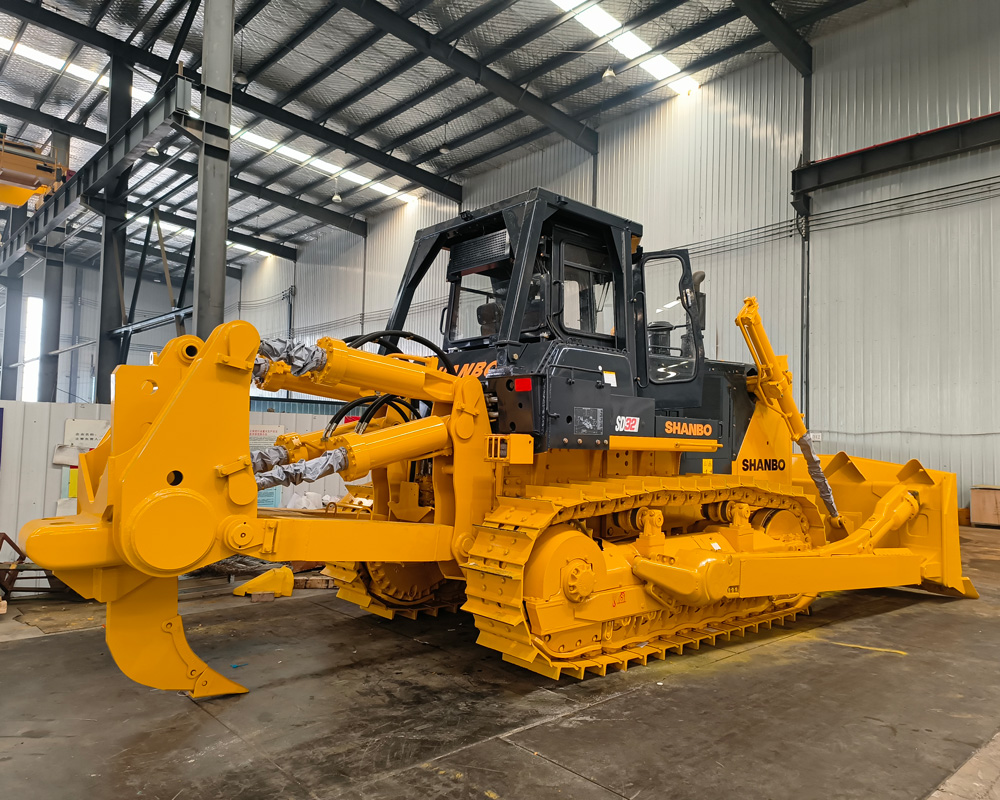
The SD32 series data associated with this article shows that the series offers multiple versions including standard, rock, desert, sanitation, and coal, with a rated power of 257 kW (corresponding to the 320-horsepower class), engine model WP12/QSNT-C345, and compliance with China III emission standards. The standard version has an operating weight of 40,200 kg, while the rock version is 40,900 kg, with ground pressure of 97.7 kPa and 99.4 kPa respectively, and overall dimensions of 8650×4130×3760 mm. These figures alone do not indicate which is stronger, but they suggest that different versions within the same series differ in weight, ground pressure, and matched work equipment, and selection should verify each version individually.
Mapping requirements to data fields
Material and blade
If the task is mainly weathered rock stripping and stony soil excavation, the rock version in the data is equipped with thickened high-wear-resistant rock blades and reinforced push arm assemblies, with options for rock straight blade, rock angle blade, and rock semi-U blade, with blade widths corresponding to 4130 mm, 5000 mm, and 4130 mm. The standard version offers choices such as straight blade, angle blade, and semi-U blade, and optional single-shank or three-shank rippers, with maximum ripping depth of 1250 mm for single-shank and 842 mm for three-shank. Whether the blade and ripper match the on-site material must be clarified before inquiry.

Undercarriage and trafficability
The undercarriage parameters given in the data are: track gauge 2140 mm, track shoe width options 560/610/660/710 mm, ground contact length 3150 mm, track pitch 228.6 mm, and ground clearance 500 mm. If the mine road has abundant crushed stone and large slope variations, the combination of track shoe width and ground pressure needs to be confirmed against site bearing capacity; the values in the data can only serve as a screening starting point and cannot replace judgment on specific road conditions.
Continuous operation and maintenance
This series has a fuel tank capacity of 640 L and hydraulic tank capacity of 97 L, adopts a six-sided enclosed cab, offers optional FOPS&ROPS protective structures, and notes that key maintenance points are centrally arranged externally. For continuous operation organization, this information helps evaluate refueling arrangements and daily inspection convenience, but the data does not provide endurance, fuel consumption, or maintenance intervals, and such data must be confirmed separately with the supplier.
Boundary conditions still to be confirmed
- Uniaxial compressive strength and lump size data of the rock material, to determine whether the rock version is necessary.
- Haulage distance and cycle route, to verify whether power and transmission matching meet shift organization.
- Site bearing capacity and slope, to determine whether track shoe width and ground pressure are suitable.
- Transport dimensions and access road conditions; the overall dimensions of 8650×4130×3760 mm must be checked against the transport plan.
- Environmental and emission requirements; whether the China III configuration complies with local regulations.
- Specific options for ripper, blade type, and protective structures must be confirmed item by item according to the task.
If the task is mainly rock stripping, the rock version configuration direction is closer to the requirement; if it is mainly general earthmoving and auxiliary haulage, the standard version's versatility deserves priority verification. This is not a conclusive recommendation but a starting point for version screening.
Information recommended to prepare before inquiry
When inquiring about mine haulage equipment, it is recommended to provide: material type and lump size, haulage distance and working face organization, average daily workload and shifts, site slope and bearing conditions, transport dimension limits, emission requirements, and key configuration needs such as blade and ripper. Only then can the supplier verify whether the version and configuration correspond.