






















Soft soil sites and slopes often appear together: backfill areas, river flats, and hilly platform leveling have insufficient surface bearing capacity, and access routes are sloped. In such cases, whether a medium crawler excavator can handle earthwork excavation and transfer depends not just on bucket capacity, but first on two questions—can the machine stand firm on soft soil, and can it travel stably on slopes? Without resolving these two constraints, even high digging force is useless.
Based on verified data for a 21.2-ton medium crawler excavator, this article explains the selection boundaries under soft soil and slope sites; judgments involving site bearing, slope adhesion, and actual productivity are conditional analyses and do not represent verification for any specific project.
First constraint on soft soil: ground pressure and track configuration
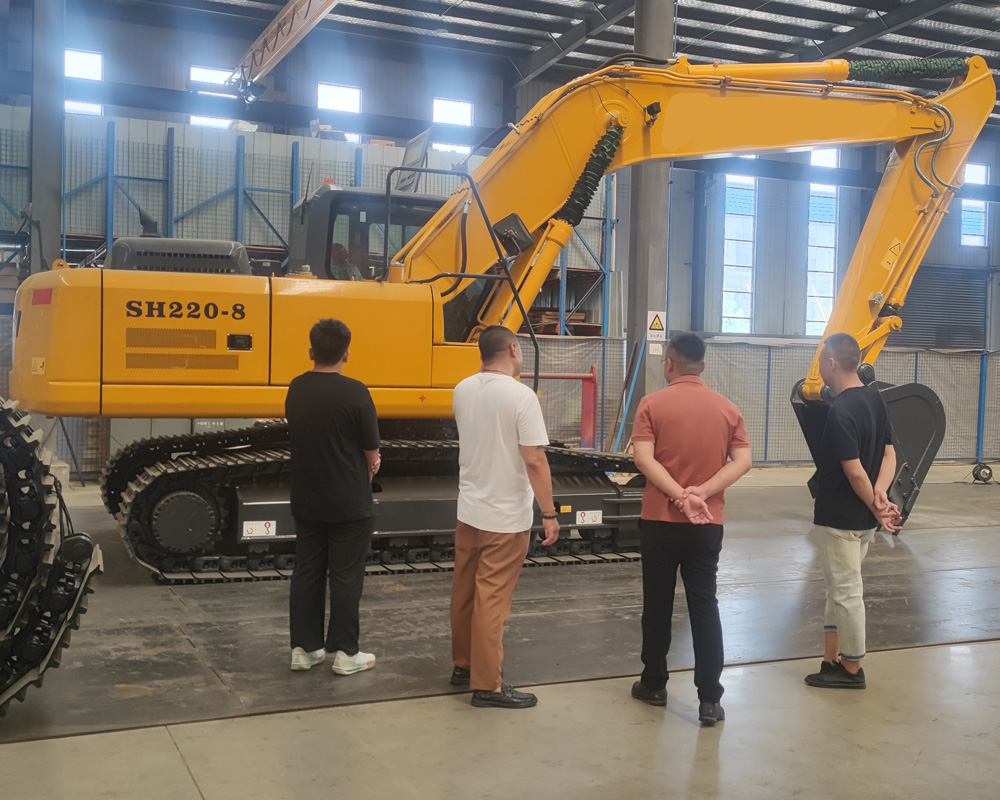
When working on soft soil, the degree of machine sinking mainly depends on ground pressure. This model has an operating weight of 21,200 kg, track shoe width of 600 mm, and a specified ground pressure of 49.8 kPa. This value is the whole-machine ground pressure under the given track shoe width and is a design reference, not equal to the actual bearing capacity of on-site soft soil.
For on-site judgment, compare 49.8 kPa with measured site bearing capacity. If the surface is high-moisture muddy soil or fresh fill, even if the ground pressure value is not high, the tracks may locally sink during travel and slewing. In this case, consider:

- Whether steel plates, gravel bedding, or temporary access roads are needed to supplement bearing capacity to a level the tracks can withstand;
- Whether travel routes should avoid local weak zones to reduce pivot turns and prolonged stationary operation;
- The 600 mm track shoes are the existing configuration for this model; whether wider or narrower track shoes can be fitted is not given in the data and must be confirmed with the supplier.
A boundary must be clarified here: ground pressure parameters only indicate the distribution under standard configuration and cannot directly lead to the conclusion that "the machine can work on any soft soil." Actual sinking in soft soil is also affected by soil layer distribution, moisture content, operating posture, and load position, and requires site reconnaissance or plate load tests to support judgment.
Second constraint on slopes: traction and climbing ability
The travel system data provided includes: maximum travel speed 5.1 km/h, traction force 214 kN, and gradeability 70% (about 35 degrees). These are whole-machine capability indicators, but whether slope operation is feasible also depends on slope surface material and adhesion conditions.
The 35-degree climbing ability typically corresponds to dry slopes with some adhesion. If the slope is wet slippery clay, loose gravel, or muddy after rain, the actual climbable grade will be significantly lower than the nominal value, and the risk of track slipping increases. Therefore, the judgment sequence under slope conditions is:
- First confirm the maximum longitudinal slope and slope surface material—hard soil, gravel, or wet slippery soil;
- Then assess whether the slope surface will be damaged by track compaction during operation and whether adhesion changes after rain;
- Finally check the machine's operating posture on the slope—whether slewing, digging, or dumping downhill on the slope is required, as these actions change the center of gravity.
Note: the data does not provide stability boundaries on slopes, side tilt limits, or climbing degradation data under different adhesion conditions. Arrangements involving prolonged operation on steep slopes or loaded climbing are items to be confirmed; request corresponding explanations from the supplier or adjust work organization to avoid treating nominal climbing ability directly as an operating permit.

When soft soil and slopes coexist, which parameters really affect the trade-off
When soft soil and slopes exist simultaneously, the two constraints of "standing firm" and "climbing up" are superimposed. Some data for this model can help judge whether it is worth considering under such superimposed conditions:
| Site constraint | Corresponding data | Judgment significance |
|---|---|---|
| Insufficient soft soil bearing | Operating weight 21,200 kg, ground pressure 49.8 kPa, track shoe width 600 mm | Used to compare with measured site bearing and judge whether bedding or route change is needed |
| Slope passage | Traction force 214 kN, gradeability 70% (35 degrees), travel speed 5.1/3.1 km/h | Nominal capability corresponds to specific adhesion conditions; judgment requires discounting based on slope surface material |
| Excavation depth and dumping position | Max digging depth 6,490 mm, max digging height 10,950 mm, max dumping height 7,190 mm | Determines whether the machine can complete excavation and loading in one pass on slopes or at soft soil edges |
| Slewing and stability | Tail swing radius 2,925 mm, overall width 2,800 mm | Affects layout margin at slope edges and narrow soft soil areas |
As the table shows, this machine has a large working range—max digging radius 9,860 mm, max digging depth 6,490 mm—so when working at the edge of a soft soil area, it may be possible to stand on firmer ground and excavate toward the soft soil area, reducing the number of times the whole machine enters weak zones. This is a work organization approach; feasibility depends on the actual layout of the soft soil area, excavation depth, and dumping point, and cannot be generalized.
Another reference point is the power and hydraulic configuration: Cummins 6BTAA5.9 engine, rated power 133 kW, maximum torque 708 N·m; Linde hydraulic system with intelligent load sensing control, providing three adjustable working modes. Under soft soil and slope conditions, the operator can adjust the power output rhythm through mode selection, but this is an operational adaptation; the data does not give specific performance of each mode on soft soil or slopes, so no effect inference is made.
Applicable boundaries: which conditions should be excluded first or separately verified
Putting the data back into the site, the following situations require caution:
- Extremely weak surface (e.g., swamps, fluid mud): The 49.8 kPa ground pressure reference may still exceed surface bearing capacity, requiring prior ground treatment or amphibious equipment; this model's data does not cover such configurations.
- Loaded slewing on steep slopes or long-distance downhill dumping: The data does not provide whole-machine stability boundaries; separate assessment is required based on site slope and load.
- Wet slippery slopes with frequent up-and-down travel: The adhesion conditions corresponding to nominal climbing ability are unclear; actual measurements or supplier explanations should prevail.
- Need for wider or narrower track shoes, extended arms, or other variants: The data only gives standard configuration; variant configurations will change ground pressure, stability, and working range, and must be confirmed item by item.
Conversely, if the site is general soft soil (e.g., fill with some strength, silty clay with moderate moisture content), the slope grade is within the nominal range and the slope surface is hard soil or gravel, and the excavation depth and dumping height fall within the coverage intervals of 6,490 mm and 7,190 mm, then this 21.2-ton crawler excavator can be one of the options for comparison. Whether it is ultimately suitable still depends on measured bearing capacity, slope conditions, and work cycle arrangements.
Items to verify before mobilization
Procurement or rental decisions for soft soil and slope sites should not be based solely on specification sheets. It is recommended to verify in the following order:
- Site bearing: Surface soil type, moisture content, soft soil layer thickness; conduct bearing tests if necessary and compare with 49.8 kPa ground pressure.
- Slope conditions: Maximum longitudinal slope, slope length, slope surface material, rainy season changes; compare with 70% (35 degrees) gradeability and 214 kN traction force.
- Work layout: Excavation depth, dumping height and position, whether slewing on slope is required; compare with 6,490 mm, 7,190 mm, and tail swing radius 2,925 mm.
- Supporting conditions: Whether bedding or access roads are needed, whether transport route width meets the 2,800 mm overall width, whether dumping trucks can approach the soft soil edge.
- Configuration confirmation: Whether track shoe specifications can be adjusted, whether the working device (1.06 m³ bucket) matches material bulk density, whether other attachments are needed.
- Shifts and maintenance: Continuous operation duration, fuel supply arrangements; daily inspection items and maintenance requirements are subject to the accompanying manual, as the data does not provide specific intervals.
When requesting a quote, provide the supplier with material type, soft soil range and bearing conditions, slope grade and surface material, excavation depth and dumping height, shift arrangements, and transport conditions together, rather than only asking about tonnage and bucket capacity, to obtain more usable configuration recommendations. Product page reference: Medium Crawler Excavator.