






















When uneven subgrade settlement appears, the common on-site reaction is to increase compaction passes or switch to heavier equipment. However, settlement often stems from multiple factors such as filler moisture content, layer thickness, and compaction uniformity; simply increasing passes may not converge. To develop an executable compaction plan, first clarify "where it is uneven, why it is uneven, and how the next layer should be paved," then determine whether the equipment parameters match these conditions.
First, break down the problem: uneven settlement does not equal insufficient compaction energy
Uneven settlement typically manifests as local depressions, longitudinal undulations, or wheel-path rutting. Causes may include fluctuations in filler gradation, moisture content deviating from optimum, excessive layer thickness, insufficient compaction overlap, or a weak underlying layer. Before treatment, three points need confirmation:
- Whether the settlement occurs within the fill layer or is overall deformation caused by insufficient bearing capacity of the underlying layer;
- How large the difference in maximum dry density test results is at different positions on the same cross-section;
- Whether the speed, number of passes, and overlap width of existing compaction equipment are properly executed.
If the underlying layer itself is weak, changing rollers or increasing passes will not solve the problem; the foundation should be treated first. Only when the problem is confirmed to be concentrated in the compaction uniformity of the fill layer does equipment-level parameter matching become meaningful.
Then break down working conditions: how layer thickness corresponds to frequency and amplitude
In layered subgrade filling, the thickness of each layer, filler type, and compaction speed determine how vibration parameters are applied. Taking a single-drum vibratory roller as an example, large amplitude and low frequency tend toward deep excitation, while small amplitude and high frequency tend toward surface densification; static linear load affects the pressure transmitted per unit drum width. These parameters are not "the larger the better"; they must match the layer thickness and filler particle size.

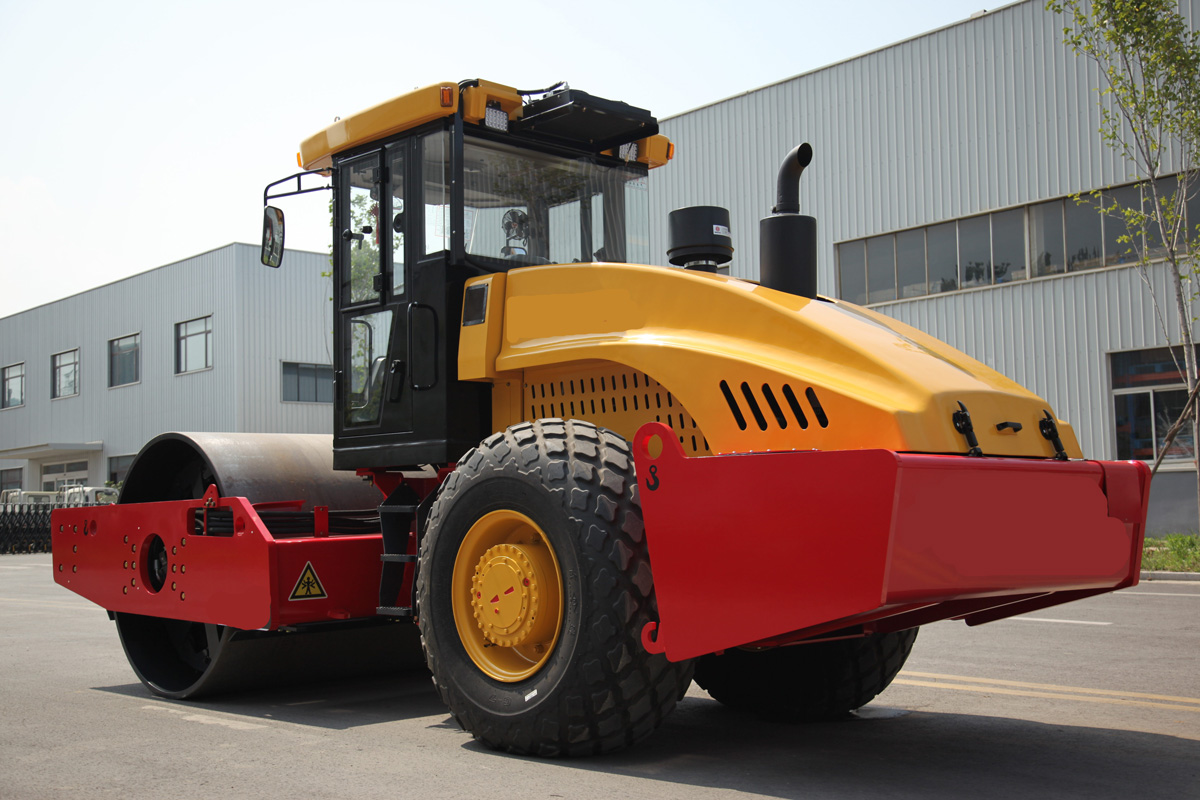
Refer to the verified data of a 20-ton-class single-drum vibratory roller: operating weight 20000 kg, drum width 2150 mm, drum diameter 1550 mm, static linear load 600 N/cm, centrifugal force 400/270 kN, dual amplitude 1.95/0.91 mm, dual frequency 28/32 Hz, speed range 0–9 km/h, gradeability 45%, turning radius 6500 mm. Power is a 140 kW engine, compliant with Tier 3/China III emission standards.
Putting this data back into the scenario of handling uneven settlement, it can be understood as follows:
- The 400 kN high centrifugal force setting combined with 1.95 mm large amplitude is suitable for thicker layers or the main compaction stage requiring deep densification;
- 270 kN combined with 0.91 mm small amplitude is closer to surface finishing or low-disturbance supplementary compaction of already compacted layers;
- The two frequencies of 28 Hz and 32 Hz allow adjustment of excitation rhythm at different travel speeds to avoid unfavorable resonance with the natural frequency of the layer;
- The 600 N/cm static linear load and 20-ton overall weight provide basic static pressure capability for thicker fill layers.
It should be noted that the above correspondences are general interpretations of parameter meanings. Which setting to use for a specific subgrade section must still be determined by filler test section results and cannot be directly applied.

Item-by-item correspondence between equipment features and requirements
| Site requirement | Reference equipment conditions | Items still to confirm |
|---|---|---|
| Thick-layer filling requires sufficient compaction energy | 20-ton operating weight, 400 kN centrifugal force, 600 N/cm static linear load | Whether filler type and single-layer loose thickness match this compaction energy |
| Surface supplementary compaction to avoid over-vibration loosening | Dual amplitude 1.95/0.91 mm, dual frequency 28/32 Hz | Recommended travel speed for different settings |
| Transition between strip-shaped subgrade operations | Speed range 0–9 km/h, gradeability 45% | Whether actual longitudinal and transverse slopes are within the equipment's permitted operating range |
| Compaction at road edges | Drum width 2150 mm, turning radius 6500 mm | Matching of site road width and stopping space |
| Emission and fuel conditions | 140 kW, Tier 3/China III | Local emission access requirements of the project |
The purpose of this table is to suggest a verification sequence, not to conclude that "this equipment is suitable for all uneven settlement sections." In particular, overlap zones and abutments of structures, which are common in settlement treatment, have different compaction spaces and methods from normal sections and require separate evaluation.
Supporting conditions and boundaries in the plan
In subgrade reinforcement, the single-drum vibratory roller handles the vibratory compaction step, and before and after it, moisture content adjustment, paving thickness control, and compaction degree testing are also required. The following points are plan boundaries:
- Filler moisture content: When it deviates from the optimum, increasing amplitude may also cause spring soil; the material should be treated first before discussing equipment settings;
- Near structures: The impact of vibratory compaction on adjacent structures must be evaluated according to site conditions; if necessary, switch to low-amplitude settings or static compaction;
- Weak underlying layer: The overall weight and excitation force may aggravate sinking; bearing capacity should be confirmed first;
- Slope operations: 45% gradeability is an equipment specification; the safety of actual wet and slippery slopes and transverse operations requires separate evaluation.
In addition, dual amplitude and dual frequency are verified configurations of this equipment, but this does not mean all single-drum rollers in the same category have the same combination of settings. During selection, each item should be verified against specific product data.
Conditions to clarify with the supplier before purchase
If such equipment is to be included in a subgrade compaction plan, the following information is recommended during the inquiry stage so the supplier can provide a substantiated configuration recommendation:
- Filler type, gradation range, and optimum moisture content test results;
- Planned single-layer loose thickness and target compaction degree;
- Subgrade width, longitudinal slope, and length of the working strip;
- Daily work shifts and transition frequency;
- Local emission access requirements of the project;
- Whether a matching explanation of vibration settings and speed is required;
- Whether supporting configurations such as drum watering and mud scraping meet the filler characteristics.
Treating uneven settlement is essentially a closed loop of "cause diagnosis—layer design—equipment matching—process testing," and the roller is only one part of it. Equipment data can help narrow the selection range, but the final settings and number of passes should still be verified through test sections and dynamically adjusted during construction based on test results.