






















Opening the data sheet for a landfill compactor, the fields are often arranged according to the manufacturer's habits: weight, power, dimensions and speed sit together, while compaction capability occupies only one line. If you read straight through from top to bottom, it is easy to remember the numbers but hard to answer the questions on site—can this machine compact the day's layer to the required standard? Does the working width of the crushing teeth match the spreading width? Is the ground clearance sufficient for work faces with large height differences and for access roads?
This article follows an "operation first, fields second" order to explain how to read a landfill compactor data sheet, using a verified 23-tonne-class machine as an example. The figures in this article come only from that model's data and do not represent the general level of similar equipment.
First clarify what this machine does at a landfill
Landfill compaction is not the same type of task as subgrade compaction. Waste material is loose and uneven in composition, and operations usually include spreading, rolling and crushing for volume reduction at the same time. Compaction results are described by the degree of compression per unit volume, not by a percentage compaction degree. Therefore, when reading the data sheet, first break the site task into several items:
- How thick each waste layer is spread and what density it needs to reach;
- Whether the working width of the crushing teeth can cover the spreading width to reduce repeated passes;
- Trafficability requirements imposed by height differences on the work face, ramps and access roads;
- Requirements for power, cooling and protective configuration during continuous operation within a shift.
Once these items are defined, the fields on the data sheet have something to be compared against.

Compaction capability field: check the unit and how it is stated
For this model, the data sheet gives a compaction capability of compression of 0.35 to 0.9 tonnes per cubic meter or more. Two details in this field deserve attention.
First, the unit: tonnes per cubic meter describes the compression result per unit volume of material, which is not the same set of indicators as the compaction degree and settlement difference commonly used in road compaction, and cannot be directly compared across categories. Second, the range: 0.35 to 0.9 or more indicates that capability varies with material composition, layer thickness, number of rolling passes and work organization; the data sheet does not promise a single fixed value. If a supplier gives only a single-point figure during procurement, ask about the test material and operating conditions.
Fields adjacent to compaction capability
Operating weight of 23,000 kg, engine power of 192 kW and maximum speed of 11 km/h are listed alongside compaction capability, but each answers a different question: weight relates to contact pressure during rolling, power relates to power reserve during continuous operation, and maximum speed only indicates travel capability, not operating efficiency. Mixing them into one impression of "performance" easily leads to misjudgment.

Crushing width and blade height: corresponding to spreading organization
The data sheet gives a crushing width of 3,430 mm and a blade height of 1,880 mm. The former determines how wide a working strip can be covered in one pass, while the latter relates to the effective height of the blade during pushing, spreading and feeding. On site, these two values should be considered together with spreading width and layer thickness: if the work face width is much greater than the crushing width, travel distance and overlap at handovers must be considered; if a single layer is spread relatively thick, check whether blade height and the number of rolling passes can match. The data sheet does not give a recommended layer thickness; this item must be determined by the site process.
Ground clearance and overall dimensions: trafficability and layout conditions
Minimum ground clearance is 490 mm, and overall dimensions are 8,100 × 3,500 × 3,670 mm (length × width × height). Ground clearance corresponds to the soft ground, stack edges and temporary road undulations common at landfills and is one basis for judging trafficability; overall dimensions affect work face layout, turning space and verification of width and height limits during transport. It should be noted that the data sheet does not give climbing ability, ground contact pressure or slope operation limits. Arrangements involving slope trafficability and soft-ground bearing capacity cannot be concluded from these three values alone.
| Data sheet field | Verified value | Main judgment it corresponds to |
|---|---|---|
| Compaction capability | Compression of 0.35 to 0.9 tonnes per cubic meter or more | Verify compression target against material and layer |
| Crushing width | 3,430 mm | Coordinate with spreading width and overlap travel |
| Minimum ground clearance | 490 mm | Trafficability on soft ground, stack edges and temporary roads |
| Overall dimensions | 8,100 × 3,500 × 3,670 mm | Work face layout and transport limit verification |
Power and emissions: must be checked against local requirements
This model uses a Shangchai Stage III emissions engine with 192 kW of power. The emissions level is related to the regulatory requirements of the region of use and fuel supply conditions. The data sheet gives only the level itself and does not cover after-treatment form or fuel consumption data. Before procurement, confirm separately in light of the emissions management requirements of the project location and on-site fuel supply conditions; fuel economy cannot be inferred from the power figure.
Questions the data sheet does not answer but should be listed in advance
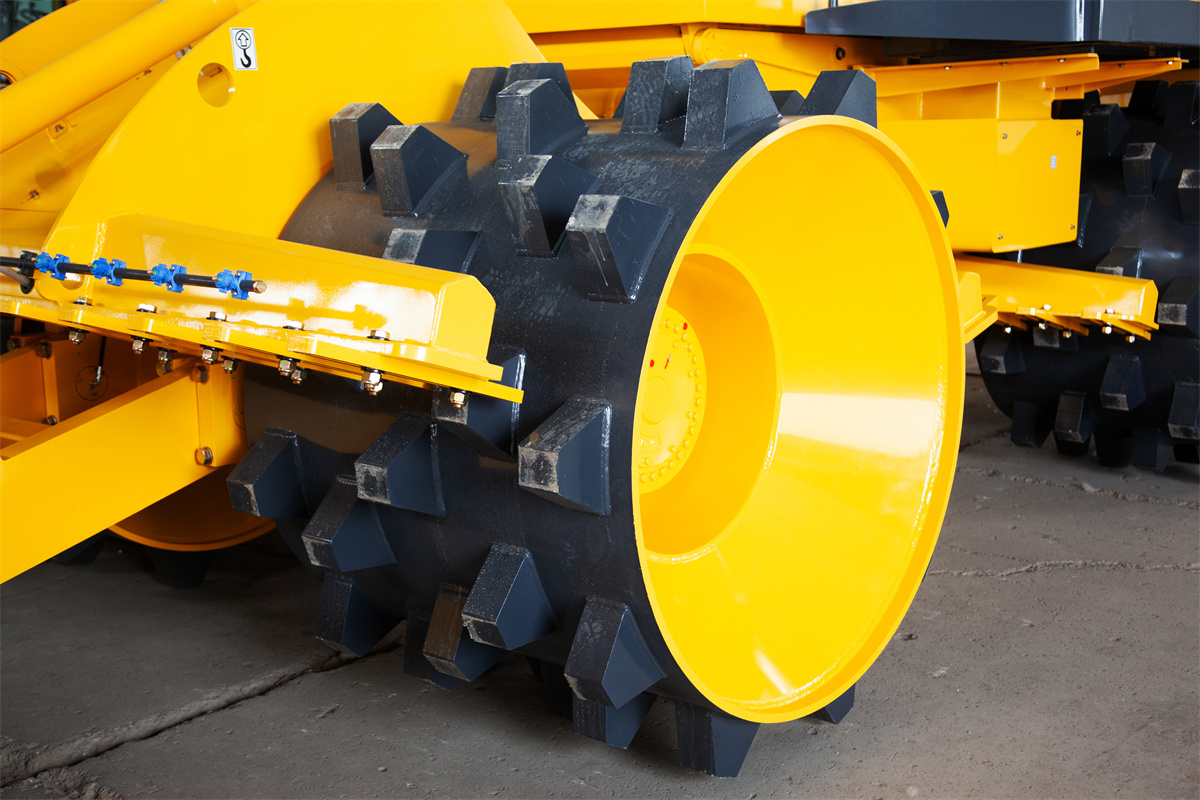
- The specific structure of the compaction wheels and crushing teeth, the number of teeth and how wear parts are replaced;
- Cab protection and cooling system configuration for landfill dust and gas;
- Recommended number of rolling passes, layer thickness and operating speed range;
- Applicable boundaries for slope operation, soft-ground bearing capacity and rainy-season sites;
- Local emissions regulations' admission requirements for equipment of this emissions level.
This content is usually not in the basic parameter table and must be obtained from the supplier as a manual or special documentation, with the configuration list written into the contract.
How to turn reading into an inquiry
If the data sheet is read as an operation comparison table, more specific questions can be raised during inquiry: daily waste intake, single-layer thickness and compaction target, work face width and ramp conditions, site bearing capacity and rainy-season arrangements, shift duration and local emissions requirements, as well as the structure of the compaction wheels and crushing teeth and spare parts supply. Choosing the equipment category is only the starting point; whether it matches the site still depends on item-by-item confirmation of the above conditions.
To view the complete specifications of this landfill compactor, see the product page: 23-tonne landfill compactor.