






















In continuous high-intensity pushing operations, equipment doesn't just make a few passes: mining stripping faces require continuous advancement, large earthworks need constant hauling, and mountain leveling involves repeated travel over rocky and sloped terrain. In such conditions, rated power is only a starting point; what truly affects job scheduling is whether the machine can run stably under prolonged load, whether fault intervals are long enough, and whether daily inspection and maintenance are convenient. From this perspective, the reliability of a 600-horsepower-class crawler dozer should be verified separately across the powertrain, transmission, undercarriage, main frame, and monitoring configuration.
Why reliability comes before comparing power figures
High-intensity pushing is continuous-load work; when a machine stops for repairs, it affects the pace of the entire work face. The verified information describes the SD46-6 as suitable for heavy-duty conditions such as mining, large earthworks, and mountain leveling, emphasizing strong power, low failure rate, and convenient maintenance. Here, "low failure rate" is the product literature's statement, not a third-party test conclusion; purchasing decisions should still consider one's own working conditions, parts supply, and maintenance capabilities.
Power determines the upper limit of capability, while reliability determines whether that capability can be used continuously. The two are not in conflict, but priority depends on work organization: single-shift short-term operations may focus more on efficiency, while multi-shift continuous heavy pushing should first ask whether core components are durable and maintenance is hassle-free.
Powertrain and transmission design approach
Engine
The SD46-6 is powered by a Cummins KTA19-C525 turbocharged and intercooled diesel engine, rated at 340 kW/600 hp, rated speed 2000 rpm, displacement 18.9 L, six cylinders, bore × stroke 159 × 159 mm. The literature mentions that the cylinder block and head use an integrated design to reduce common faults such as water seepage and oil leaks. For long-term heavy-duty operation, leakage issues, though not fatal, can accumulate into downtime for inspection and maintenance workload—exactly the practical content of reliability discussions.

Transmission
The machine uses a hydraulic power-shift transmission with planetary final drives. The literature states that the system can adjust power output according to external load changes and incorporates hydraulic buffer structures to absorb impact loads in power transmission. The transmission assembly features multi-plate hydraulic clutches and forced circulation lubrication, while the final drive uses high-precision spiral bevel gears with splash lubrication. These structures address the need for transmission components to withstand impacts and maintain stable lubrication as loads fluctuate frequently during pushing.
Undercarriage and main frame: the load-bearing foundation for continuous operation
- K-type floating undercarriage: The literature claims it cushions impact loads during travel and operation, improves traction performance, and extends the life of core components;
- Integral articulated undercarriage + multi-stage damping assembly: Used to counteract vibrations on complex road surfaces, corresponding to travel stability in mountainous, rocky, and mining conditions;
- Sealed and lubricated track chain: Integrated design of the main link; the literature emphasizes wear resistance and ease of disassembly and replacement;
- Fully enclosed box-section main frame: High-strength wear-resistant steel and heavy cast steel parts, emphasizing impact, bending, and torsion resistance.
These structures are directly related to "long-term high intensity." The undercarriage of pushing equipment endures repeated impacts and ground contact wear, and the maintenance frequency of tracks and travel systems significantly affects availability scheduling. Therefore, undercarriage structure, track type, and lubrication method should be verified during the selection phase, not adjusted after the machine is on site.
What on-site needs do hydraulics, electricals, and maintenance structures address?
Working hydraulic cylinders are optimized, with core seals and high-pressure hoses using imported high-standard components, and an externally mounted distribution valve group for easy inspection, removal, and maintenance. On the electrical side, the combination instrument panel provides electronic monitoring and over-limit alarms for key data such as hydraulic oil temperature, oil level, and coolant temperature. For heavy-duty continuous operation, the value of these features lies in exposing abnormal conditions early and reducing unexpected downtime.

The literature also mentions: the number of core components is reduced by more than 25% compared to models of the same class, and daily maintenance time is saved by more than 50%; the machine features maintenance reminder labels, a maintenance-free battery, and a wide-opening engine hood. These are manufacturer statements; actual differences under different maintenance items and usage intensities still need to be confirmed against on-site records.
Working equipment and protective features
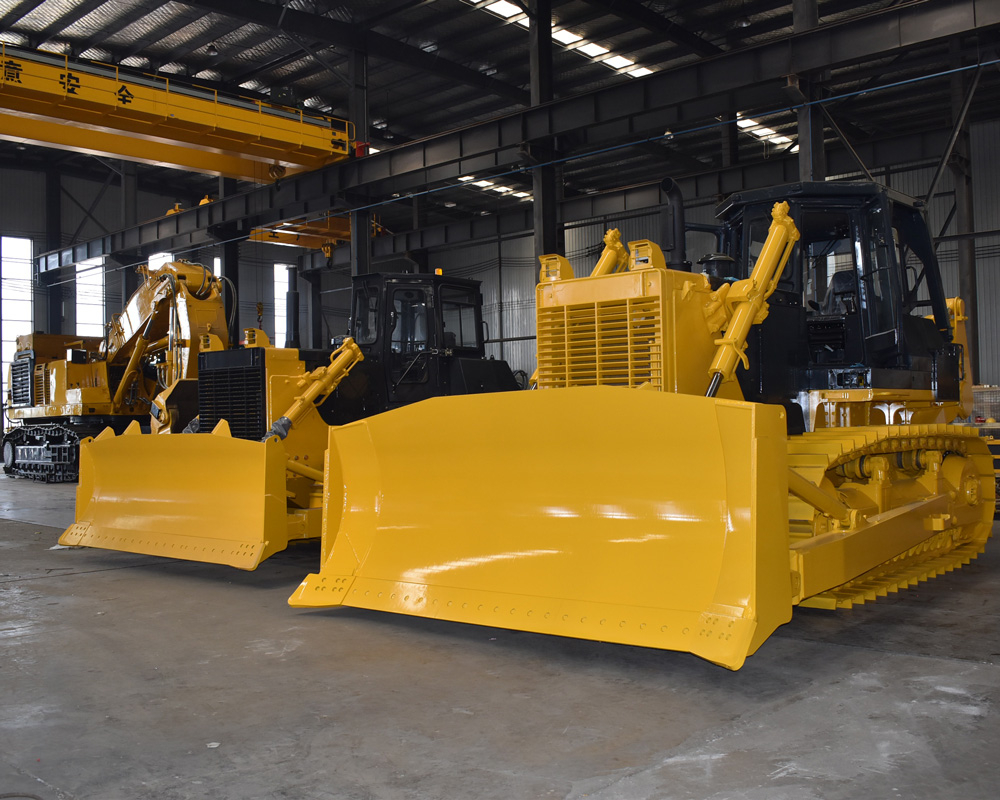
The SD46-6 comes standard with a large-capacity semi-U bulldozer blade, blade capacity 16 m³, blade width 4314 mm, blade height 1841 mm, maximum cutting depth 700 mm, and maximum blade tilt 1000 mm. The rear attachment is an adjustable-angle single-shank heavy-duty ripper. For safety, ROPS rollover protection and FOPS falling-object protection are standard, with an optional upgraded integrated ROPS & FOPS protective frame.
It should be noted that 16 m³ is the blade capacity given in the literature; pushing efficiency also depends on material density, pushing distance, ground traction conditions, and operating method, and actual production cannot be inferred from this figure alone. Whether the ripper is suitable for hard rock or hard ground loosening should also be determined by on-site material conditions.
Conditions to verify before purchase
Confirmed overall parameters from the literature include: operating weight 54000 kg, minimum ground clearance 525 mm, ground pressure 0.123 MPa, gradeability 30 degrees, track gauge 2260 mm. These values can be used for preliminary assessment of site bearing capacity and transport conditions, but are not sufficient to draw direct conclusions. It is recommended to confirm item by item before inquiry and site entry:
- Material type and density, pushing distance, single-shift or continuous operation arrangements;
- Site slopes, ground bearing capacity, and soft foundation conditions during rainy seasons; verify the applicable boundaries of ground pressure and gradeability;
- Overall transport dimensions and access road conditions, and whether split transport is required;
- Specific configuration requirements for the blade and ripper, and whether the upgraded protective frame is optional;
- Daily maintenance items, spare parts supply, and on-site repair capabilities.
If the operation involves long-term continuous heavy pushing, the structures discussed in this article can serve as evaluation priorities; if it is only intermittent general earthmoving, this level of configuration may not be necessary. Specific selection should still be judged based on site conditions and manufacturer confirmation.