






















Quarry loading and general earthmoving loading may look similar—both involve excavator slewing, lifting, and dumping—but the on-site demands on equipment are not entirely the same. Quarries deal with coarse material or blasted rock of uneven lump size, often involving hard-material penetration, bucket impact, and greater loading height; general earthmoving involves softer or compacted soil with less continuity, with more focus on cycle rhythm and coordination with dump trucks. This article breaks down the differences between the two loading tasks and, using verified data for a 37-ton class crawler excavator, explains what should be checked separately before purchase.
The differences between the two loading tasks first lie in the material and the loading stage.
When loading coarse material in a quarry, the resistance as the bucket penetrates the pile is not uniformly distributed: large rocks may concentrate in one spot, requiring greater digging force to pick up the material, while the bucket and stick endure uneven impact. If loading into dump trucks with higher beds, it is also necessary to check whether the maximum dump height can cover common truck models.
General earthmoving loading is closer to continuous material pickup, with loose or already loosened material and relatively smooth penetration resistance. Loading efficiency then depends more on actual bucket payload, swing speed, and positioning coordination with transport trucks, rather than on material-breaking capability.

The two are not a matter of which is superior, but of different verification sequences: for coarse material, first check whether it can be dug and loaded; for general earthmoving, first check whether the cycle is smooth and whether bucket capacity matches the truck bed.
Loading conditions based on verified data for the SH380
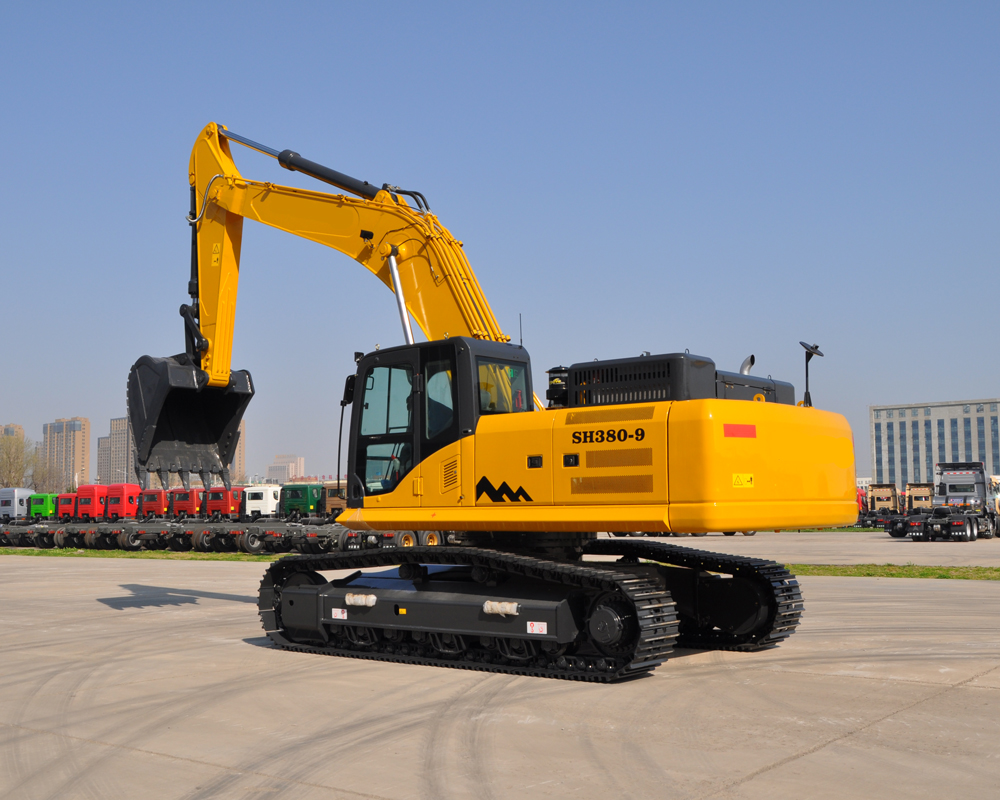
The SH380 is a 37-ton class crawler excavator with an operating weight of 37,000 kg, powered by a 6LTAA8.9-325 engine rated at 242 kW/2000 rpm. The following parameters and their relationship to the two loading tasks are provided only as selection reference and do not represent verification for any specific quarry or earthmoving project.
Fields more relevant to coarse material loading
- Bucket digging force 230 kN, stick digging force 190 kN: these can serve as a reference for judging whether material can be picked up during hard-material penetration and prying of large rocks, but actual results also depend on rock strength, lump size, and pile condition.
- Bucket capacity 1.62–1.82 m³, bucket width 1571 mm: the capacity range relates to matching pile shape and dump truck bed capacity, while bucket width affects coverage of the material face.
- Hydraulic system: 2× variable displacement piston pumps + 1× gear pump, maximum operating flow 2×330 L/min, main system pressure 36 MPa: response and motion smoothness during combined operations relate to continuous loading rhythm.
- Maximum dump height 7182 mm, maximum digging height 10134 mm: used to check compatibility with common dump truck bed heights, and cannot be directly equated with smooth loading for any truck model.
Fields more relevant to general earthmoving loading
- Swing speed 9.7 rpm: affects swing time in a single cycle and is one condition for judging loading rhythm.
- Maximum digging depth 7240 mm, maximum digging radius 11051 mm: used to check the layout of the material face and machine position.
- Travel speed 5.0/3.0 km/h, gradeability 70% (35°): related to site transfer and ramp access conditions, and does not mean operation is possible on any slope.
- Fuel tank capacity 580 L: related to shift arrangements and on-site refueling conditions; actual consumption must be confirmed based on working conditions.
Undercarriage and ground conditions determine stable positioning
Both loading tasks encounter site levelness and load-bearing issues. The SH380 has a track shoe width of 600 mm, track ground contact length of 4080 mm, ground pressure of 62 kPa, counterweight ground clearance of 1312 mm, and minimum ground clearance of 565 mm. For quarries, the ground after blasting may be uneven, requiring verification of machine position levelness and track load-bearing; for general earthmoving, soft soil after rain changes ground contact conditions, and 62 kPa is a parameter under given conditions and cannot be directly inferred to mean all soft-ground sites are passable.

Tail swing radius is 3438 mm, overall width is 3200 mm, and ground contact length during transport is 5872 mm. When arranging loading positions, the tail swing space and dump truck positioning must be considered together to avoid interference between the swing range and transport vehicles or material piles.
Items still requiring confirmation after comparison
| Verification item | Quarry coarse material loading | General earthmoving loading |
|---|---|---|
| Material condition | Lump size, hardness, and soil content need on-site confirmation | Degree of looseness or scarification and moisture content need confirmation |
| Loading coordination | Dump truck bed height matches maximum dump height | Cycle matching between truck bed volume and bucket capacity |
| Site load-bearing | Ground levelness after blasting and machine position stability | Impact of soft soil and rainy season on track ground contact |
| Efficiency judgment | Production should not be inferred from digging force alone | Cycle time should not be inferred from swing speed alone |
The table above lists on-site information to be collected before selection, not results the equipment has already achieved. The SH380 data does not provide productivity, fuel consumption, or wear data for specific materials; before purchase, confirm with the supplier whether the bucket type is suitable for coarse material, as well as wear part supply and on-site service conditions.
Provide conditions by task during procurement communication
If the work is mainly quarry coarse material loading, the inquiry should state the rock lump size range, per-shift loading volume, common dump truck models and bed heights, pile and machine position layout, and site levelness and load-bearing conditions. If the work is mainly general earthmoving loading, state the soil type, moisture content, material face depth, transport truck bed capacity, and transfer frequency.
Regardless of task type, the work equipment configuration, track shoe type, transport dimensions, and local service conditions should all be included in verification, and the supplier should be asked to provide explanations for the actual material and site. The parameters cited in this article come from this site's product data; specific configuration and applicability are subject to the final confirmed technical documents and on-site conditions.